
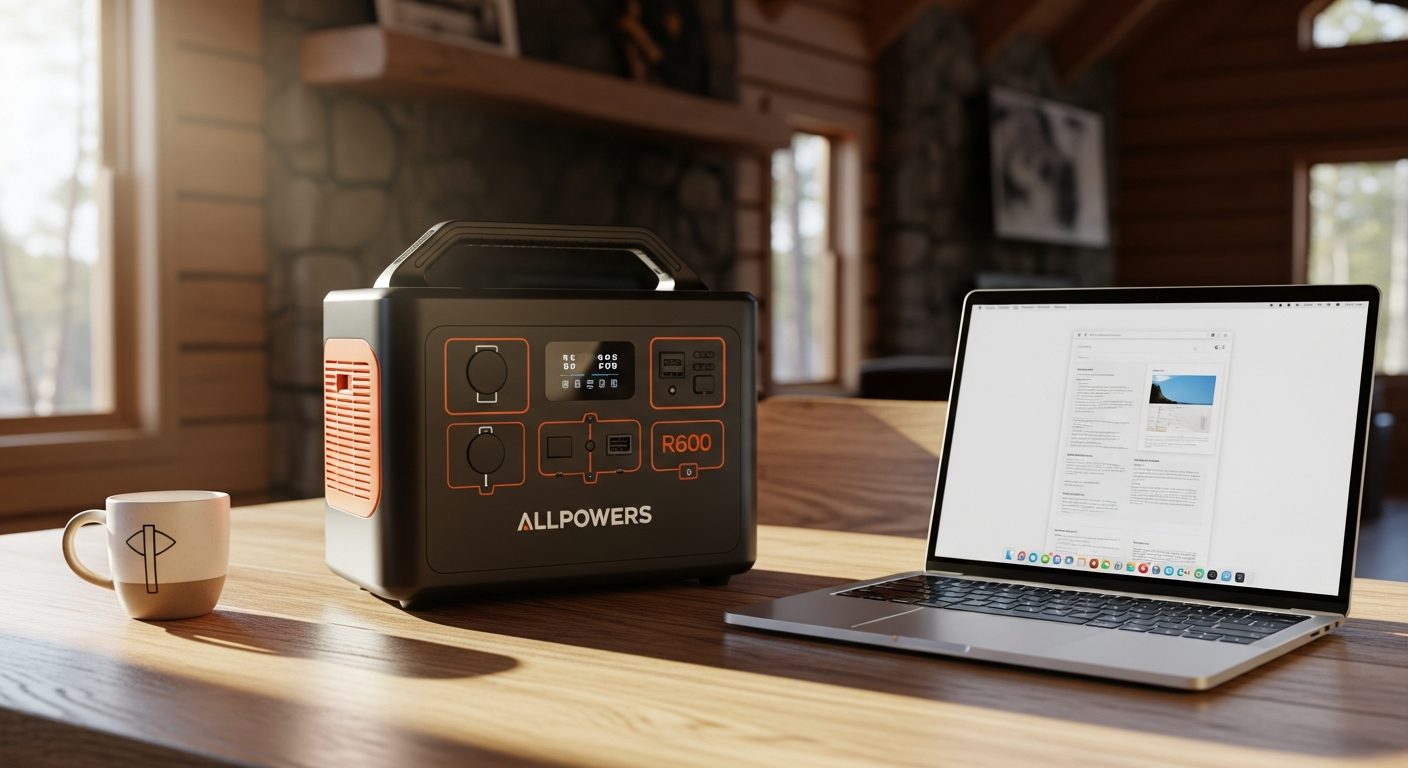
Discover how the ALLPOWERS R600 Portable Power Station delivers 600W of pure sine wave power with LiFePO4 battery technology. Learn why it’s ideal for remote work, van life, and sustainable living.
The Off-Grid Professional's Power Solution: Why the R600 Changes Everything
Power outages don't discriminate—they strike remote cabins, RVs, and rural homesteads with equal indifference. What makes the difference is preparation. Over 40% of remote workers cite unreliable power as their biggest productivity barrier, turning a simple blackout into a genuine crisis that disrupts income, deadlines, and peace of mind. The stakes feel higher when your livelihood depends on consistent electricity and you're nowhere near a utility grid.
The ALLPOWERS R600 Portable Power Station represents a fundamental shift in how modern professionals and off-grid enthusiasts approach energy independence. With its 299Wh LiFePO4 battery and rapid one-hour charging capability, this mid-sized power station bridges the gap between lightweight portability and genuine power reliability. It's engineered for those who refuse to compromise between mobility and performance.
Throughout this guide, you'll discover how the R600 transforms your off-grid experience—from powering your entire remote workspace to keeping essential devices running during emergencies, and understand why this particular model has become the preferred choice for digital nomads and homesteaders alike.
Explore the ALLPOWERS R600 and take control of your power independence today.
How 600W Continuous Output Supports Simultaneous Laptop, Monitor, and Networking Equipment
The R600 delivers 600W of stable AC pure sine wave output—enough to run a functional remote office setup without compromise. Your laptop charger typically demands 60-90W, a monitor pulls 20-40W, and a WiFi router needs just 10-15W. That's roughly 100-145W for a baseline workspace configuration, leaving substantial headroom for additional devices. A small desk fan, smartphone chargers, or a portable speaker all fit within the R600's capacity without causing voltage sags that damage sensitive electronics.
The real advantage emerges when you're powering multiple devices simultaneously. Many portable power stations experience voltage instability when devices power on—the R600's pure sine wave technology maintains consistent 110V/220V output regardless of load fluctuations. This matters directly for your equipment longevity. Sensitive electronics perform best under steady electrical conditions, and the R600 provides exactly that.
Real-World Runtime Expectations for Typical Remote Work Setups
A realistic workday scenario looks like this: laptop (60W average), monitor (25W average), and networking equipment (15W average) totals 100W of sustained consumption. The R600's 299Wh capacity theoretically provides roughly 3 hours of continuous runtime at this load. However, real-world conditions typically extend this further—most remote work involves variable intensity, with periods of lower draw when you're reading documents or waiting for uploads.
Expect 3-5 hours of uninterrupted work before requiring a recharge, depending on your specific equipment mix and usage patterns. For comparison, a traditional laptop battery alone typically manages 6-10 hours, but adding a monitor eliminates that advantage. The R600 effectively doubles your off-grid working window, transforming a morning session into a full workday capability.
Comparison of the R600 Against Traditional Generator Alternatives for Off-Grid Professionals
Gasoline generators offer raw power output—often 5000W or higher—but they introduce significant trade-offs. Noise levels from conventional generators typically range 80-95 decibels, making focused work difficult or impossible. Running costs accumulate quickly: gasoline expenses, regular maintenance, and eventual engine overhauls. The environmental footprint matters too, especially for those committed to sustainable living. Generators emit carbon monoxide and other pollutants, requiring outdoor placement and ventilation precautions.
The R600 operates silently—approximately 0 decibels when inactive, virtually undetectable during regular use. There's no fuel to purchase, no engine maintenance required, and zero emissions. The tradeoff is capacity: a generator handles much higher wattage, while the R600 serves specific, predictable loads. For remote professionals working with laptops and standard office equipment, the R600's targeted approach proves more practical, cleaner, and ultimately more economical over years of use.
Why Pure Sine Wave AC Output Protects Sensitive Electronics and Equipment Longevity
Not all AC power is created equal. Cheap inverters produce modified sine waves—approximations of true alternating current that consist of stepped waveforms. These rough electrical signals confuse sensitive equipment, particularly power supplies in laptops and medical devices like CPAP machines. Over time, devices exposed to modified sine waves experience accelerated component degradation, reduced lifespan, and potential data corruption.
The R600 generates pure sine wave AC output, mirroring the smooth, continuous waveforms delivered by utility companies. Your equipment's internal power supplies recognize this as legitimate electricity and operate without stress. This translates directly into equipment reliability—your devices last longer, perform more consistently, and avoid the sudden failures that plague systems running on inferior power quality.
The Advantage of 1200W Peak Surge Capacity for Powering Startup-Intensive Devices
Some devices demand temporary power surges during startup. A mini-fridge compressor might pull 400W when engaging. An electric kettle draws 1000W+ when first switched on. These brief, intense demands would overwhelm a 600W power station if that was its only capability—but the R600 handles this through its 1200W peak surge capacity.
The distinction matters practically: you can power devices that momentarily exceed the continuous 600W rating, as long as their steady-state consumption remains manageable. A CPAP machine that requires 300W continuous operation might spike to 800W during initial pressurization. The R600 handles this gracefully, maintaining operation where lesser power stations would simply shut down or reset.
LiFePO4 Battery Technology: Understanding Your Power Station's Heart
What Makes LiFePO4 Chemistry Superior to Standard Lithium-Ion for Long-Term Reliability
Lithium iron phosphate batteries represent the latest evolution in portable power technology. Unlike standard lithium-ion cells (used in consumer electronics like phones and tablets), LiFePO4 chemistry prioritizes stability and longevity over maximum energy density. This philosophical difference produces concrete advantages for devices that remain in service for years rather than being replaced annually.
Standard lithium-ion batteries suffer from thermal runaway—a condition where internal chemical reactions accelerate uncontrollably, potentially causing fires or explosions. LiFePO4 chemistry is inherently more stable; the iron-phosphate compound resists thermal runaway even under abusive conditions. This safety margin matters when you're relying on a power station in remote locations where emergency services are hours away.
The performance profile differs too. LiFePO4 cells maintain stable voltage throughout their discharge cycle, meaning the R600 delivers consistent power whether the battery is 90% or 10% charged. Standard lithium-ion voltage droops significantly as charge depletes, causing connected devices to receive progressively less stable power and eventually triggering automatic shutdowns before the battery is truly empty.
The 3500+ Charge Cycle Lifespan and What That Means for Your Investment Timeline
A charge cycle represents one complete discharge and recharge. The R600's LiFePO4 battery maintains 80% capacity after 3500 cycles—meaning you could fully charge and discharge it nearly once daily for approximately 9-10 years while still retaining substantial usable capacity. Even at reduced capacity, the R600 remains functional for many additional years beyond this threshold.
Compare this to standard lithium-ion batteries, which typically degrade to 80% capacity after 500-1000 cycles. A consumer laptop battery that feels "worn out" after three years of daily use actually experienced roughly 1000 charge cycles. The R600's 3500-cycle rating effectively triples the practical lifespan, transforming it from a consumable replacement item into a genuine long-term investment. The upfront cost amortizes beautifully across years of service.
Temperature Stability and Performance in Extreme Off-Grid Environments
Off-grid locations aren't climate-controlled. Mountain cabins experience subfreezing winters. Desert vans reach 120°F+ in summer. Most lithium-ion batteries suffer dramatically in temperature extremes, either refusing to charge in cold conditions or experiencing accelerated degradation in heat.
LiFePO4 chemistry tolerates these extremes better. The R600 maintains functional performance in temperatures from approximately -10°C to 45°C (14°F to 113°F). This operating window covers most realistic off-grid scenarios. The battery won't charge optimally at extreme temperatures, but it won't suffer permanent damage from exposure either. Winter camping or desert van life both remain viable with the R600, whereas standard lithium-ion power stations might refuse service entirely in these environments.
How LiFePO4 Batteries Maintain Consistent Voltage Throughout Discharge Cycles
The voltage stability of LiFePO4 technology directly translates to device safety. The R600 delivers 110V or 220V AC (depending on region) consistently from full charge to nearly depleted state. Devices connected to the R600 receive the same electrical quality throughout the entire discharge process, without the voltage sagging that triggers protective shutdowns in sensitive equipment.
Standard lithium-ion chemistry produces voltage curves that drop as discharge progresses—starting at the rated voltage but declining significantly as capacity depletes. This creates a window where connected devices might fail not because the battery is truly empty, but because voltage has fallen below their minimum operating threshold. The R600 eliminates this unreliability through superior chemistry, ensuring your equipment operates until the very end of discharge.
Safety Advantages of Lithium Iron Phosphate Technology During Extended Use
Extended use in remote locations means limited access to maintenance or replacement. If a power station fails or becomes dangerous, you're stuck with the consequences. LiFePO4 chemistry minimizes these risks through inherent stability. The batteries don't degrade dangerously during extended use, don't overheat during rapid charging, and won't catch fire if accidentally short-circuited.
The R600 includes multiple safety features beyond the chemistry itself—battery management systems that prevent overcharging, thermal sensors that monitor temperature, and protection circuits that isolate the battery if dangerous conditions develop. These safeguards work in concert with the inherent safety of LiFePO4 chemistry, creating a power station that remains reliable and genuinely safe during months or years of extended off-grid service.
Charging Flexibility for Every Off-Grid Scenario
One-Hour AC Recharging: Why 400W Input Speed Matters for Remote Workers
The R600 accepts up to 400W of AC power input, enabling complete recharges from 0% to 100% in approximately one hour. This speed transforms your power station from an auxiliary backup into a genuine all-day power solution. A traditional power station requiring 8-10 hours to recharge forces you to charge overnight and hope tomorrow's power draw doesn't exceed stored capacity. The R600's rapid charging eliminates this uncertainty.
For remote workers, one-hour charging means you can recharge during lunch break, between client calls, or during afternoon coffee time. You maintain full or near-full capacity throughout your working day, with the ability to rapidly top off as needed. This transforms your relationship with stored power from anxious rationing to confident, abundant usage.
Solar Charging with MPPT Technology: Maximizing Efficiency in Variable Sunlight Conditions
The R600 supports up to 220W of solar input when equipped with compatible solar panels. More importantly, it includes MPPT (Maximum Power Point Tracking) technology—a sophisticated charging controller that constantly adjusts how it draws power from solar panels to extract maximum available energy.
MPPT technology becomes critical in variable sunlight conditions. As clouds move across the sky, shadows shift, and sun angle changes throughout the day, the optimal charging point for solar panels constantly shifts. A basic solar controller charges at fixed parameters, missing efficiency gains when conditions change. MPPT controllers continuously sample the panel voltage and adjust charging parameters to match the current optimal point, potentially increasing effective solar charging by 20-30% compared to basic controllers.
This efficiency advantage matters directly for off-grid reliability. Where a basic controller might yield 140W average power from a 200W solar panel over an entire day, MPPT technology extracts 170W average. That difference accumulates into additional hours of power availability, extending your daily working capacity and reducing pressure on battery reserves.
220W Solar Input Capacity and Realistic Panel Combinations for Consistent Power
The R600 accepts 220W maximum solar input, suggesting a typical pairing with a 200W or 220W solar panel. A single quality 200W panel provides roughly 160-180W average output under realistic daytime conditions (accounting for sun angle, weather, and inefficiencies). For truly consistent, all-day charging while simultaneously powering work equipment, many users combine the R600 with two 100W panels, providing redundancy and approximately 300-350W theoretical maximum input (capped at 220W by the R600's controller).
This configuration enables a genuine solar-powered remote office. Your solar panels charge the R600 throughout the day while simultaneously providing power directly to AC-powered devices. Even on partially cloudy days, 100-150W of solar input continues topping off your battery while you work. Only during extended overcast periods or at night do you need to rely purely on stored battery capacity.
Car Cigarette Lighter Input for Emergency Top-Ups During Travel
Van lifers and RV dwellers particularly appreciate the R600's 200W car cigarette lighter input. This 12V connection enables charging while driving—your vehicle's alternator continuously tops off the R600's battery during transit. For full-time travelers, this means reaching your destination with the power station fully charged, ready for evening work or emergency situations.
The charging rate via car cigarette lighter input is moderate compared to AC charging, but it's consistent and continuous whenever your vehicle is running. Someone driving 8 hours daily would accumulate roughly 2-3 full charges of the R600 during that travel period, transforming your commute time into productive charging time.
Hybrid Charging Strategies for Van Lifers and RV Dwellers
The R600's true power emerges when combining multiple charging sources simultaneously. A van lifer might wake up, start driving (beginning 12V car charging), deploy portable solar panels on the dashboard (beginning solar charging), and simultaneously plug into shore power if camped at an RV park (beginning 400W AC charging). Multiple inputs work independently and simultaneously, each contributing power according to available source capacity.
This hybrid approach ensures you never face depleted batteries unless experiencing multiple consecutive days of combined cloud cover, minimal driving, and no AC access—a scenario that rarely occurs in practice. The flexibility to layer multiple charging sources creates genuine resilience, transforming the R600 from a day-to-day power solution into a multi-week sustainability system.
Eight Output Ports: Powering Your Entire Digital Ecosystem
Dual 100W USB-C Ports and Why This Matters for Modern Laptop Charging
Modern laptops increasingly rely on USB-C charging, with many premium models ditching proprietary power adapters entirely. The R600's dual 100W USB-C ports acknowledge this reality—each port delivers sufficient power to charge demanding laptops like MacBook Pro models or high-performance gaming laptops that would overwhelm lower-powered USB charging.
The 100W rating per port enables rapid charging. A 65W laptop charger reaches full charge in roughly 2-3 hours on the R600; a 100W USB-C port theoretically cuts that time in half. More practically, you could charge a laptop at full speed using one USB-C port while simultaneously charging your smartphone on the other, without either device receiving reduced power.
Simultaneous Charging of Multiple Devices Without Performance Degradation
The R600 supports charging eight devices simultaneously across its various ports without voltage sags or reduced charging speeds. Your laptop charges at full 100W via USB-C, your smartphone charges at 18W via USB-A, your tablet charges wirelessly at 15W, and your smartwatch charges from the remaining USB-A port—all simultaneously, all at their rated speeds.
This capability transforms the R600 from a single-device backup into a complete ecosystem power hub. Everyone in your off-grid situation (whether a partner in an RV or crew members at a remote worksite) can charge their devices concurrently without competing for limited power or experiencing frustratingly slow charging speeds.
15W Wireless Charging Pad for Smartphones and Compatible Wearables
The built-in 15W wireless charging pad eliminates cable clutter and provides convenience for devices that support Qi charging. Rather than searching for USB cables or adapters, simply place your compatible smartphone or earbuds on the R600's charging surface. The pad automatically detects compatible devices and initiates charging.
This seemingly small feature significantly improves daily usability, particularly in mobile situations where cable management becomes friction-filled. Camped in your van or working from a cabin, you're not fumbling with cables or concerned about losing specialized chargers.
Two AC Outlets for Small Appliances, Mini-Fridges, and CPAP Machines
The R600's dual AC outlets power any standard 110V or 220V device, provided consumption stays within the 600W continuous (1200W peak) power envelope. Mini-fridges, which consume 150-300W, run efficiently. CPAP machines, which draw 300-400W, operate reliably. Electric kettles, blenders, or coffee makers all function normally, though simultaneously running two high-wattage appliances would exceed capacity.
This versatility extends far beyond laptops and phones. Off-grid professionals aren't purely tethered to digital devices—a heating pad for winter nights, a humidifier for dry environments, or evening entertainment devices all become practical with AC outlets available.
12V/10A Car Cigarette Lighter Port for Automotive Accessories and RV Integration
The 12V/10A cigarette lighter port (providing up to 120W at 12V) powers automotive accessories and RV equipment directly. Portable compressors for tire inflation, heated blankets for winter camping, and RV auxiliary systems all draw 12V power. Rather than draining your vehicle's battery, these devices draw from the R600, preserving vehicle reserves for actual driving needs.
For RV dwellers, this port enables seamless R600 integration into existing 12V systems, eliminating the need for separate power conversions or adapters.
The Bottom Line for Off-Grid Energy Independence
The ALLPOWERS R600 Portable Power Station isn't just another gadget—it's a genuine enabler of location-independent living. Whether you're orchestrating client calls from a mountain cabin, running a sustainable homestead, or exploring remote regions in your van, this power station delivers the reliability and flexibility that off-grid life demands. The combination of LiFePO4 durability, rapid charging across multiple input sources, and eight simultaneous output ports creates a genuinely comprehensive power solution that grows with your needs.
Yes, the 299Wh capacity has boundaries, but within those parameters, the R600 punches well above its weight class. The investment pays dividends through years of dependable service—and that peace of mind is genuinely priceless when you're miles from the nearest power outlet.
Make the leap toward genuine off-grid energy independence with the ALLPOWERS R600 today.