
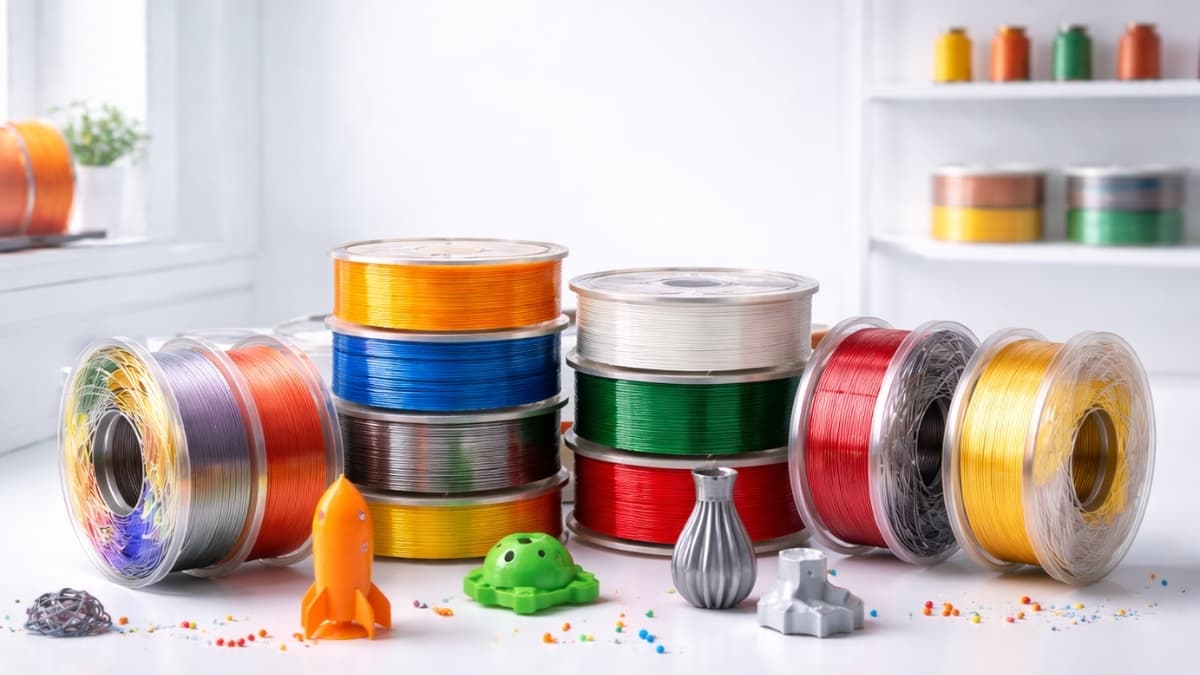
The Complete Guide to Bambu Lab Filaments explains types, prices, AMS support, and real performance tips to help you choose materials for cleaner, stronger prints.
Plastic choices can make or break a 3D print. The Complete Guide to Bambu Lab Filaments breaks down what actually matters when choosing materials for Bambu Lab printers.
Filament quality affects strength, surface finish, accuracy, and failure rates. That matters for hobby parts and for functional components that must fit and last.
Bambu Lab designs filaments to work as part of a closed system. Each spool includes RFID data that talks to the printer and the AMS.
Temperatures, flow rates, and cooling profiles load automatically. Less tuning. Fewer surprises.
Independent testing from Sculpteo’s State of 3D Printing reports that material inconsistency is a top cause of print failure in desktop FDM systems.
Bambu Lab addresses this with tight diameter tolerances and controlled moisture packaging. The result shows up in daily use, especially during long prints.
The Complete Guide to Bambu Lab Filaments: Types, Uses, and Real Results
Bambu Lab filaments cover decorative, functional, and industrial needs. Each category serves a clear purpose. Pricing reflects material performance and system integration.
Quick overview table
| Filament Type | Price Range (USD) | Best Use |
|---|---|---|
| PLA Basic | $19.05–$24.99 | Everyday prints |
| PLA Silk / Matte / Wood | $24.99–$27.99 | Visual models |
| PETG / PETG-CF | $19.05–$44.99 | Functional parts |
| ABS / ASA | $29.99–$36.99 | Heat-resistant parts |
| TPU 90A / 95A | $34.99–$41.99 | Flexible components |
| PA-CF / PPS-CF / PPA-CF | $49.99–$149.99 | Industrial use |
PLA Basic: Reliable and Predictable
PLA Basic remains the most-used option across Bambu Lab printers. Diameter control stays within ±0.02 mm based on manufacturer data. That consistency reduces extrusion variance during long jobs.
Key details
- Low warping
- Strong layer adhesion
- Minimal odor
- Works on all Bambu Lab printers
PLA prints cleanly at high speed on the X1 and P1 series. Surface finish stays smooth even with aggressive acceleration. For display models, fixtures, and household parts, PLA Basic covers most needs.
Specialty PLA Filaments for Visual Impact
Specialty PLA focuses on appearance while keeping print difficulty low.
PLA Silk
Silk PLA uses reflective additives to create a metallic look. Layer lines appear softer. Post-processing needs stay minimal. This filament suits figurines, props, and decor.
PLA Matte
Matte PLA reduces glare and fingerprints. Photos look better under direct light. Many product designers prefer this finish for mockups.
PLA Wood
Wood PLA blends PLA with real wood fibers. Sanding and staining work well. Nozzle sizes of 0.6 mm reduce clog risk.
PLA Glow and Gradient
Glow PLA absorbs light and emits it slowly in darkness. Gradient PLA shifts color along the filament length. Both options avoid multi-material setups while adding visual depth.
Engineering Filaments for Functional Parts
When strength matters, engineering filaments outperform PLA.
PETG and PETG-CF
PETG handles impact better than PLA and resists moisture. PETG-CF adds stiffness and reduces flex.
Use cases
- Tool holders
- Mounts
- Outdoor parts
PETG prints around 240 °C with controlled cooling. AMS profiles load automatically through RFID.
ABS and ASA
ABS and ASA tolerate heat up to about 85 °C according to material datasheets. ASA resists UV exposure better than ABS.
These filaments benefit from enclosed printers. The X1 series chamber reduces warping and layer separation.
TPU Filaments: Flexible and Tough
TPU 95A and 90A offer controlled elasticity.
- 95A feels firm with slight flex
- 90A bends more and absorbs impact
Cable protectors, gaskets, and phone mounts print cleanly with tuned profiles. Print speeds stay lower, yet reliability remains high due to consistent filament diameter.
Carbon Fiber and High-Temperature Composites
Advanced users turn to composite materials for demanding environments.
Nylon Carbon Fiber (PA6-CF, PAHT-CF)
These filaments combine nylon toughness with carbon fiber stiffness. Strength-to-weight ratios rival aluminum for some applications, based on testing published by MatterHackers.
PPS-CF and PPA-CF
These materials handle extreme heat and chemicals. Aerospace and automotive prototyping often relies on PPS-based polymers due to thermal stability above 200 °C.
Requirements
- Hardened steel nozzle
- Enclosed printer
- Dry filament storage
RFID checks hardware compatibility before printing starts.
AMS Compatibility and RFID Automation
All official filaments include RFID chips.
What the system handles automatically
- Material type detection
- Temperature and cooling profiles
- Remaining filament tracking
This automation cuts setup time and reduces human error. According to All3DP, automated material profiles lower failure rates for complex prints by reducing misconfiguration.
Cost, Value, and Real-World Tradeoffs
Bambu Lab filaments cost more than generic brands. The difference shows in reliability.
Pros
- Fewer failed prints
- Less tuning time
- Consistent results across spools
Limitations
- Higher upfront cost
- Best performance inside the Bambu Lab ecosystem
Many users mix brands. Critical parts use official filaments. Test prints use third-party materials. This balanced approach controls costs without sacrificing quality where it counts.
Storage and Handling Tips
Moisture affects print quality.
Best practices
- Store spools in airtight containers
- Use fresh desiccant
- Dry nylon and composites before use
The AMS helps maintain humidity levels during printing, though long-term storage still matters.
Conclusion
Material choice shapes print success more than slicer tweaks. Bambu Lab filaments remove much of the trial and error from 3D printing through tight manufacturing control and smart automation.
Visual filaments deliver clean finishes. Engineering materials handle real-world stress. High-performance composites open doors to industrial applications.
For consistent results, start with the filament designed for the system. Explore specialty options as project needs grow. Review part requirements, environment, and budget before loading the next spool.
The right material turns a good printer into a dependable tool.