
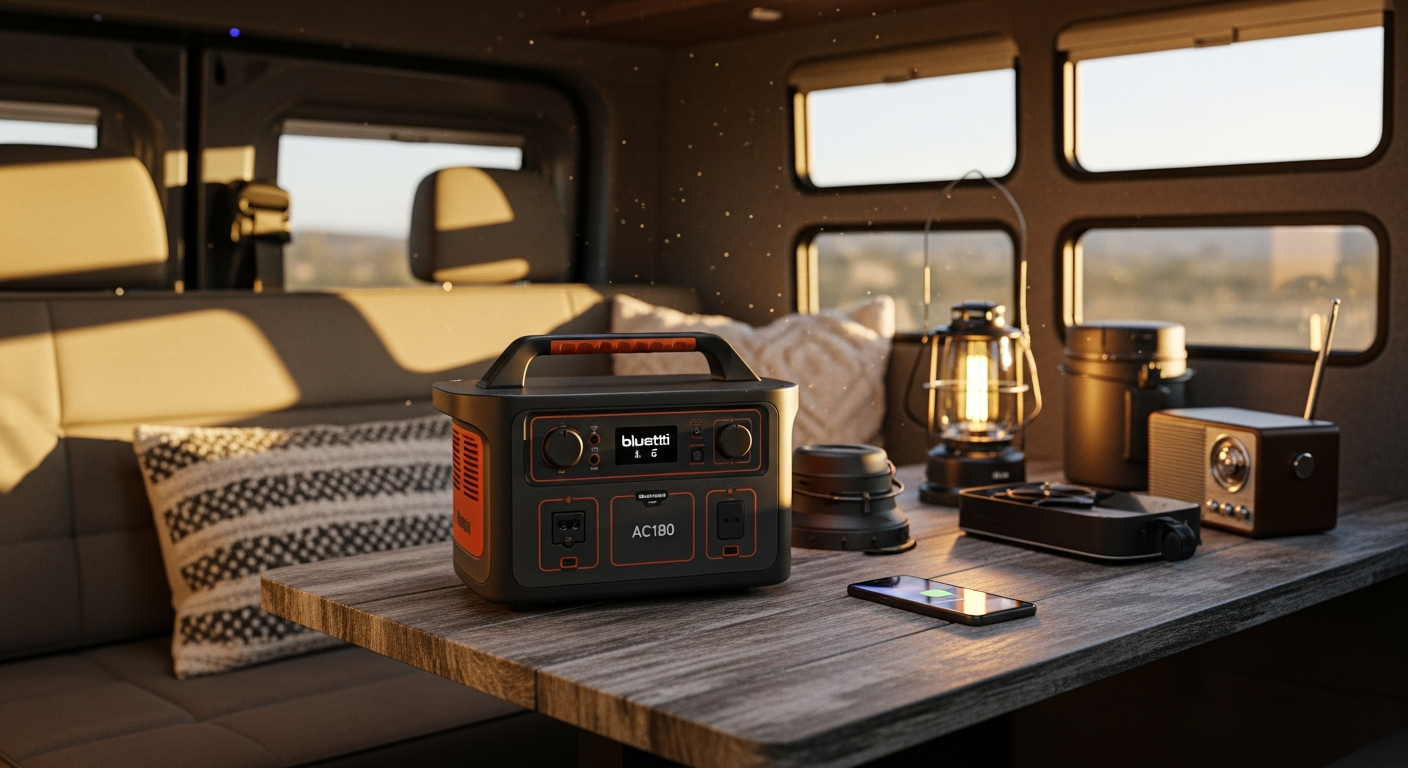
Discover how the Bluetti AC180 portable power station transforms van life and off-grid adventures with 1152Wh capacity, 1800W output, and fast charging. Learn if it’s right for your lifestyle.
Nearly 60% of van lifers cite unreliable power as their biggest pain point when hitting the road. Whether you're boondocking in remote deserts, camping off the beaten path, or simply escaping the grid for a weekend, having dependable electricity transforms the entire experience—and the Bluetti AC180 has become the go-to solution for adventurers who refuse to compromise on comfort or connectivity.
The portable power station market has exploded over the past few years, but most options force you to choose between affordability and performance. The AC180 shatters that false choice. It's designed specifically for people who want genuine off-grid capability without the premium price tag, making it the unofficial standard for van dwellers, digital nomads, and weekend explorers who need serious power in a genuinely portable package.
Throughout this guide, you'll discover everything that makes the AC180 special for mobile living scenarios. Explore the Bluetti AC180 and transform your off-grid adventures today.
The Van Life Game-Changer: Why the AC180 Dominates Mobile Living
How 1152Wh Capacity Translates to Actual Days of Off-Grid Living
The AC180's 1152Wh capacity sounds impressive on paper, but what does it mean when you're actually living in a van? Consider a realistic scenario: you're charging a laptop (50Wh), running a small refrigerator (120Wh daily), powering LED lights (20Wh), and topping up phones and tablets (30Wh). That's roughly 220Wh daily, giving you five days of comfortable living on a single charge—before adding any solar input. In reality, most van lifers using the AC180 charge every 2-3 days through a combination of solar panels and quick AC top-ups at campsites, meaning you're never truly stranded without power.
Real-World Power Scenarios: Running Multiple Devices Simultaneously
The true strength of the AC180 emerges when you need real power at real moments. Picture this: your partner makes coffee (1200W), you're working on a laptop (65W), and your phone is charging (15W). That's 1280W of simultaneous demand—well within the AC180's 1800W continuous output. The inverter doesn't strain, the battery doesn't panic, and you both go about your morning without negotiating power priorities. This kind of simultaneous demand management is where cheaper alternatives choke, but the AC180 handles it with remarkable stability.
Comparison of AC180 Capacity Versus Typical Van Electrical Systems
Traditional van electrical setups often rely on 100-200Ah lithium batteries with complex wiring, multiple breakers, and ongoing maintenance. The AC180 delivers comparable energy storage (1152Wh ≈ 96Ah at 12V nominal voltage) in a self-contained unit with built-in management, far simpler installation, and no troubleshooting of parallel battery configurations. For van builds with limited technical expertise, the AC180 eliminates entire categories of potential problems while delivering equivalent or superior performance.
Why the 1800W Continuous Output Handles the Appliances Van Lifers Actually Use
Coffee makers, hair dryers, portable induction cooktops, and small microwaves—these are the comfort-of-home devices that justify leaving the traditional grid. Most operate between 800W and 1500W, landing comfortably within the AC180's continuous output window. Traditional generators in this wattage class cost twice as much, require fuel storage, produce noise that disrupts camping neighbors, and demand regular maintenance. The AC180 delivers equivalent wattage in silence, without exhaust fumes or the constant nagging feeling that you should be using it only for "emergencies."
The Power Lifting Mode Advantage: Temporary Boosts Without Oversizing
The Power Lifting Mode temporarily surges to 2700W—a feature that prevents the absurd scenario where you'd need to buy a 3000W power station just to run a 2400W hair dryer once a week. This surge capacity lasts long enough to get high-draw appliances past their startup peak, then settles into sustainable operation. You're not paying for a massively oversized system that sits idle 99% of the time; instead, you get a right-sized workhorse that flexes when necessary.
Weight and Portability Benefits for Van Builds
At 35.6 pounds, the AC180 occupies a genuinely portable sweet spot. It's light enough to move around your van, pack into an adventure van's garage, or carry to a campsite if you're setting up satellite workspaces. Compare this to traditional generator setups (often 50+ pounds, requiring fuel cans and maintenance supplies adding another 20-30 pounds total), and the AC180's integrated portability becomes a massive practical advantage, especially when van space is precious and weight distribution matters for vehicle stability.
Multiple Output Ports for Diverse Device Charging
The AC180 features AC outlets, USB-C, and USB-A ports—covering virtually every device you'll have in a van. Your laptop charges via USB-C while someone else tops a camera battery on USB-A, while a coffee maker runs on AC, all from a single unit. This port diversity eliminates the need for multiple chargers, adapters, and power strips that would otherwise consume valuable van real estate and create charging bottlenecks.
Battery Technology That Survives the Road: Understanding LiFePO4 Chemistry
Why LiFePO4 Outperforms Cheaper Lithium-Ion Alternatives
LiFePO4 (Lithium Iron Phosphate) batteries are fundamentally more durable than standard lithium-ion cells. While lithium-ion batteries suffer from thermal runaway risks and capacity fade under stress, LiFePO4 chemistry provides superior thermal stability, better performance across temperature extremes, and dramatically longer lifespan. When you're living in a van, you're subjecting your power station to constant charging cycles, temperature swings between desert heat and mountain cold, and regular vibration from driving. LiFePO4 simply handles this punishment better, degrading more gracefully and maintaining usable capacity far longer.
3500+ Charge Cycles to 80% Capacity: What This Means
3500 cycles isn't just a number—it's a practical commitment to years of reliable power. If you charge your AC180 every other day (roughly 180 cycles yearly), you're looking at nearly 20 years before capacity drops to 80% of original. For context, cheaper lithium-ion alternatives typically guarantee 2000 cycles, meaning they're half-dead in a decade. The AC180's LiFePO4 chemistry essentially means you're making a purchase decision about power supply for your entire van life chapter, not a temporary solution requiring replacement mid-adventure.
Temperature Tolerance and Safety in Extreme Climates
LiFePO4 maintains stable operation across -10°C to 50°C temperature ranges, handling both high desert heat and mountain cold without performance degradation or safety risks. Standard lithium-ion batteries suffer capacity loss in cold temperatures and face fire risks if overheated. When you're parked in Death Valley in July or mountaineering in Colorado in December, the AC180's chemistry keeps operating while inferior alternatives develop problems or shut down entirely.
How Traditional Lead-Acid Batteries Compare
Lead-acid batteries have been van lifers' go-to for decades, but the comparison to the AC180 is brutal. A lead-acid system delivering equivalent capacity requires multiple batteries (2-4 units), weighs 2-3 times more, demands regular water top-ups and equalization charging, and dies completely at 50% discharge (meaning you're paying for double the capacity you actually use). The AC180 delivers superior usable capacity, requires zero maintenance, survives total discharge cycles, and weighs a fraction of lead-acid equivalents. The days of choosing lead-acid for anything other than cost are genuinely finished.
Built-In Battery Management System Protection
The AC180's integrated BMS (Battery Management System) continuously monitors individual cell voltages, temperatures, and charge rates, instantly shutting down if anything approaches dangerous parameters. This means overcharging is physically impossible—the system simply stops accepting power. Short circuits, overcurrent conditions, and thermal issues are similarly prevented. You're not relying on user discipline or hoping you remembered to turn off a charging controller; the AC180 makes dangerous scenarios literally impossible through hardware-level protection.
Long-Term Cost-Per-Cycle Analysis
Calculate the true cost of power over time: an AC180 at $500 providing 3500 cycles equals $0.14 per cycle. A $300 lithium-ion station with 2000 cycles costs $0.15 per cycle, but the AC180 lasts 75% longer and maintains 80% capacity while the cheaper alternative is effectively dead. Over five years of van life, the AC180 saves money despite the higher upfront cost, while providing superior reliability when you're far from service centers.
Warranty Coverage and Bluetti's Reliability Commitment
Bluetti backs the AC180 with comprehensive warranty coverage reflecting confidence in LiFePO4 durability. This warranty matters intensely when you're living in a van—you're not near a service center, you can't afford extended downtime, and you need power systems you can trust implicitly. The warranty isn't just legal protection; it's an assurance that Bluetti engineers designed this system for the kinds of extreme use cases that van lifers impose.
Invest in the AC180's proven LiFePO4 technology and secure years of reliable off-grid power.
Charging Speed That Fits Your Schedule: Turbo Charging and Solar Integration
1440W Turbo Charging Capability: 80% in 45 Minutes
The AC180's 1440W Turbo Charging feature means you can pull into an RV park in the afternoon, charge to 80% capacity in under an hour while setting up camp, and have virtually full power for evening usage. Compare this to competitor models requiring 4-8 hours to reach comparable charge levels, and you're gaining real flexibility in your travel itinerary. You're not slave to charging schedules; instead, quick top-ups become routine between campsites rather than mandatory overnight operations.
Practical Charging Scenarios for Van Lifers
Your typical week might look like this: Monday morning, you top up at a coffee shop with a 120V outlet (slower charging, maybe 60% in two hours). Tuesday, you park at a campground with 30A service and hit 100% in 90 minutes via Turbo Charging. Wednesday through Friday, solar panels handle daily top-ups. This flexible charging approach—combining Turbo Charging for quick boosts with solar for maintenance—is precisely how the AC180 enables extended boondocking without forcing you to commit to permanent solar installations if you're still building your van setup.
Solar Input Up to 500W: Building Complete Off-Grid Ecosystems
The AC180 accepts solar input up to 500W through its integrated charge controller, enough to add meaningful charging without roof-mounted panels if you use portable solar options. A typical 400W portable solar array (two 200W panels) charges the AC180 from empty in roughly 3-4 hours on a sunny day, providing realistic off-grid living when combined with strategic power management. This flexibility means you're not forced into expensive roof installations immediately; you can test solar charging with portable solutions first, then upgrade to permanent mounting once you've refined your setup.
Flexibility of Multiple Charging Methods
The beauty of the AC180 lies in charging optionality. You can charge from standard 120V outlets (slowest but always available), 240V if you find 50A RV service (fastest wall charging), solar panels during sunny periods, or even vehicle charging via 12V input in emergency scenarios. This redundancy is genuinely valuable for van lifers—you're never forced into reliance on a single charging method, and system flexibility increases reliability when one option becomes unavailable.
Realistic Solar Charging Timelines
A 200W solar panel array delivers roughly 1-2 hours of useful charging daily (accounting for sun angle, cloud cover, and seasonal variation). That translates to roughly 150-300Wh daily from solar, meaning you're covering modest consumption indefinitely while expensive high-draw appliances (hair dryers, microwaves) still require AC charging or power management. Setting expectations realistically prevents disappointment—solar is continuous maintenance charging, not primary power source for most van lifers, unless you're building a dual or triple panel array.
Hybrid Charging Approach: Combining Methods for Faster Replenishment
The optimal strategy combines multiple methods: solar panels maintain baseline consumption while you're stationary, AC Turbo Charging handles rapid top-ups when you pass through towns, and careful power management ensures you're never depleting the battery completely. This hybrid approach converts what could be a limiting factor (no permanent charging infrastructure while boondocking) into a strength—you're actually more flexible than someone plugged into shore power 24/7, unable to move without reconnecting.
Built-In Solar Charge Controller Efficiency
The AC180's integrated solar controller is competent but not optimal—some users report 5-10% efficiency gains by upgrading to third-party MPPT controllers. However, for most van lifers using 200-400W solar arrays, the built-in controller is entirely adequate and eliminates the need for external hardware cluttering your electrical bay. The efficiency difference only becomes meaningful if you're running massive solar arrays (1000W+) where professional MPPT controllers genuinely justify their cost.
App-Based Monitoring: Tracking Charge and Consumption Remotely
The Bluetti app lets you monitor AC180 status from inside your van—checking battery percentage, current draw, and charging rate without leaving your workspace or bed. This convenience transforms power management from guesswork into data-driven decisions. You see that your laptop is consuming 65W, your fridge 120W, and lights 20W, totaling 205W, meaning you've got roughly 5.6 hours until battery exhaustion. This real-time awareness enables smarter decisions about when to charge or reduce consumption, rather than discovering you're low on power mid-evening.
Real-World Performance: What the AC180 Actually Powers in Your Van
Coffee Makers and Espresso Machines: Morning Routines Without Compromise
Your morning routine doesn't have to change when you go off-grid. A quality coffee maker uses 1200W for roughly 5 minutes—consuming about 100Wh from your 1152Wh capacity. An espresso machine is similar. The AC180 handles these devices effortlessly, letting you maintain the comfort rituals that make van living feel like home rather than deprivation. For van lifers, this is non-trivial—many report that preserving "normal life" elements like good coffee is psychologically crucial for extended road living.
Hair Dryers and Personal Grooming Devices
Hair dryers run 1500-2000W, hitting the AC180's Power Lifting Mode limits but operating reliably. A typical dry cycle consumes 100-150Wh, representing 10-15% of total capacity. Smaller grooming devices (electric shavers, heated styling tools) are trivial loads. The AC180 makes personal grooming accessible without the generator noise and fuel dependency that made traditional off-grid living feel like sacrifice.
Laptop and Work Equipment: Sustained Power for Digital Nomads
A laptop consuming 65W can run for 17 hours on a single AC180 charge. This reality transforms remote work logistics—you're not hunting for charging outlets, you're not worrying about power stability during video calls, and you're not building backup charging systems. For digital nomads, this reliability is foundational to maintaining professional credibility while living in a van, enabling income generation that actually sustains van life long-term.
Refrigeration and Coolers: Food Safety During Extended Boondocking
A 12V compressor fridge draws 3-5A at 12V (roughly 36-60W), consuming 100-150Wh daily. The AC180 can run this indefinitely if recharged daily via solar or every 7-10 days if using only stored battery capacity. This means your food stays fresh, your medications (if temperature-sensitive) remain viable, and your diet isn't limited to non-perishables during extended boondocking trips. For multiweek adventures, this is genuinely transformative.
Phone, Tablet, and Camera Charging: Managing Multiple Devices
Multiple USB outputs mean everyone in your van can charge devices simultaneously without rationing power outlets. A phone charging session consumes roughly 10-15Wh; tablets 30-50Wh. These are trivial draws on a 1152Wh capacity, letting you maintain communication and capture adventure memories without power anxiety. The diversity of USB-C and USB-A ports eliminates the adapter chaos that plagues traditional van setups.
CPAP Machines and Medical Devices: Reliable Backup Power
People with sleep apnea can run CPAP machines (50-100W) through an entire night on the AC180. This transforms van travel from impossible to genuinely accessible for people with medical power requirements. The reliability and surge capacity guarantee that medical devices function as designed, eliminating the anxiety of insufficient power when health depends on it.
Entertainment Systems: Powering TVs and Downtime Equipment
A 32-inch TV draws 30-50W and can run 20+ hours on AC180 capacity. Gaming consoles (100-150W) can operate for 7-8 hours before needing recharge. Streaming and entertainment become genuinely possible during downtime, preventing the boredom that sometimes derails extended van trips, especially during bad weather when outdoor activities are unavailable.
Inverter Management: Preventing Battery Drain
The one operational quirk: the AC180's inverter draws small power when left on standby (roughly 5-10W), which over 12 hours of sleep drains 60-120Wh unnecessarily. Experienced users toggle the inverter off when not actively using AC power, a 10-second routine that prevents battery waste. This isn't a defect—it's expected behavior for inverted systems—but it requires conscious habit formation. Some users integrate a smart switch for automation, but manual toggling becomes second nature within weeks.
The Honest Trade-Offs: Understanding AC180 Limitations for Mobile Living
Inverter Standby Drain: Why Manual Power Toggling Matters
The AC180's inverter doesn't fully disable when idle; it maintains low-power standby mode consuming 5-10W continuously. Over a full day of moderate usage (inverter on 16 hours, off 8 hours), you're losing 80-160Wh to standby waste. This isn't catastrophic—it's roughly 8-15% capacity loss—but it's real. Users quickly develop the habit of toggling the inverter off when retreating to bed or leaving the van, similar to how you'd close a refrigerator or turn off lights. Once this becomes routine, it's not genuinely limiting.
Solar Charge Controller Efficiency Gaps
The built-in solar controller delivers 90-95% efficiency, while premium third-party MPPT controllers reach 97-98%. For small solar arrays (200-400W), this difference is negligible. For those eventually upgrading to 800W+ solar setups, a dedicated MPPT controller becomes worthwhile. This is a scaling limitation, not a fundamental flaw—the AC180 handles small to medium solar gracefully, and you upgrade external components as your setup grows.
Mobile App User Experience: Functional but Needing Refinement
The Bluetti app works reliably for monitoring AC180 status—battery percentage, current draw, charging rate—but the interface feels utilitarian rather than elegant. Connection occasionally drops requiring reconnection, and menu navigation could be more intuitive. These are genuine inconveniences but not dealbreakers. The core functionality (monitoring your power status remotely) works reliably, and the app continues receiving updates improving user experience. If you're sensitive to software elegance, you'll notice; if functionality is paramount, you'll overlook these rough edges.
Weight Considerations: 35.6 Pounds Requires Thoughtful Placement
At 16.1 kg, the AC180 is portable but substantial. In a van context, placement matters—you can't casually toss it around, and positioning affects weight distribution and vehicle handling. Most van builders integrate the AC180 into dedicated electrical cabinets with securing hardware, essentially treating it as semi-permanent infrastructure rather than grab-and-go equipment. This isn't a limitation for stationary van living, but it does require deliberate installation planning.
Space Requirements: Fitting AC180 Into Compact Conversions
The AC180 measures roughly 11.8 x 7.1 x 7.5 inches, requiring modest dedicated space in your electrical system. In ultra-compact conversions (sprinter vans, small campervans), every cubic inch matters. You're not squeezing the AC180 into random nooks; you're building intentional infrastructure to house it. Most van builders allocate space easily, but minimalist builds might face constraints.
Noise Levels During Operation
The AC180 operates silently during discharge but produces slight cooling fan noise during heavy charging. This is minimal compared to generator alternatives but worth acknowledging if you're sensitive to equipment noise in quiet camping environments. Charging during campground quiet hours can generate barely-noticeable sound; it's not intrusive but also not silent.
Expandability Constraints: Single Unit Versus Parallel Systems
The AC180 functions as a standalone unit; you can't directly parallel multiple units for capacity expansion. If you later need more power, you're adding a secondary standalone system (two separate power stations) rather than upgrading infrastructure. This works fine for van lifers—many successfully operate dual AC180 systems—but it's less elegant than expandable systems where you add battery modules to grow capacity within unified architecture.
Building Your Off-Grid Power Ecosystem: AC180 as the Foundation
Pairing the AC180 With Solar Panels: Recommended Wattage
A 400W portable or roof-mounted solar array (two 200W panels) provides optimal sizing for the AC180. This combination delivers roughly 300-400Wh daily in reasonable sunlight, covering baseline consumption (fridge, lights, devices) while requiring AC charging for high-draw appliances. Smaller arrays (100-200W) extend boondocking capability but rely heavily on AC charging infrastructure. Larger arrays (600W+) accelerate charging but face diminishing returns for most van lifers and require complicated roof engineering.
Battery Expansion Strategies: When and Why to Add Secondary Storage
If six months of van living reveals insufficient capacity—you're consistently depleting before evening and can't reliably solar-charge daily—adding a second AC180 creates dual-unit redundancy. Two AC180s (2304Wh combined) support comfortable living for larger groups or higher consumption patterns. Alternatively, some users add supplementary lithium batteries specifically for essential loads (fridge, lights), letting the AC180 focus on discretionary consumption (entertainment, charging devices). This tiered approach optimizes cost per actual usage pattern.
Wiring and Installation Best Practices
The AC180 connects to your van electrical system through its AC and DC outputs. AC loads (coffee makers, appliances) run directly from AC ports, while 12V loads can connect to the DC output. Proper installation involves dedicated breakers between the AC180 and loads, preventing cascading failures if a device shorts, and using appropriately-sized cabling to handle current loads without voltage drop. Many van builders partner with experienced electricians for proper integration, though straightforward installations are feasible for mechanically-inclined owners.
Load Management Techniques: Prioritizing Devices
Smart load management means intentional scheduling: coffee makers in mornings, hair dryers before solar hours end, high-draw appliances during peak sun. Conversely, laptop work, entertainment, and light loads distribute throughout the day. This isn't rigid rationing—you're not depriving yourself—but rather thoughtful distribution preventing simultaneous peak demands that unnecessarily strain the system. Many van lifers discover this happens naturally; you naturally adjust behavior without perceived sacrifice.
Backup Charging Solutions: Redundancy Through Diversity
Optimal setups combine three charging methods: solar panels for continuous baseline recharging, 120V AC charging for quick top-ups when available, and 12V vehicle charging as emergency fallback. This redundancy ensures you're never stranded—even if solar panels fail, you'll eventually reach a campground with electrical service; if AC power is unavailable, solar keeps you operating indefinitely. The AC180's flexibility enables this multi-method approach seamlessly.
Monitoring and Optimization: Using the App and Manual Checks
Spend your first week monitoring consumption patterns through the app—how much power your laptop actually draws, how much refrigeration costs, what your evening lighting demand is. This data transforms power management from guesswork into precise planning. You'll identify unexpected consumers (maybe your cooler fan runs more than expected) or discover you're more efficient than feared. This learning period ensures you're genuinely optimizing rather than operating conservatively out of fear.
Future-Proofing Your Setup: Scaling Capacity as Needs Evolve
Van life isn't static—maybe you later add heating equipment, invite a partner aboard, or transition to full-time living rather than weekends. The AC180 foundation accommodates growth: additional solar panels upgrade charging capacity, secondary power stations increase storage, and electrical upgrades enhance distribution. The AC180 isn't locked you into permanent limitations; instead, it's a flexible foundation supporting evolution.
Cost Analysis: Is the AC180 Worth the Investment for Van Lifers?
Price Point Versus Capacity and Performance Metrics
At $449-$499 during sales, the AC180 delivers 1152Wh at roughly $0.42-$0.43 per watt-hour. Competitors in the 1000-1200Wh range typically cost $500-$800, making the AC180 competitively priced. Premium alternatives offering 2000+Wh capacity cost $1000+, requiring substantially deeper investment. The AC180 occupies the sweet spot where you're not overpaying for excess capacity while securing excellent performance.
Cost-Per-Watt-Hour Analysis Versus Competitors
The Goal Zero Yeti 1400 costs roughly $1600, delivering $1.14 per watt-hour for comparable capacity. The Jackery 1500 costs $1400 at $0.93 per watt-hour. The AC180 at $0.42 per watt-hour is genuinely unmatched in value. You're not sacrificing quality for this pricing advantage—the LiFePO4 battery actually outperforms cheaper lithium-ion alternatives in reliability—you're simply getting better engineering per dollar invested.
Long-Term Value Calculation: Comparing Systems
A traditional generator system (2000W portable generator, $400; fuel costs, $50/month; maintenance/repairs, $100/year) costs $600 initial plus $700 annually. Over five years, that's $3900 total investment for a system requiring fuel storage, spark plug replacement, oil changes, and increasingly unreliable starting after periods of storage.
The AC180 ($500) plus 400W solar ($300) plus cables and hardware ($200) equals $1000 initial investment, with zero ongoing fuel or maintenance costs. Over five years, the AC180 is cheaper despite higher upfront cost, while simultaneously requiring less maintenance and eliminating fuel storage logistics.
Hidden Costs: Solar Panels, Cables, Installation, and Maintenance
Budget realistically: quality portable solar panels cost $300-$500 (400W), proper DC cabling adds $50-$100, and installation (whether DIY or professional) requires $100-$300. Total system integration might reach $1500-$2000 when fully equipped. This sounds expensive until you realize you're acquiring a complete power ecosystem lasting decades, not a consumable requiring replacement every 5-10 years like generators or lead-acid batteries.
Financing Options and Warranty Coverage
Some retailers offer financing (0% interest for 12 months), spreading the AC180 cost across several months if needed. The comprehensive warranty covering battery defects and manufacturing issues for several years provides genuine protection—if something fails out-of-warranty, you're paying for repairs, but manufacturing defects are covered. This warranty backing is meaningfully better than cheap alternatives offering minimal coverage.
Resale Value: AC180 Reliability Makes It Attractive
The AC180's reputation means used units sell for 60-70% of original price, compared to 40-50% for competitors. If you eventually transition from van living or upgrade to larger capacity, you'll recover meaningful investment through resale. The durable LiFePO4 battery provides confidence to used buyers, supporting strong secondary market valuations.
ROI Timeline: When AC180 Pays for Itself
The clearest ROI calculation compares generator to AC180 system. If you previously paid $50/month for campground hookups to charge devices and run appliances ($600/year), upgrading to solar-powered AC180 eliminates this cost. In roughly two years, the $1000-$1500 system investment equals saved campground fees, meaning subsequent years are pure financial gain. Additionally, you're gaining independence—no more hunting for electrical service, no more hookup fees at crowded parks, no more generator noise disturbing neighbors.
Who Should Choose the AC180 for Their Mobile Adventure?
Van Lifers and Full-Time RV Travelers: Ideal Match
The AC180 is genuinely designed for this use case. Full-time van living requires reliable power, frequent solar recharging, and handling peak demands (coffee makers, showers, entertainment). The AC180's capacity covers 3-5 days of comfortable living between charges, its solar compatibility enables true off-grid operations, and its robustness handles the constant cycling that destroys weaker systems. If you're converting a van for extended travel, the AC180 should be your electrical foundation.
Weekend Campers and Festival Attendees: Sufficient Capacity Without Overkill
Weekend trips to remote campsites require enough power to charge devices, run lights, and handle minor appliances without diesel generator noise. The AC180 delivers exactly this—1152Wh covers two days of moderate consumption comfortably, while rapid AC charging handles quick top-ups at nearby facilities. Festival attendees particularly benefit; you can camp nearby, charge everything efficiently, and never hunt for electrical service.
Digital Nomads and Remote Workers: Reliable Power for Connectivity
Reliable internet depends on reliable power—your laptop, router, and backup devices all need consistent supply. The AC180 provides 15+ hours of laptop operation plus device charging, letting remote workers maintain productivity through entire workdays without anxiety about power exhaustion. The app-based monitoring lets you confirm power status before starting important calls, eliminating the stress of wondering whether you'll lose connectivity mid-meeting.
Adventure Travelers and Overlanders: Proven Durability in Harsh Conditions
Off-road travel through deserts, mountains, and remote regions requires equipment that survives extreme conditions and demands. The AC180's LiFePO4 chemistry handles temperature extremes, its rugged design tolerates vibration and dust, and its reliability record is proven across thousands of adventure deployments. When you're hours from help, equipment durability is paramount.
Emergency Home Backup Seekers: Secondary Use Case Beyond Van Applications
The AC180 isn't exclusively for van lifers—anyone wanting home backup power (grid outages, emergency situations) benefits tremendously. A 1152Wh capacity combined with solar panels provides genuine resilience, running critical loads (medical devices, communication equipment, essential lighting) for days during grid failures. The portability lets you position it where needed—next to your home, in your garage, or ready for evacuation if necessary.
Solo Travelers Versus Couples: Capacity Considerations
Solo travelers typically consume 150-250Wh daily (laptop work, phone charging, lights, minimal appliances), meaning the AC180 provides 4-7 days between charges. Couples with shared loads and dual devices might consume 350-450Wh daily, reducing this to 2-3 days. Know your consumption before commitment—you can test using power monitoring tools before purchasing. Many couples successfully operate single AC180 systems through mindful consumption; others prefer dual units for convenience.
When to Upgrade or Downsize: Determining Proper Fit
Choose the AC180 if your daily consumption falls 200-400Wh (accounting for high-draw devices used occasionally). If you consistently approach 1000Wh daily, you'd benefit from larger capacity. If you never exceed 300Wh daily, smaller stations might be more cost-efficient. Calculate your actual usage realistically before deciding—neither oversizing (wasting money) nor undersizing (creating frustration) is ideal.
Setup and Optimization Tips from Van Life Enthusiasts
Optimal Placement in Van Conversions: Ventilation and Accessibility
Position the AC180 where it receives adequate air circulation—closed cabinets can trap heat during charging. Simultaneously, place it accessibly so you can quickly check status, swap output cables, or troubleshoot connections without dismantling other systems. Many builders integrate it into dedicated electrical cabinets with ventilation holes, treating it as semi-permanent infrastructure rather than random equipment. Secure the AC180 with non-slip material or straps preventing movement during vehicle operation.
Cable Management: Organizing Multiple Output Connections
Multiple devices drawing from limited AC and DC outputs means cable chaos without organization. Use labeled cable ties, route wires thoughtfully to prevent tripping hazards, and consider adding an outlet surge-protected power strip for AC loads (safely rated for power station use). USB cables cluster more safely in a small bin than scattered across your van. Spent time organizing cables initially pays dividends in troubleshooting speed and safety.
Temperature Management: Keeping AC180 Within Ideal Operating Ranges
The AC180 operates reliably from -10°C to 50°C but performs optimally at 15-25°C. In extreme heat (desert summers), position it in shade, ensure ventilation, and avoid direct sun exposure. In extreme cold (mountain winters), insulation or internal cabin placement keeps it warm. Monitor the app—if it reports elevated temperature during charging, reduce charging speed or allow cooling time. Simple precautions prevent performance degradation in extreme conditions.
Seasonal Considerations: Winterization and Summer Heat Management
Winter operation means slower solar charging (lower sun angle, fewer daylight hours) and increased power consumption (heating, reduced outdoor activity). Prepare by aggressive solar charging mid-day and conservative evening loads. Summer brings intense heat and rapid solar charging; you might achieve 100% by afternoon. Adjust consumption patterns accordingly—use AC-powered appliances during peak solar hours, reserve discretionary power for evening entertainment when solar contribution drops.
Routine Maintenance: Monitoring Battery Health and Extending Lifespan
Check the app monthly for any anomalies: unusual temperature readings, slow charging, or irregular discharge rates. Keep the AC180 clean and dust-free. Avoid deep discharges if possible (