
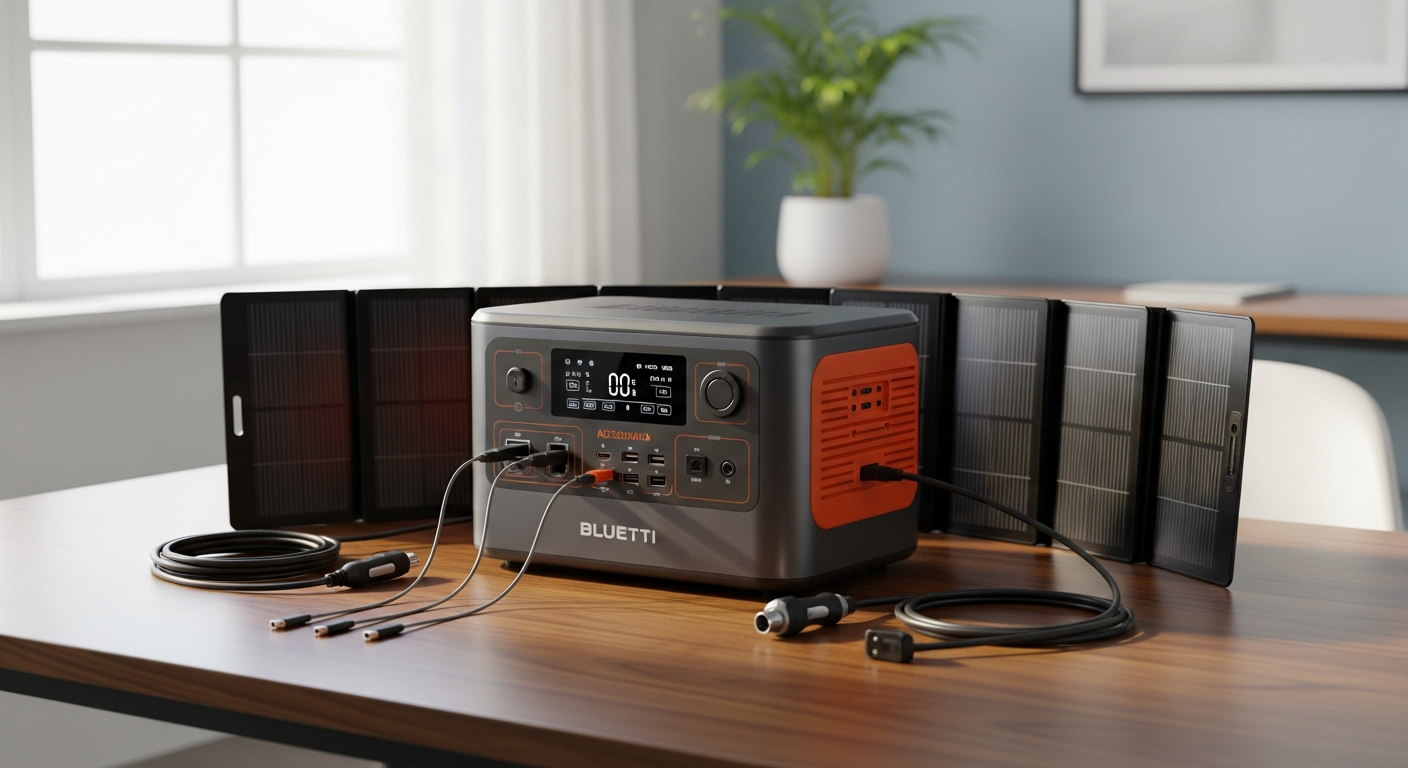
Discover how the BLUETTI AC200MAX expandable portable power station delivers up to 8192Wh of scalable power for RVs, camping, and emergency home backup. Learn expansion options, real-world performance, and whether it’s worth the investment.
Imagine the lights cutting out during a critical moment—no refrigeration for your insulin, no way to charge your phone, no power for essential medical devices. You wish you’d invested in something robust, something that could grow with your needs rather than leaving you stranded. Over 62,000 outdoor enthusiasts and homeowners have already solved this exact problem with a system designed to adapt.
The BLUETTI AC200MAX isn’t just another portable power station sitting on a shelf. It’s a modular energy ecosystem that responds to whatever life throws at you, whether that’s a week-long blackout or an extended off-grid adventure. What sets it apart isn’t just raw capacity—it’s the ability to scale that capacity as your circumstances change.
The portable power station market has exploded in recent years, but most units hit a hard ceiling. You pick a capacity at purchase and live with that choice forever. The AC200MAX changed the game by introducing genuine expandability. You start with a robust 2048Wh LiFePO4 battery and scale it up to 8192Wh by connecting external battery modules. This guide walks through everything necessary to maximize the AC200MAX’s expandable architecture—how the battery modules work, expansion strategies for different situations, real-world performance data, and whether modular expansion actually delivers the flexibility it promises.
Explore the BLUETTI AC200MAX expandable system today.
Understanding the AC200MAX’s Modular Battery Architecture
The AC200MAX arrives with a 2048Wh LiFePO4 battery already built in. This isn’t a small starting point—it’s a fully functional power station capable of handling serious loads on its own. The innovation lies in what happens next: the unit supports up to two external expansion modules connected via proprietary connectors.
Two types of expansion modules exist. B230 modules add 2048Wh each, while B300 modules add 3072Wh each. This means maximum expandable capacity reaches 8192Wh when two B300 modules are installed—a four-fold increase from the base configuration. The modular design allows phased investment. Users don’t need to commit everything upfront; they can add batteries as budget and needs evolve.
The LiFePO4 chemistry deserves special attention here. This battery type delivers 3500+ charge cycles to 80% capacity—significantly outlasting traditional lithium-ion alternatives. That longevity translates to a system capable of serving users for a decade or more rather than 3-5 years. Each module operates independently or in tandem, providing both redundancy and flexibility. Battery modules connect seamlessly, with the touchscreen monitoring system tracking each unit’s charge and discharge status separately.
Expansion Strategies for Different Power Scenarios
Different situations call for different expansion approaches. Understanding your specific scenario prevents both underinvestment and wasted spending.
Short-term emergencies (24-48 hours)
The base unit alone handles essential loads during brief outages. Lighting, phone charging, and small appliances run without requiring expansion. Most blackouts resolve within this timeframe, making the standalone unit sufficient for basic emergency preparedness.
Extended home backup (3-7 days)
A single B230 module doubles capacity for continuous operation of refrigerators, medical devices, and climate control. This configuration provides confidence that multi-day outages won’t compromise food safety or essential medications. The weight remains manageable at approximately 50kg total.
RV and camping adventures
A B230 module provides comfortable power for mini-fridges, air compressors, and power tools without excessive weight penalties. RV owners can keep this configuration in the vehicle permanently, with the expansion module providing genuine comfort rather than mere survival capability.
Off-grid living
Two B300 modules maximize capacity for sustained daily consumption, solar recharging cycles, and seasonal variations. This configuration targets users building toward energy independence or running remote cabins and homesteads.
Hybrid approach
Pairing one B230 with the base unit delivers balanced portability and capacity—an optimal middle ground for most RV owners and frequent campers. This setup totals approximately 72kg, manageable with effort but not trivial.
Budget-conscious scaling
B230 modules are more affordable than B300s. Cost-per-watt-hour analysis becomes important when planning expansion. Starting with the base unit and single B230 module provides higher value per dollar than committing to full expansion immediately.
Future-proofing
Starting with the base unit and adding modules as technology improves or needs change provides flexibility without overcommitting to current assumptions about future requirements.
Real-World Performance: What Expandable Capacity Actually Delivers
Numbers on a spec sheet matter less than actual performance under realistic conditions. The AC200MAX’s capabilities play out differently depending on load type, ambient temperature, and configuration.
The base unit (2048Wh) runs a 100W mini-fridge for approximately 20 hours at 80% usable capacity. That’s not theoretical—it’s what actually happens when a user depletes the battery from full to empty running only a fridge. Real-world usable capacity falls slightly short of rated capacity due to inverter conversion losses and battery management system overhead.
The 2200W pure sine wave inverter handles simultaneous loads—mini-fridge, laptop charging, and power tools running without voltage sag or performance degradation. This matters practically because most people don’t run one appliance at a time. The 4800W surge capacity powers high-inrush appliances like air compressors and circular saws without tripping protection systems. These surge capabilities separate the AC200MAX from lighter-duty competitors.
Solar recharging happens at 900W input, meaning full base unit recharge in 2-3 hours under ideal conditions. AC mains charging proves slower—approximately 8-10 hours for complete base unit recharge via wall outlet. Expandable units recharge proportionally; two B300 modules require significantly longer mains recharge times, potentially 20-24 hours. This creates a practical consideration: owners with multiple modules often rely on solar input for realistic recharge speeds.
Efficiency losses occur during inverter conversion. Expect 85-92% usable capacity depending on load type and ambient temperature. This means a stated 8192Wh system under full expansion actually delivers 6900-7500Wh of truly usable energy. Fan noise increases under sustained heavy loads (above 1800W). It’s acceptable for emergency use but noticeable in quiet environments, something apartment dwellers should consider.
Check out the BLUETTI AC200MAX and start building your expandable power solution.
Cost-Benefit Analysis of Battery Module Expansion
Investment required for full expansion approaches the cost of multiple smaller power stations, so cost-benefit analysis matters significantly.
The base AC200MAX unit typically prices around $1,799-$1,999 depending on sales and bundle availability. B230 modules cost approximately $700-$900 each, while B300 modules run approximately $1,000-$1,200 each. A full expansion kit with two B300 modules previously listed at $3,578, bringing total system cost to $5,500-$6,000.
This steep pricing makes more sense when examined through cost-per-watt-hour. The base unit costs roughly $0.88/Wh, while expansion modules cost $0.45-$0.65/Wh. Doubling or quadrupling capacity actually decreases cost-per-watt-hour significantly—a better value than purchasing multiple smaller power stations.
LiFePO4 longevity (3500+ cycles) justifies premium pricing over budget lithium-ion competitors. A system that lasts 10 years costs less annually than one lasting 3-4 years, even at higher upfront cost. Resale value remains strong; expandable systems hold 60-70% value after 2-3 years, substantially better than competing fixed-capacity units.
Financing options available through retailers make expansion more accessible. Monthly payments spread the cost over time, reducing sticker shock. ROI calculation depends on usage frequency. Daily users recoup investment faster than occasional users. Someone running the system continuously during frequent blackouts or off-grid living reaches payback within 2-3 years, while someone using it once yearly might never recover the investment purely on power bill savings.
Connectivity and Control Across Your Expandable System
The AC200MAX’s integration features prove surprisingly sophisticated for a portable device. A full-color touchscreen displays charge/discharge status, power consumption, and estimated runtime for the entire system at a glance. Bluetooth connectivity enables smartphone app control for remote monitoring and system adjustments from anywhere within range.
The app provides real-time notifications for charging status, low battery warnings, and maintenance alerts. Users can monitor individual battery module status separately, identifying which module is discharging first—useful data for diagnosing potential issues. Dual wireless charging pads built into the main unit charge Qi-enabled devices without cables.
Multiple AC outlets (including NEMA TT-30 for RV integration) plus USB-A, USB-C, and 12V/30A DC outputs mean compatibility with virtually any device. Smart load management prevents simultaneous high-draw scenarios that could exceed inverter capacity. Firmware updates via app keep the system optimized and add new features over time, extending the lifespan of the hardware investment.
Portability Trade-offs When Scaling Capacity
Expandability comes with physical weight trade-offs that matter practically.
The base unit weighs 28.1kg (62 lbs)—manageable for two people but challenging for solo transport. Each B230 module adds approximately 22kg (48 lbs), while each B300 adds approximately 33kg (73 lbs). A fully expanded system with two B300 modules creates a 94kg (207 lb) system requiring vehicle transport rather than carrying on foot.
Integrated handles on the main unit facilitate short-distance movement, but external modules require separate carrying solutions. The dimensions (42cm x 28cm x 38.7cm) fit in most vehicle cargo areas; expansion modules stack but require organization to prevent damage. Weight distribution becomes critical when stacking modules—top-heavy configurations are unstable and unsafe.
For true portability, the base unit alone or with a single B230 module represents the practical limit. Users wanting to carry a power station on foot or hike to remote locations should consider capacity requirements more carefully. Stationary installations (RVs, cabins, emergency home backup) benefit from maximum expansion without portability concerns.
Maintenance, Longevity, and Long-Term Value of Expandable Systems
LiFePO4 chemistry is inherently safer and more stable than traditional lithium-ion. Fire risk decreases significantly, and the chemistry remains stable across a broader temperature range. Recommended maintenance includes monthly charge cycles and storage in cool, dry environments between uses.
Battery modules should be stored at 30-50% charge during extended periods of non-use. Firmware updates release regularly—keeping app and system software current ensures optimal performance and access to new features. Connection points between modules require occasional inspection for corrosion or debris, especially in humid environments.
Dust filters on cooling vents should be cleaned monthly, particularly in sandy or dusty environments. Warranty typically covers 5 years and includes manufacturing defects but excludes user-caused damage. Replacement battery modules are available for purchase, allowing users to refresh capacity without replacing the entire system.
Degradation follows a predictable curve. Expect 80% capacity after 3500 cycles—manageable for most users since this still provides substantial usable power. End-of-life recycling programs available through BLUETTI handle LiFePO4 batteries responsibly; they’re recyclable and less toxic than older battery chemistries.
Comparing AC200MAX Expansion to Fixed-Capacity Competitors
Fixed-capacity competitors like Jackery and EcoFlow offer simpler user experience but no upgrade path. AC200MAX users avoid capacity regret—the frustration of outgrowing a system and needing complete replacement.
Competitors’ fixed systems may cost less initially but provide worse cost-per-watt-hour at higher capacities. The AC200MAX’s modular approach spreads investment over time; competitors require full upfront commitment. Battery management systems in modular units are more complex, introducing potential for software bugs or compatibility issues that fixed systems don’t encounter.
Fixed-capacity units often have simpler app interfaces, though the AC200MAX’s expanded monitoring offers genuinely useful features. The resale market favors expandable systems—buyers appreciate upgrade potential and longevity advantages. Competitor systems may offer lighter weight at equivalent capacity due to different battery chemistry, but they sacrifice the 3500+ cycle longevity advantage.
The AC200MAX’s LiFePO4 advantage (longevity and safety) represents a significant edge versus competitors using standard lithium-ion chemistry.
Practical Expansion Scenarios: When and Why to Add Modules
Real-world situations clarify which expansion path makes sense.
Scenario 1 – New RV owner: Start with the base unit. Add a B230 module after the first season if power needs exceed expectations. This approach prevents overcommitting before understanding actual usage patterns.
Scenario 2 – Frequent blackouts: A single B230 module provides confidence for 3-5 day outages without requiring full expansion. Most users find this sweet spot perfect for emergency preparedness.
Scenario 3 – Off-grid cabin: Two B300 modules justify initial investment for year-round independent living. Daily consumption needs make large capacity essential.
Scenario 4 – Growing family: Expansion allows the power station to scale with household consumption increases. Adding modules matches increasing power demands.
Scenario 5 – Business use: Contractors and service professionals add modules as client base and equipment needs expand. The system grows with the business.
Scenario 6 – Solar integration: Larger battery capacity maximizes benefit of solar charging by capturing more solar generation throughout the day.
Scenario 7 – Climate considerations: Cold climates reduce battery efficiency. Expansion compensates for seasonal capacity loss during winter months.
Scenario 8 – Redundancy planning: Multiple modules provide backup if one unit requires servicing, ensuring continuous power availability.
Troubleshooting and Optimization Tips for Expandable Systems
Several optimization principles extend system life and maximize performance.
Ensure all modules maintain firmware at the same version; mismatches cause communication errors. Check connection points regularly since loose connections reduce charging and discharging efficiency. Monitor individual module discharge rates; significant variations indicate potential battery health issues requiring attention.
Optimize load distribution by avoiding concentration of all high-draw devices on a single module. Temperature management proves critical—keep the system in 15-35°C range for optimal charging efficiency. Use the app’s load management features to prevent simultaneous high-draw scenarios that stress the inverter.
Calibrate the battery gauge periodically by fully charging and fully discharging the system. Solar input optimization matters: position panels for consistent 900W input while avoiding partial shading. AC mains charging works best on dedicated 20A circuits to prevent voltage fluctuations.
Seasonal adjustments include reducing discharge rates in cold weather and allowing longer recharge times. These practical steps prevent many common issues before they become serious problems.
The Expandable Power Station Revolution: Why Scalability Matters
The BLUETTI AC200MAX’s expandable architecture fundamentally changes how users think about portable power. Instead of choosing between insufficient capacity and excessive upfront cost, you get to grow your system alongside your needs. That flexibility is genuinely transformative—whether you’re preparing for occasional emergencies or committing to extended off-grid living.
Real-world performance data supports the hype. The LiFePO4 battery chemistry delivers reliability that cheaper competitors can’t match, and the 3500+ charge cycle lifespan means you’re investing in a system that will serve you for a decade or more. Yes, weight and mains charging speed present legitimate trade-offs, and yes, a fully expanded system approaches $6,000. But when you break down the cost-per-watt-hour and factor in the longevity advantage, the math becomes compelling.
The decision ultimately hinges on your specific scenario. If you’re an RV enthusiast or someone who experiences frequent blackouts, the base unit with a single B230 module strikes the optimal balance between capacity and portability. If you’re building an off-grid homestead or running a power-hungry business, the full expansion to 8192Wh justifies the investment. If you’re uncertain about your future needs, the modular design lets you start small and scale confidently as your situation evolves.
The portable power station market continues to evolve, but the AC200MAX’s expandable foundation positions it as a long-term solution rather than a temporary fix. Start where you are, expand where you need to, and enjoy the freedom that reliable, scalable power provides.
Discover the BLUETTI AC200MAX and build your expandable power system now.