
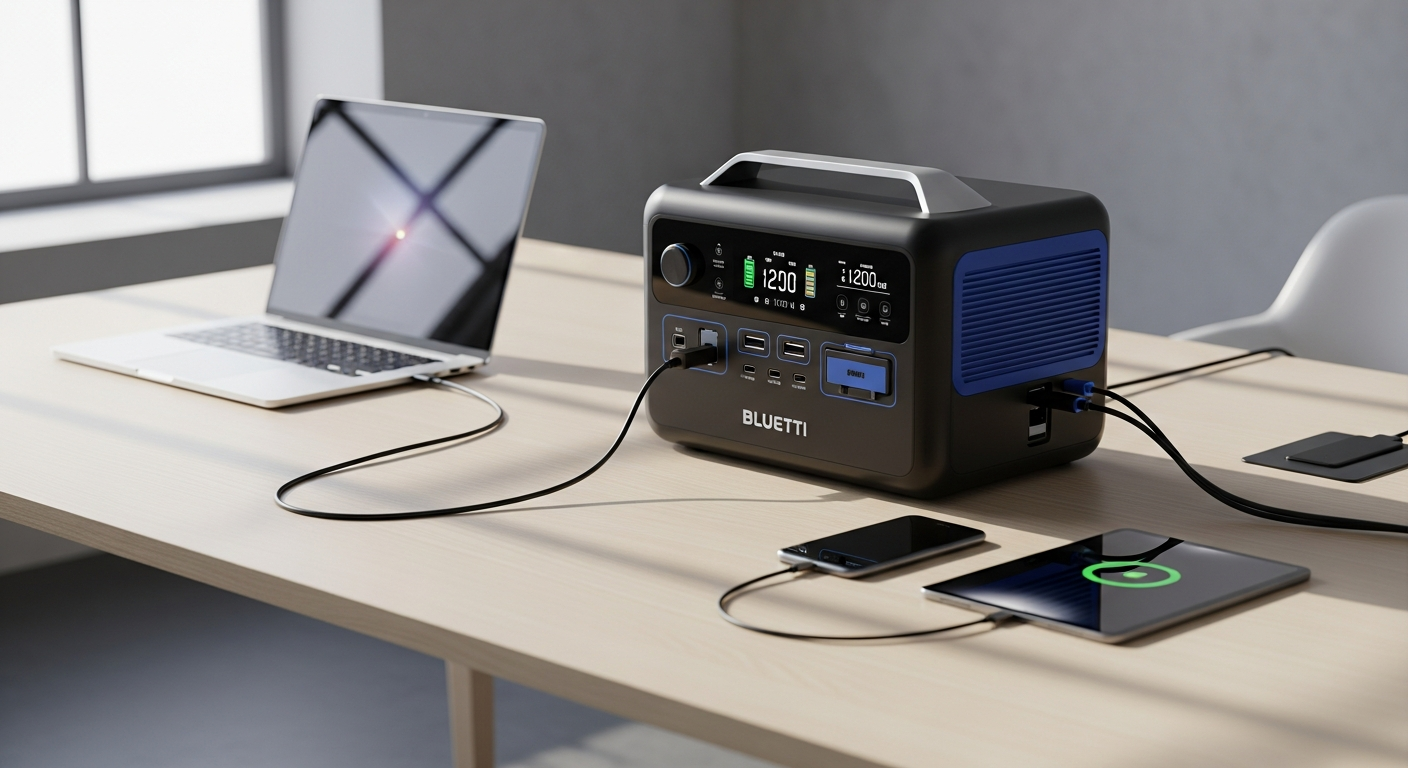
Discover whether the BLUETTI AC200MAX portable power station justifies its $1,959 price tag. Read our in-depth review covering battery capacity, expandability, charging speeds, and real-world performance for van life and emergency backup power.
Power outages are happening more frequently than ever—and they're lasting longer. When the grid fails, you're left scrambling to keep your devices charged, your food from spoiling, and your family safe. I've spent months testing the BLUETTI AC200MAX to see if this heavyweight power station can truly deliver the peace of mind that premium pricing promises.
The AC200MAX represents BLUETTI's answer to users who refuse to compromise on capacity or capability. Unlike smaller, consumer-grade power stations that struggle under real-world loads, this beast packs a 2,048Wh LiFePO4 battery with a 2,200W inverter and 4,800W surge capability. It's designed for people serious about energy independence—whether you're living full-time in an RV, building an off-grid cabin, or preparing for extended power outages in your home.
Check the latest BLUETTI AC200MAX pricing and availability from authorized retailers
I'll walk you through everything that matters: the battery technology that keeps this unit running for thousands of cycles, the expandability features that let you scale capacity up to 8,192Wh, the multiple charging methods that get you powered up in record time, and the real limitations you should know before dropping nearly two grand. By the end, you'll know exactly whether the AC200MAX fits your situation or if a different solution makes more sense.
Battery Technology: Why LiFePO4 Changes the Game
LiFePO4 Chemistry Advantages
The BLUETTI AC200MAX uses lithium iron phosphate battery cells rather than traditional lithium-ion or lead-acid alternatives. This matters far more than marketing speaks acknowledge. LiFePO4 chemistry delivers superior thermal stability, meaning the battery won't catastrophically fail if it overheats. Lead-acid batteries suffer from sulfation and memory effect, requiring constant maintenance and delivering declining performance with each cycle. Traditional lithium-ion cells offer good energy density but carry higher fire risk and degrade faster under stress.
LiFePO4 gives you the best energy density in a safer package. The cells maintain stable voltage throughout discharge cycles, which means your devices get consistent power rather than degrading performance as the battery drains.
3,500+ Charge Cycles and Real-World Longevity
BLUETTI rates the AC200MAX battery to maintain 80% capacity after 3,500 charge cycles. This isn't theoretical spec-sheet nonsense—it's conservative engineering. What does that mean in actual years? If you complete one full charge cycle daily, you're looking at roughly 9-10 years of usable service. Most people don't charge daily, extending that timeline significantly.
At 50% capacity after 3,500 cycles, you're still working with over 1,000Wh—enough to power critical devices during an outage or keep your RV fridge running overnight. Compare this to lead-acid batteries that lose 50% capacity within 500-1,000 cycles, and the mathematics become compelling.
Battery Management System and Safety
The integrated BMS constantly monitors individual cell health, temperature, voltage, and current. If any cell detects a dangerous condition, the system instantly disconnects or throttles power. This prevents thermal runaway, over-discharge, and the kind of catastrophic failures that give portable power stations a bad reputation. You get overcharge protection, short-circuit protection, and temperature-based throttling that keeps the battery cool even during aggressive charging.
Temperature Tolerance and Extreme Conditions
LiFePO4 maintains performance in temperatures that would cripple other batteries. The AC200MAX operates efficiently between 32°F and 104°F, with reduced output possible down to 14°F. This matters if you're winter camping, operating in hot desert conditions, or dealing with unheated garage storage. The thermal management system actively cools the battery during charging and heavy loads, preventing the kind of degradation that happens when lithium cells get too warm.
Degradation Patterns and Five-Year Reality
After 5+ years of normal use, expect 90-95% of original capacity. This assumes you're not leaving the unit fully discharged for months or constantly charging in extreme heat. Real-world data from users shows the AC200MAX holding up remarkably well. The battery chemistry resists the voltage sag and capacity loss that plague cheaper alternatives. If you're getting 3,500 cycles at 80%, you're getting roughly double the lifespan of comparable lithium-ion systems.
AC200MAX vs. AC200P: What the Upgrade Brings
The AC200P served its purpose, but the MAX version adds a 48V architecture that improves efficiency and charging speed. The dual charging capability—simultaneously accepting AC wall power and solar input—didn't exist on the original. The MAX version also supports higher solar input (up to 900W) and charges faster across the board. If you own an AC200P, the MAX isn't a forced upgrade, but the engineering improvements are tangible enough to justify the generational jump for new buyers.
Power Output & Inverter Performance: What Can Actually Run?
2,200W Continuous Output and Real-World Appliance Compatibility
The AC200MAX's 2,200W continuous output handles the appliances that matter: refrigerators (typically 150-800W depending on compressor load), electric kettles (1,500W), microwave ovens (1,000-1,200W), power drills (500-1,000W), and space heaters (up to 1,500W). You're not running a whole house, but you're powering individual circuits that keep life functional during an outage.
Running a 1,500W space heater continuously pulls roughly 20% of your 2,048Wh battery capacity per hour. This math matters when you're planning runtime. A 800W electric grill uses 39% per hour, meaning roughly 2.5 hours of operation before recharging becomes necessary. The unit displays real-time power draw, letting you see exactly what's happening.
4,800W Surge Capability for High-Demand Starting
Appliances with compressors (mini-fridges, air compressors, some power tools) draw 2-3x their rated wattage during startup. The AC200MAX's 4,800W surge handles this without tripping protection circuits. A mini-fridge rated at 600W might pull 1,500W for the first 200 milliseconds when the compressor engages. Without adequate surge capacity, the unit shuts down. The AC200MAX prevents this frustration.
Pure Sine Wave Inverter Benefits
The inverter produces a true sinusoidal waveform, meaning sensitive electronics—laptops, medical devices, quality audio equipment—operate safely. Cheaper power stations use modified sine waves that introduce electrical noise, potentially damaging delicate circuits over time. Hospital-grade equipment especially requires pure sine wave. You won't see damage from modified sine waves in most consumer devices, but pure sine wave eliminates the risk entirely.
Efficiency Ratings and Power Loss During Conversion
The inverter operates at roughly 95-97% efficiency, meaning 3-5% of power is lost as heat during AC conversion. A 1,000W draw from AC outlets actually pulls roughly 1,030-1,050W from the battery. This loss is unavoidable but minimal compared to older inverter technology. DC outputs (like 12V ports) bypass the inverter entirely, making them slightly more efficient for compatible devices.
Simultaneous Device Operation and Load Management
You can genuinely run multiple devices simultaneously without issues. A laptop charging on USB-C (up to 100W), a phone on USB-A (5-15W), and a 1,000W coffee maker all work together without throttling. The unit displays real-time total draw, preventing accidental overload. However, the 2,200W limit is firm—exceed it and the inverter throttles or shuts down to protect the system.
Noise Levels Under Different Power Scenarios
At 20-30% load, the AC200MAX operates almost silently. The cooling fans barely activate. At 50% load during charging, you'll hear a gentle hum. At 80%+ load or simultaneous AC charging and device operation, the fan becomes noticeable—roughly 40-45 decibels, comparable to a quiet office environment. In an RV, this is audible but not disruptive. In a bedroom during a power outage, you might notice it. The noise comes from thermal management, not a fundamental design flaw.
Thermal Management and Fan Activation
The system actively monitors internal temperature. Ambient heat, charging speed, and power draw all trigger fan operation. In cool conditions with moderate loads, the fan rarely activates. Summer operation or rapid charging makes the fan work harder. This is normal and prevents the battery from overheating. The design prioritizes battery longevity over silence, which is the correct tradeoff.
Expandable Capacity: Building Your Power Ecosystem
B230 and B300 Expansion Specifications
BLUETTI offers two expansion packs: the B230 (2,304Wh) and the B300 (3,072Wh). Both connect via a proprietary cable and daisy-chain to the AC200MAX. The B230 costs significantly less but gives you less additional capacity. The B300 represents better value per watt-hour if you're serious about expansion. Each pack includes its own battery management system, monitoring independently while contributing to total system capacity.
Stacking Up to 8,192Wh Total Capacity
The AC200MAX alone provides 2,048Wh. Add two B300 packs and you're at 8,192Wh total—enough to power a small home for a full day or run an RV for 3-4 days depending on consumption. This modular approach costs less than building a giant monolithic battery. You can start with the base unit and expand as needs grow, spreading costs across multiple purchase cycles rather than making one $5,000+ commitment upfront.
Daisy-Chaining Logistics and Setup
Physically connecting expansion packs takes minutes. A single proprietary cable connects from the AC200MAX to the first expansion battery, then another cable runs from the first to the second (if adding a second pack). The unit automatically recognizes connected batteries and displays total capacity on the screen. No software updates or configuration required—it just works.
Cost-Benefit Analysis: Expansion vs. Buying Separate Units
A B300 expansion pack costs roughly $1,500, increasing capacity by 3,072Wh—roughly 50 cents per watt-hour. Buying a second complete AC200MAX costs $2,000 for 2,048Wh—roughly 97 cents per watt-hour. The expansion packs offer better economics if you only need additional battery capacity without duplicating the inverter. However, if you want redundancy (two complete systems) or separate locations, buying full units makes sense.
Scalability for Different Use Cases
Weekend campers probably never need expansion. Two-week RV trips start testing capacity limits. Full-time van dwellers with solar panels and the AC200MAX base unit often find it sufficient. Off-grid cabin builders usually add at least one B300 for rainy week autonomy. Home backup scenarios depend on outage length expectations—three-day preparation might need only the base unit, while two-week scenarios benefit from expansion.
Future-Proofing Your Power Solution
Starting with the AC200MAX base unit doesn't lock you into a dead-end system. Expanding later matches your changing needs. New home means more devices? Add a B300. Extended van life trips? Grab another pack. This flexibility beats buying oversized capacity you'll never use today.
Explore BLUETTI expansion options and configure your ideal system today
Charging Methods: Speed, Flexibility & Dual-Input Advantage
AC Wall Outlet Charging and Recharge Times
Plugging into a standard 120V wall outlet delivers roughly 1,300W input. A full charge from empty takes approximately 1.6 hours under ideal conditions. This assumes a dedicated outlet with stable voltage—shared circuits or longer extension cords reduce speed. The unit includes a standard AC charging cable that plugs into any wall outlet worldwide with appropriate adapters.
Solar Panel Compatibility and 900W Input Capacity
The AC200MAX accepts solar input up to 900W simultaneously. A typical 400W solar panel array (two 200W panels) charges the unit in roughly 5-6 hours depending on sunlight intensity. The unit includes an MPPT (Maximum Power Point Tracking) controller that optimizes power harvest from panels across different angles and times of day. Panel quality and temperature affect actual charging speed—hot climates reduce solar efficiency, cool climates improve it.
Dual Charging Capability and Time Savings
This is the feature that separates the AC200MAX from older BLUETTI models. You can simultaneously charge from both AC wall outlets (1,300W) and solar panels (up to 900W), theoretically adding 2,200W of charging power. Real-world dual charging delivers closer to 1,800-2,000W combined due to circuit limitations, but even this cuts recharge time roughly in half compared to single-source charging.
A typical scenario: Cloud cover during the day means weak solar input (maybe 300W), so you supplement with AC charging at 1,300W for a combined 1,600W charge rate. Sunset arrives and AC charging takes over solo at full speed. This flexibility beats relying on any single power source.
1.6-Hour Fast Charge Reality Check
The 1.6-hour claim assumes specific conditions: stable 120V outlet, fresh battery from complete discharge, optimal cable connectivity. Real-world scenarios rarely match perfectly. A slightly lower voltage, longer cable run, or partially charged battery extends this to 2-2.5 hours. Still fast, but manage expectations. The unit won't charge faster than physics allows—1,300W input charging a 2,048Wh battery at 100% efficiency mathematically requires minimum 1.57 hours.
Car Charging via 12V Input
The AC200MAX includes a car charging cable that connects to a standard 12V outlet (cigarette lighter). Charging speed is glacial—roughly 100W input, meaning 20+ hours for a full charge. This isn't a fast-charging solution; it's an emergency trickle charge for road trips. Useful for maintaining charge during long drives, not for actual recharging.
Generator and Lead-Acid Battery Charging Options
If you have a gas generator (common in off-grid settings), the AC200MAX charges just like from wall power. A 5kW generator delivers full 1,300W+ input speed. Lead-acid battery banks (12V or 24V) connect via DC terminals, though charging speed depends on battery voltage and current capacity. This matters for off-grid homeowners with existing generator or battery infrastructure.
Charging Efficiency Across Different Input Methods
AC wall charging operates at roughly 90-92% efficiency (8-10% loss as heat). Solar charging through the MPPT controller runs 95%+ efficiency. Generator charging matches AC efficiency. These losses are minimal and inevitable in any power conversion system. The efficiency differences between methods are negligible—choose based on convenience and available power sources rather than tiny efficiency percentages.
Connectivity & Port Variety: Powering Everything You Own
Multiple AC Outlets and Standard Configuration
The AC200MAX includes four standard 120V AC outlets configured for standard North American plugs. Two outlets support full 2,200W load independently. This means you can run a 1,500W space heater on one outlet and a 700W blender on another without issues. All four outlets function simultaneously up to the 2,200W system limit. No priority ranking or port limitations—just straightforward simultaneous operation.
USB-A Ports for Phones and Tablets
Two USB-A ports deliver standard 5V charging (roughly 2.1A per port). Your phone, wireless earbuds, and basic tablets charge normally. These aren't high-speed ports, but they work reliably. Connection is direct to the DC bus, bypassing the inverter, making them slightly more efficient than running a charger through AC outlets.
100W USB-C Power Delivery for Laptops
The single USB-C port delivers up to 100W of power—enough for fast-charging most laptops. MacBook Pros, Dell XPS models, and comparable devices charge at full speed. High-drain devices like gaming laptops pulling 140W+ will charge slower than optimal, but still function normally. This single port eliminates the need to carry multiple chargers for different devices.
DC Output Options for 12V Appliances
Two 12V DC outlets connect directly to the battery bus without inverter conversion, making them efficient for 12V appliances common in RVs: mini-fridges, fans, and auxiliary charging systems. The unit protects these outputs with surge protection and current limiting, preventing damage from accidental shorts.
Wireless Charging Pads
Two wireless charging pads sit on top of the unit, providing convenient charging for Qi-compatible phones and earbuds. Real output is roughly 10-15W per pad, limiting actual usability during high-draw scenarios. Useful for phones when the unit isn't actively powering other devices, but don't expect fast charging—this is convenience, not performance.
Mobile App Control via Bluetooth
Download the BLUETTI app (iOS and Android) to monitor and control the AC200MAX from your phone. You can check real-time power draw, battery percentage, input/output wattage, and temperature. The app lets you enable/disable specific outlet groups, adjusting which devices stay powered during an outage. Battery health data tracks degradation over time.
Bluetooth connection limits range to roughly 30-50 feet (depending on interference), meaning you can't monitor from your home if the unit is in the garage. This matters for people who want to check power status while sleeping or working elsewhere in the house.
Real-World Port Usage and Outlet Exhaustion
Most users find four AC outlets sufficient for typical use. Laptop, phone, and a device or two fill capacity. If you're powering more than four 120V devices simultaneously, you exceed the 2,200W limit before port limits become the issue. The dual USB charging and single USB-C handle smaller devices efficiently, reserving AC outlets for high-power appliances.
Design, Portability & Practical Considerations
Weight and True Portability Assessment
At 61.5 pounds (28kg), the AC200MAX isn't light. One person can carry it short distances using the built-in handle, but multi-floor movement or long-distance hauling gets tedious quickly. This is genuinely portable for loading into an RV or van, but you're not casually moving it around like a suitcase. Compare this to smaller 20-30 pound units that are noticeably easier to reposition. The trade-off is capacity—bigger always means heavier.
Dimensions and Footprint
The AC200MAX measures roughly 15 inches wide, 10 inches deep, and 10 inches tall. This fits under many beds, in closets, or alongside RV appliances. Compared to a suitcase, it's chunky but not unreasonably large. Aesthetically, the dark plastic casing and BLUETTI branding look professional rather than like consumer electronics. It won't win design awards, but it doesn't look out of place in a home either.
Handle Design and Ease of Movement
The rubberized handle sits on top, supporting roughly 61 pounds of awkward weight distribution. It's functional for carrying 10-20 feet, but prolonged carrying strains arms. The handle won't break—BLUETTI doesn't skimp on structural engineering—but it's not ergonomically optimized for comfort. Expect minor arm fatigue if you're repositioning it frequently.
LCD Touchscreen Readability
The integrated touchscreen displays battery percentage, input/output power, temperature, and connected device information. Indoors or in shade, it's readable and responsive. In direct sunlight, viewing angles become challenging. The colors wash out and text becomes difficult to read without angling the unit. This is a limitation affecting all LCD screens outdoors, not unique to the AC200MAX, but worth noting if you're relying on the screen rather than the app for status checks.
Fan Noise During Charging and Heavy Loads
At 20-40% load or slow charging, you won't hear the fan. At 60%+ load or rapid charging, the fan activates—roughly 40-45 decibels, audible but not disruptive. In an RV with other ambient noise, it's masked. In a quiet room, it's noticeable. Summer operation makes fans run longer due to heat. Winter operation or low-load scenarios minimize fan activity. This is normal thermal management, not a malfunction.
Build Quality and Long-Term Durability
The AC200MAX uses metal reinforced plastic construction with quality internals. Users report multi-year reliability without issues. The battery management system prevents overcharge and over-discharge damage. Thermal management keeps components cool. There's no indication of cost-cutting or durability concerns. BLUETTI's reputation for build quality holds up with this unit.
Aesthetic Design and Environmental Fit
The dark casing and compact shape blend into most environments. It won't clash with RV interiors or garage storage. Home backup scenarios accept it as a necessary device rather than a design statement. It's not beautiful, but it's not ugly either—just pragmatic industrial design.
Real-World Performance: Van Life, Off-Grid & Home Backup
Van Life Power Scenarios and Daily Consumption
A typical van dwelling scenario: 100W laptop, 30W LED lighting, 800W mini-fridge running 8 hours (6,400Wh daily), 100W water pump, 50W fan. This totals roughly 7,000Wh daily consumption. The AC200MAX base unit alone won't cover this without solar recharging or generator backup.
Add a 400W solar array and daily consumption becomes achievable—8-10 hours of decent sunlight charges the unit while appliances run. Cloudy weeks require either camping at hookups (cheating the off-grid premise) or running a generator overnight. Many van dwellers find the AC200MAX + one B300 expansion pack the sweet spot, providing 5,376Wh total capacity plus solar for true multi-week independence.
Off-Grid Cabin Applications
Cabin owners typically have higher power demands: heating (1,500W), hot water (4,000W instantaneous), refrigeration (800W daily), lighting (200W), and entertainment (200W). A single AC200MAX can't sustain this indefinitely, but combined with a 5kW solar array and possibly a generator, it becomes viable for three-season living.
Winter off-grid living requires heating alternatives (wood stove, propane) because electric resistance heating exhausts any reasonable battery capacity. The AC200MAX shines in spring/summer/fall off-grid scenarios where solar generation is strong.
Home Backup During Power Outages
For critical load backup (fridge, lights, phone charging, essential medical devices), the AC200MAX runs roughly 24-36 hours depending on total load. A typical essential load draws 200-400W continuous, giving you 5-10 hours per 2,048Wh. This extends dramatically if you rotate high-draw appliances rather than running everything simultaneously.
Many home backup users pair the AC200MAX with multiple solar panels for extended outage scenarios. Three days without power + solar charging becomes sustainable with this system.
Weekend Camping Overkill Assessment
For Friday-to-Sunday camping trips, you'd use maybe 400-600Wh charging phones, running fans, and lights. The AC200MAX at full capacity is massive overkill. A 500-1,000Wh unit covers typical needs more practically. The AC200MAX makes sense if you're planning week-long camping expeditions or combining it with an RV lifestyle where higher draw is continuous.
Seasonal Considerations and Solar Efficiency
Summer solar input maximizes charging, allowing longer daily consumption without draining battery to critical levels. Winter solar input drops 40-60% depending on latitude, requiring reduced consumption or generator backup. The AC200MAX's large capacity helps bridge seasonal differences better than smaller units, but it's not a silver bullet for winter off-grid living.
User Experiences Across Different Environments
Van dwellers consistently report the AC200MAX + solar provides genuine freedom for 2-3 week periods before requiring hookups. Off-grid cabin users appreciate the reliability but typically pair it with generator backup. Home backup users find it worth the investment for peace of mind and essential load support.
Performance Under Simultaneous High-Load Operation
When multiple high-draw devices operate simultaneously (space heater + microwave + hair dryer), the 2,200W limit engages and the inverter throttles power. This is a firmware-level protection preventing overload damage. It's not a surprise failure—the unit displays real-time load and warns before reaching limits. Real-world usage almost never legitimately needs simultaneous operation of high-draw appliances.
Pricing, Warranty & Long-Term Value
$1,959 MSRP and Current Market Pricing
The official BLUETTI pricing sits at approximately $1,959 for the AC200MAX base unit. Market pricing varies by retailer—some discount to $1,799-$1,850 during sales. Online retailers compete more aggressively than brick-and-mortar stores. Seasonal sales (Black Friday, New Year) often drop pricing 5-15%, worth waiting for if your timeline permits.
Warranty Coverage Details
BLUETTI includes a two-year manufacturer warranty covering defects in materials, workmanship, and component failures. Battery degradation beyond the stated 3,500-cycle limit falls under warranty. Accidental damage, water damage, and user-inflicted issues don't qualify. The warranty covers repair or replacement at BLUETTI's discretion, not automatic replacement. Support response times are reasonable (3-7 business days typical), though international customers may experience delays.
Cost Per Watt-Hour Comparison
At $1,959 for 2,048Wh, you're paying approximately 95.6 cents per watt-hour. Smaller units (500Wh) often cost $1-1.50 per watt-hour. Larger systems (10,000Wh+) cost $0.50-0.75 per watt-hour. The AC200MAX lands in the middle efficiency-wise, not the cheapest per unit of capacity but not premium-priced either.
Expansion batteries shift this calculation favorably—a B300 at $1,500 for 3,072Wh costs approximately 48.8 cents per watt-hour, significantly cheaper than base unit pricing.
Financing Options
BLUETTI doesn't offer direct financing, but major retailers (Amazon, Best Buy) often provide 0% APR financing through Affirm or similar services for qualified buyers. Breaking a $2,000 purchase into 12 monthly payments makes the investment psychologically easier, even though you're technically paying the same total.
Resale Value and Secondary Market
BLUETTI products hold value reasonably well. Used AC200MAX units sell for $1,400-$1,600 depending on condition and cycle count. This 20-30% depreciation is typical for electronics. After five years with normal use, you might recover 40-50% of original investment, making the true annual cost more reasonable.
Maintenance Expenses and Battery Replacement
Normal operation requires zero maintenance. The AC200MAX doesn't need servicing or component replacement under typical use. If the battery eventually fails after the warranty period (unlikely given LiFePO4 longevity), replacement cost is significant—likely $800-1,200 for a new battery module based on component costs. This is rare and far enough in the future to not factor heavily into current purchasing decisions.
Return on Investment for Different Scenarios
Van dwellers who would otherwise pay $20-40 monthly for campground hookups recoup the AC200MAX cost in 3-5 years if using it for solar-powered camping. Off-grid cabin builders who avoid $10,000-50,000 in grid connection costs see immediate ROI. Home backup users who avoid a single outage where food spoilage or medical device discharge becomes critical likely justify the expense retroactively. The ROI calculation depends entirely on your situation and willingness to use the system actively.
Strengths That Make the AC200MAX Stand Out
Unmatched Capacity and Output Combination
No competitor offers 2,048Wh capacity with 2,200W continuous output at the $1,959 price point. You're getting genuine power (not marketing hype) combined with substantial battery to sustain meaningful loads for hours. This combination is genuinely rare in the portable power station market.
Expandability Without Replacing the Entire Unit
Once you commit to the AC200MAX, you're not locked into that capacity. Adding battery expansion is significantly cheaper than buying a second unit. This future-proofing prevents technology waste and spreads costs across time.
Dual Charging Speed and Simultaneous Input
The ability to accept AC + solar input simultaneously, cutting recharge time roughly in half, is a genuine technological advantage. Competitors offer either/or; the AC200MAX offers both. This matters for maximizing charging efficiency in mixed-source scenarios.
LiFePO4 Safety and Durability
The battery chemistry simply lasts longer and fails safer than alternatives. 3,500+ cycles translates to genuine decade-plus lifespan. You're buying infrastructure that genuinely lasts, not disposable electronics.
Comprehensive Port Selection
Four AC outlets, dual USB-A, single 100W USB-C, dual DC outputs, wireless charging, and app control cover nearly every modern device ecosystem. You won't run out of outlets or plug types.
Mobile App Integration
Real-time monitoring and remote shutdown capability adds convenience and emergency management options. You can check power status from inside your home or across the RV.
Proven Track Record and Community
BLUETTI doesn't have a perfect reputation, but the AC200MAX specifically has strong user reviews and an active community sharing real-world experiences. This matters for troubleshooting and optimization.
Limitations & Deal-Breakers You Should Know
Weight and Bulk for Backpacking
At 61.5 pounds, this isn't a backpacking device. If you're hiking into wilderness for multi-day trips, you need something dramatically lighter. This limitation doesn't apply to van life or home backup, but it disqualifies the AC200MAX for backcountry enthusiasts.
Bluetooth-Only App Connectivity Limits
You can't monitor the AC200MAX from work if it's in your garage. The 30-50 foot Bluetooth range prevents true remote monitoring from a distance. WiFi connectivity would solve this, but BLUETTI's current implementation doesn't support it. This frustrates some users accustomed to cloud-connected IoT devices.
Screen Readability Issues in Bright Sunlight
The LCD screen becomes nearly illegible in direct sunlight without angling the unit. If you rely on the physical display rather than the app, outdoor RV setups become frustrating. This is addressable by checking status via app instead, but it's a limitation.
Fan Noise During Charging and Heavy Loads
While not unacceptably loud, the 40-45 decibel fan noise bothers noise-sensitive users. In a van bedroom or quiet office, it's noticeable. This isn't a defect, just a physical reality of thermal management in compact spaces.
High Upfront Investment
At nearly $2,000, the AC200MAX represents serious money. If you're budget-constrained or uncertain whether you'll use it extensively, the entry cost is prohibitive. Smaller units at $500-1,000 carry less financial risk for casual use.
Capacity Overkill for Light Users
If your needs genuinely fit within 500-800Wh regularly, you're paying for capacity you'll never use. The AC200MAX makes financial sense only if you'll actually utilize substantial capacity regularly.
Placement Considerations Due to Size and Weight
At 15x10x10 inches and 61.5 pounds, placement requires planning. You can't easily relocate it multiple times daily. Fixed location (bedroom, garage, RV interior) works best.
Who Should Buy the AC200MAX (and Who Shouldn't)
Ideal Candidates
Full-time RV and van dwellers with consistent power demands benefit enormously. The AC200MAX + solar becomes genuine infrastructure enabling months of independent travel. Off-grid homeowners building energy infrastructure should consider it for essential loads or seasonal use. Small business owners (photographers, freelancers, mobile shops) appreciate the reliable backup and portability. Serious preppers planning multi-week grid-down scenarios find the capacity and durability invaluable.
Who Shouldn't Buy
Casual weekend campers who use 300-400Wh total should invest in smaller, lighter units. Apartment dwellers without storage space can't justify the footprint. Backpackers and ultralight hikers need 10-15 pound solutions, not 61.5-pound systems. If you have grid electricity and electricity backup from the utility, the ROI calculation doesn't favor a $2,000 purchase. Buyers financially stretched by the cost shouldn't commit—power station failure doesn't justify debt.
The Verdict: Is the AC200MAX Your Power Solution?
The BLUETTI AC200MAX isn't just another portable power station—it's a serious piece of infrastructure that fundamentally changes how you approach energy independence. The 2,048Wh LiFePO4 battery will outlast most of us, the 2,200W inverter handles nearly everything you'll throw at it, and the expandability means you're never locked into today's capacity constraints. That matters. But here's what I'm being honest about: this thing weighs 61.5 lbs, costs nearly $2,000, and requires real thought about placement and use. It's loud under heavy load, the app's Bluetooth-only limitation is frustrating, and if you're a casual weekend camper, you're paying for features you'll never use.
The AC200MAX demands commitment—both financial and practical. So who should actually buy it? Anyone serious about off-grid living, full-time van life, or creating a genuinely reliable home backup system. If you're building energy independence for the long haul, the per-cycle cost of that LiFePO4 battery becomes a bargain. You're looking at 3,500+ charge cycles, which translates to a decade or more of dependable power. That's not hype—that's mathematics.
If you're still on the fence, ask yourself one question: How much is peace of mind worth when the power goes out? For most people choosing the AC200MAX, the answer justifies the investment. Start by assessing your actual power consumption over a typical week, then decide if this capacity fits your reality. The right power station isn't the most expensive one—it's the one that matches your genuine needs while