
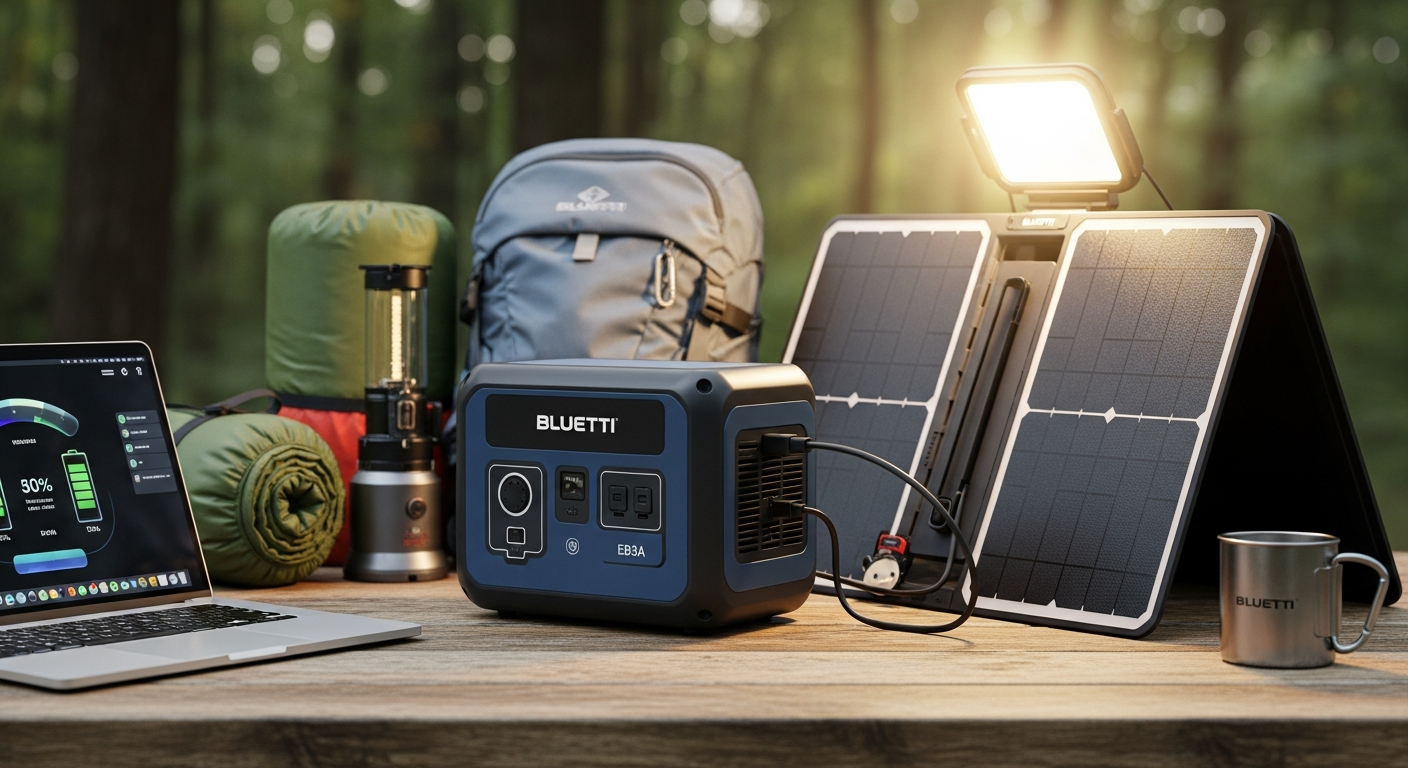
Master solar charging with the BLUETTI EB3A portable power station. Learn setup, efficiency tips, and how to achieve true off-grid power independence with integrated MPPT technology.
The power landscape is shifting. Over 40% of outdoor enthusiasts now prioritize solar-compatible power solutions for their adventures—and for good reason. The ability to recharge your power station under the sun means genuine freedom from electrical outlets, untethered to the infrastructure that constrains traditional energy solutions.
The BLUETTI EB3A isn't just another portable power station; it's engineered specifically for solar integration with its integrated MPPT controller and support for solar input up to 430W. This compact 268Wh unit bridges the gap between portability and renewable energy adoption, offering a practical entry point for anyone seeking reliable off-grid power without the bulk and expense of larger systems.
This guide covers everything solar-related with the EB3A—from selecting compatible panels to optimizing charge times and maximizing efficiency. You'll find real-world charging scenarios, troubleshooting tips, and strategies for creating a truly self-sustaining power ecosystem that works wherever you go.
Understanding the EB3A's Solar Architecture and MPPT Technology
How the integrated MPPT controller works to optimize solar input
The BLUETTI EB3A's integrated MPPT (Maximum Power Point Tracking) controller is the intelligent heart of its solar charging system. Rather than accepting whatever power solar panels provide, MPPT continuously monitors the panel's voltage and current output, then adjusts the charging parameters to extract maximum available power at any given moment. This dynamic optimization happens automatically and instantly, responding to changing light conditions throughout the day.
The difference between MPPT and standard PWM charging methods
Standard PWM (Pulse Width Modulation) charging uses a simpler approach—it essentially matches the battery voltage to the panel voltage and regulates current through on-off switching. While functional, this method wastes significant energy as heat. MPPT technology, by contrast, uses a DC-to-DC converter to optimize the voltage-current relationship independently, typically capturing 20-30% more energy from the same solar panel setup compared to PWM systems. For portable power users, this efficiency difference translates directly into faster charging and more usable energy.
Solar input specifications: 200W standard vs. 430W maximum capacity explained
The EB3A supports solar input up to 200W as its standard specification, though some configurations allow up to 430W maximum capacity. This distinction matters when planning your solar panel setup. The 200W rating represents the typical safe continuous input, suitable for most portable panel configurations. The 430W maximum indicates the controller can handle higher peak inputs during optimal conditions, allowing flexibility for larger or multiple panel setups without damaging the unit. Understanding this range prevents over-specification or under-utilization of your solar investment.
How the EB3A automatically adjusts charging parameters based on panel output
The MPPT controller continuously evaluates incoming solar power and adjusts three key parameters: voltage stepping, current regulation, and charging mode switching. On a bright morning, the controller might operate in fast-charge mode; as clouds pass overhead and panel output drops, it seamlessly transitions to maintain optimal efficiency at lower power levels. This automated responsiveness means you don't need to manually configure settings throughout the day—the system self-optimizes based on real-time solar conditions.
Efficiency gains when using MPPT versus conventional solar charging methods
Real-world testing demonstrates that MPPT-equipped systems like the EB3A capture 20-30% more energy than PWM alternatives when charging from identical solar panels under identical conditions. On a 200W solar panel setup, this translates to potentially 40-60 additional watts flowing into your battery during peak sun hours. Over a week-long camping trip with consistent solar charging, these efficiency gains compound significantly, potentially adding 6-10 additional hours of device usage compared to PWM-based systems.
Selecting the Right Solar Panels for Your EB3A Setup
Recommended wattage ranges (100W, 200W, 400W panels) and their charging impact
A 100W portable solar panel represents the entry-level choice, suitable for maintaining charge during light usage or as a backup charging source. With the EB3A's 268Wh capacity, a 100W panel under optimal sun conditions requires approximately 2.5-3 hours for a complete charge. A 200W panel halves this timeframe to roughly 1.5 hours, striking the sweet spot between portability and charging speed for most users. For those seeking the fastest possible solar charging, 400W setups (typically two 200W panels) can fully charge the EB3A in approximately 45 minutes under peak sunlight conditions, though this configuration sacrifices some portability.
Monocrystalline vs. polycrystalline panels for portable off-grid systems
Monocrystalline panels, manufactured from single-crystal silicon, deliver 15-22% efficiency and maintain better performance in low-light conditions and high temperatures. Their higher efficiency means more compact physical dimensions for the same wattage output—critical for portable applications. Polycrystalline panels, made from multiple silicon crystals, offer slightly lower efficiency (13-16%) but historically cost less. For the EB3A's portability requirements, monocrystalline panels are generally the superior choice despite marginally higher cost, as their space and weight advantages outweigh the price premium.
Portable solar panel options that pair well with the EB3A's compact design
The EB3A's modest dimensions (255 x 180 x 183 mm) pair exceptionally well with foldable solar panels ranging from 100W to 200W. Leading portable brands offer monocrystalline designs that fold down to briefcase-sized packages, weighing 4-6 kg—comparable to the EB3A itself. When selecting a partner panel, prioritize designs with integrated kickstands or mounting points that accommodate the EB3A's compact footprint, ensuring both units can sit side-by-side in your setup without excessive cable runs.
Fixed vs. foldable panel configurations for different use cases
Foldable solar panels excel for mobile applications—camping trips, overlanding, or any scenario involving regular repositioning. They pack down into manageable dimensions and reconfigure for optimal sun angle throughout the day. Fixed-mounted panel arrays suit semi-permanent installations, such as a cabin's roof or a van's permanent setup, where repositioning isn't necessary. The EB3A's versatility supports both approaches; consider foldable panels if your solar setup moves frequently, fixed mounting if your EB3A location remains relatively constant.
Charging Speed Comparisons: Solar vs. Wall vs. Hybrid Approaches
Wall outlet charging: 51 minutes to 80%, 1 hour 11 minutes to full capacity
Wall outlet charging through an AC outlet represents the fastest charging method available. The EB3A achieves 80% capacity in approximately 51 minutes using standard AC charging, with complete full charge occurring around 1 hour and 11 minutes. This speed serves as the baseline against which solar charging must be measured. While solar can't match wall charging's raw speed, its distinct advantage emerges when wall outlets are unavailable—a common scenario for extended outdoor adventures.
Solar-only charging timelines with 100W, 200W, and 400W panel setups
A 100W solar panel requires approximately 2.5-3 hours for complete charge under optimal conditions (clear skies, optimal angle, no shade). A 200W panel reduces this to roughly 1.5 hours, while a 400W setup (dual 200W panels) achieves full charge in approximately 45 minutes. These timelines assume peak sun hours (typically 10 AM to 3 PM) and no environmental obstructions. Real-world scenarios—accounting for sub-optimal angles, atmospheric conditions, and seasonal variations—typically extend these timelines by 20-40%.
Turbo mode charging specifications and when to use this feature
Turbo mode charging accepts up to 310W input and completes a full charge in approximately 80 minutes. This mode proves valuable when you encounter brief windows of excellent sunlight and need maximum charging speed without AC outlet access. Turbo mode generates more heat and stresses the battery slightly more than standard charging, so it's best reserved for situations where faster charging justifies the minor added wear. Standard solar charging, even at 200W input, generally represents a more balanced approach for regular use.
Pass-through charging: powering devices while simultaneously solar charging
Pass-through charging represents one of the EB3A's most practical features—the ability to power devices while simultaneously recharging the battery itself. This capability transforms the EB3A from a "charge or use" device into a true hybrid energy hub. During a camping trip, you could run a mini-fridge and laptop continuously while a 200W solar panel replenishes the battery. This functionality extends multi-day trips substantially by converting the EB3A into an intermediary energy conduit rather than a finite battery reserve.
Optimize your EB3A's solar charging with proven strategies and expert configuration techniques.
Maximizing Solar Efficiency: Positioning, Angles, and Environmental Factors
Optimal panel angles for different latitudes and seasons
Solar panel angle fundamentally affects charging efficiency. At your local latitude, the optimal angle typically equals that latitude (approximately 40° for middle North America, 35° for southern U.S., and so forth). This rule holds true for year-round average performance. However, seasonal optimization improves results further: angle 15° steeper in winter to compensate for lower winter sun heights, and 15° shallower in summer. For portable setups where angle adjustment is feasible, these seasonal adjustments can improve winter charging by 20-30% and maintain superior summer efficiency.
Sun tracking techniques for portable solar setups
Manual sun tracking—periodically adjusting panel angle throughout the day—increases captured energy by 25-35% compared to fixed positioning. The technique requires minimal effort: reposition panels roughly every 2-3 hours to maintain perpendicularity to incoming sun rays. For maximum efficiency during critical charging windows, adjust once in early morning (around 9 AM), again at midday (around 12 PM), and finally in early afternoon (around 3 PM). This three-adjustment approach captures most of the enhanced efficiency benefit without excessive repositioning labor.
Shade management and avoiding partial panel obstruction
Even partial shade dramatically reduces panel output—a single panel obstruction of 25% can reduce overall output by 75% due to the way solar arrays function. During site selection for your portable solar setup, identify shade patterns created by trees, structures, or terrain features throughout the day. Morning and late afternoon shadows typically move quickly, but midday shadows remain static. Position your panel in areas with the longest unobstructed sun exposure during peak charging hours (10 AM to 3 PM).
Temperature effects on solar panel output and battery charging
Solar panels perform counterintuitively: they operate more efficiently in cool conditions despite requiring sunlight. Panel efficiency drops approximately 0.4-0.5% for each degree Celsius above 25°C (77°F). A panel operating at 55°C (131°F) on a hot day delivers roughly 12-15% less power than the same panel at 25°C. The EB3A's battery chemistry (LiFePO4) similarly performs optimally between 15-35°C; extreme heat or cold reduces charging speed and battery lifespan. During summer heat waves, prioritize morning charging sessions when panels and batteries operate at cooler temperatures.
Real-World Off-Grid Scenarios: Where the EB3A Solar Setup Shines
Extended camping trips: 3-7 day scenarios with typical device usage
Consider a three-day camping trip with two smartphones (two 100Wh charges daily), one laptop (150Wh daily), and miscellaneous LED lighting and portable speakers (50Wh daily). Daily consumption totals roughly 400Wh—exceeding the EB3A's 268Wh capacity. However, with a 200W solar panel providing 5-6 peak sun hours daily, you capture approximately 1000-1200Wh daily, easily covering consumption plus recovery for the next day. Pass-through charging enables continuous device use while solar replenishes the battery. A 7-day trip remains feasible with moderate usage discipline and consistent solar access.
Digital nomad workflows: keeping laptops, phones, and peripherals charged
Remote workers face different demands than casual campers: laptops draw sustained power (40-100W depending on model), constant phone charging, and peripheral devices like external drives and monitors accumulate additional load. A typical digital nomad setup consuming 300-400Wh daily benefits substantially from the EB3A's pass-through charging capability. Paired with a 200W solar panel, the system sustains continuous operation during daylight hours while rebuilding reserves overnight. Multiple EB3A units positioned in sequence create even greater capacity for power-hungry professional workflows.
Emergency backup power: maintaining essential devices during grid outages
Grid outages typically create three priority needs: communication (phones and portable radios), lighting (LED lanterns and flashlights), and medical devices (CPAP machines, refrigerated medications). The EB3A's 268Wh capacity maintains these essential devices for 12-36 hours depending on load. Solar charging transforms temporary backup power into sustained autonomy—a 100W panel can trickle-charge the EB3A during daylight, ensuring ready capacity when evening arrives. This capability proves invaluable during multi-day outages when grid restoration remains uncertain.
Overlanding and van life applications with continuous solar input
Van life demands continuous, reliable power: refrigeration (80-150W), water heaters (1000W intermittent), lighting, climate control, and entertainment systems. The EB3A serves excellently as a secondary power source or gateway to larger battery systems. A roof-mounted 400W fixed solar array continuously feeds the EB3A during daylight, which then powers daily consumption while supporting larger lithium batteries. This cascading approach leverages the EB3A's swift MPPT charging to optimize overall system efficiency.
Building Your Complete Solar Power Ecosystem Around the EB3A
Scaling beyond single-panel setups: parallel and series configurations
Two 200W panels connected in parallel (positive to positive, negative to negative) present the EB3A with 400W maximum input—well within its 430W specification. This configuration maintains consistent voltage while doubling current capacity, ideal for faster charging. Series configurations (positive of first panel to negative of second) double voltage, which can exceed safe input limits; avoid series wiring unless specifically designed with voltage regulation. Parallel panel arrays represent the scalable approach for expanding solar capacity beyond single-panel limitations.
Integrating additional batteries for extended off-grid autonomy
The EB3A's 268Wh capacity, while adequate for day trips, limits extended off-grid living. Additional BLUETTI units (EB3A or larger models like the EB55 or EB70S) can be charged sequentially or simultaneously from solar panels. Larger dedicated LiFePO4 battery banks, while heavier, provide scalable capacity for semi-permanent installations. The EB3A's fast charging allows it to serve as a "solar harvester" that quickly captures renewable energy and distributes it to larger storage systems.
Portable power station combinations for larger energy needs
Stacking multiple EB3A units creates modular capacity expansion. Two units provide 536Wh total capacity; three provide 804Wh—sufficient for most week-long off-grid scenarios. Each unit operates independently with its own solar input, creating redundancy: if one unit fails, others continue functioning. This approach also distributes load across multiple inverters, enabling simultaneous use of high-power devices without exceeding single-unit inverter limits.
Monitoring and tracking energy generation with the BLUETTI app
The BLUETTI app (connected via Bluetooth) displays real-time solar input wattage, battery state of charge, inverter load, and efficiency metrics. Tracking this data over time reveals consumption patterns, optimal charging windows, and system efficiency. The app provides historical data useful for planning: comparing your actual solar charging performance against theoretical projections helps identify environmental factors (shade, dust accumulation, angle suboptimality) affecting real-world results.
Your Path to Solar-Powered Portable Energy
The BLUETTI EB3A transforms from a capable portable power station into a gateway toward genuine energy independence when paired with solar charging. Understanding its MPPT technology, selecting compatible panels, and optimizing your setup unlocks capabilities that extend far beyond what wall charging alone can provide. The 268Wh capacity combined with rapid solar input—reaching up to 430W—creates a surprisingly powerful renewable energy system in a compact, portable form factor.
Whether you're camping for a weekend, working remotely from off-grid locations, or building a backup power strategy for emergencies, solar charging the EB3A adapts to your lifestyle. The pass-through charging capability means you're never truly offline—your devices stay powered while the battery replenishes itself. Start with a single 200W panel to test the system, then expand as your needs grow. The future of portable power isn't tethered to outlets or generators; it flows from the sun.