
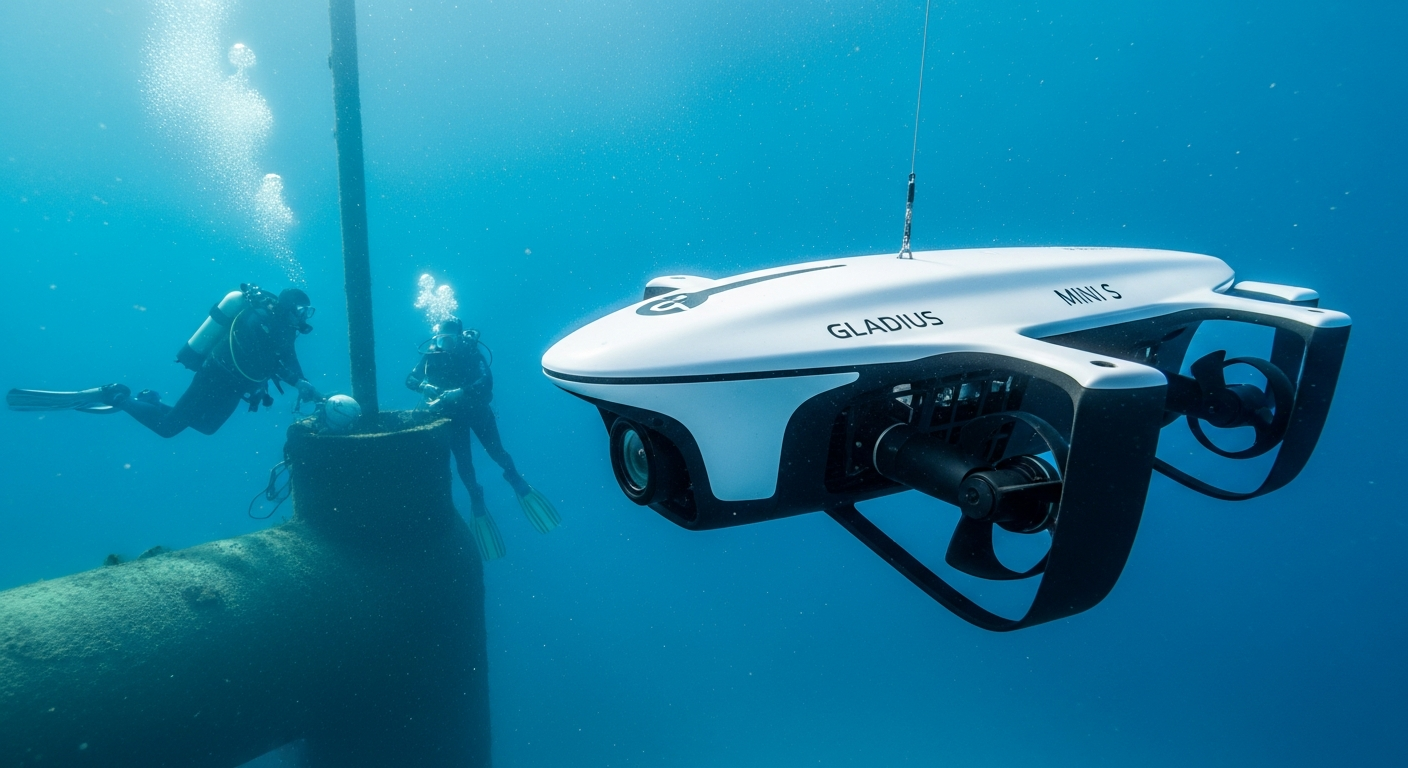
Discover how the CHASING GLADIUS MINI S underwater drone delivers professional-grade inspection capabilities at a fraction of traditional ROV costs. Explore its portable design, 4K imaging, and real-world industrial applications.
The traditional approach to underwater infrastructure inspection has always involved deploying massive, expensive remotely operated vehicles that cost anywhere from $50,000 to $500,000. These systems require specialized support vessels, trained crews, and extended mobilization periods that make even routine inspections prohibitively expensive for most organizations.
The gap between consumer underwater drones and industrial-grade ROVs has narrowed considerably in recent years. The CHASING GLADIUS MINI S was engineered specifically to bridge this divide, offering serious professionals and specialized contractors a tool that combines genuine portability with industrial-class performance capabilities. This shift represents a fundamental change in how inspection work gets accomplished across maritime, infrastructure, and environmental sectors.
Discover how the GLADIUS MINI S can transform your inspection workflow today.
Industrial-Grade Specifications for Professional Inspection Tasks
The GLADIUS MINI S delivers a comprehensive feature set designed specifically for professional documentation and regulatory compliance. Its 4K EIS camera system captures 12-megapixel still photography that satisfies stringent documentation requirements for everything from insurance claims to government regulatory filings. The electronic image stabilization ensures usable footage even in challenging conditions, eliminating the fuzzy, unusable video that plagues cheaper alternatives.
The 100-meter depth rating with extendable tether options (100m and 200m E-Reel configurations) covers the vast majority of commercial inspection scenarios. Whether examining bridge foundations, pipeline infrastructure, or offshore platform pilings, this depth capability removes the need for multiple specialized vehicles tailored to different depth ranges.
Battery endurance represents one of the GLADIUS MINI S’s most significant technical advantages. The 4-hour operational window enables comprehensive site surveys without mid-mission recharging interruptions. This extended runtime directly translates to faster project completion, fewer deployment cycles, and reduced overall costs compared to systems offering only 2-3 hours of operation.
The 45-degree tilt capability provides multiple viewing angles essential for thorough structural assessment. An inspector can examine an underwater foundation from multiple perspectives without repositioning the entire drone, capturing evidence of corrosion, damage, or structural anomalies that might be missed with fixed-angle systems. Precise thruster control maintains stable positioning against currents and water movement, critical when documenting specific areas requiring detailed scrutiny.
The 2.7 kg lightweight design fundamentally changes deployment logistics. Traditional ROVs require substantial support infrastructure just to transport and deploy equipment. This compact powerhouse fits inside a standard vehicle and can reach remote or difficult-to-access sites without elaborate staging areas. Durable construction withstands repeated exposure to challenging underwater environments and the mechanical stress of frequent deployment cycles.
Real-World Professional Applications Beyond Recreation
Maritime Hull Inspections
Shipping vessels, offshore platforms, and port infrastructure require regular assessments without expensive dry dock procedures. The GLADIUS MINI S enables rapid hull surveys identifying corrosion, biofouling, or impact damage that affects vessel performance and safety compliance.
Bridge and Culvert Assessment
Underwater structural integrity, erosion patterns, and foundation conditions demand detailed visual documentation. Traditional bridge inspection methods often miss subsurface problems detectable through direct underwater observation.
Pipeline and Subsea Cable Monitoring
Critical infrastructure spanning kilometers requires systematic damage detection, corrosion assessment, and environmental hazard identification. The drone’s portability enables regular monitoring intervals that traditional ROV systems make economically prohibitive.
Environmental Impact Surveys
Environmental agencies benefit from cost-effective documentation of marine ecosystems, pollution assessment, and habitat monitoring. The capability to conduct thorough surveys without massive equipment deployment enables more frequent environmental assessment.
Archaeological and Salvage Operations
High-resolution documentation of underwater sites with minimal environmental disturbance appeals to both academic researchers and commercial salvage operations. The stability and image quality support rigorous documentation standards.
Water Utility Inspections
Dam conditions, intake structures, and underwater pipeline systems require regular assessment. The GLADIUS MINI S enables municipalities and utility companies to conduct thorough inspections without contracting expensive external ROV services.
Insurance and Liability Documentation
Capturing detailed visual evidence for claims assessment and risk evaluation provides insurers and property owners with comprehensive documentation supporting settlement decisions or regulatory compliance.
Cost-Benefit Analysis: GLADIUS MINI S vs. Traditional ROV Systems
The financial case for the GLADIUS MINI S centers on total cost of ownership rather than hardware price alone. While the base package starts around $1,599, traditional entry-level professional ROVs cost $50,000 or more. The initial investment difference alone represents a 30-to-1 cost advantage before any operational expenses.
Beyond hardware, operational expenses tell a more dramatic story. Traditional ROV systems require expensive support vessels, specialized crews, and extended mobilization requirements. A single day of traditional ROV work might involve $10,000 to $30,000 in vessel and crew costs. The GLADIUS MINI S operates with one or two trained personnel and minimal logistical support.
Rapid deployment advantage reduces project timelines substantially. A traditional ROV mobilization might take days to schedule and stage equipment. The GLADIUS MINI S deploys within hours, enabling faster turnaround for time-sensitive inspections and reducing overall project costs. Maintenance and support expenses remain significantly lower than traditional systems with fewer moving parts and simpler logistics.
Scalability matters considerably for small to mid-sized operations. Independent contractors and smaller firms previously couldn’t afford to offer professional inspection services. The GLADIUS MINI S makes entry-level professional service delivery economically viable, enabling business model flexibility that justifies bidding on smaller projects previously considered economically unfeasible.
Hidden cost elimination removes requirements for specialized training certifications or expensive operator licensing in many jurisdictions. Accessibility for budget-conscious municipalities enables smaller communities to conduct necessary infrastructure assessments independently rather than contracting expensive external services.
Technical Performance Under Professional Conditions
Image stabilization reliability maintains footage quality in challenging currents and turbid water conditions common in industrial sites. Unstabilized video becomes nearly worthless for documentation purposes, and the EIS system ensures usable footage regardless of environmental conditions.
Tether management systems minimize snagging risks during extended deployments around complex underwater structures. The carefully engineered cable routing and drone design reduce entanglement potential compared to earlier-generation systems, though operator technique remains critical.
Control responsiveness delivers the precise maneuvering required for detailed inspection work and documentation photography. Sluggish controls create frustration and extend mission times unnecessarily. The GLADIUS MINI S responds intuitively to operator input, enabling rapid positioning and consistent documentation quality.
Low-light performance captures usable footage in murky water and shadowed areas beneath structures where many alternative systems fail. Professional inspection work often occurs in conditions far from ideal lighting, and the camera system handles these challenges effectively.
Data recording and transmission ensure consistent capture of inspection documentation for regulatory filing and client deliverables. Losing footage due to technical failures represents an unacceptable risk in professional contexts.
Accessory compatibility supporting grabber arms and additional sensors expands inspection capabilities. The ability to attach retrievable sample collection devices or supplementary recording equipment adds versatility for specialized applications.
Thermal stability maintains consistent performance across varying water temperatures and environmental conditions. Professional equipment must perform reliably whether operating in frigid northern waters, warm tropical environments, or anywhere between.
Practical Deployment Strategies for Inspection Professionals
Pre-deployment planning establishes inspection protocols, maps dive routes, and identifies critical documentation points. Taking time before launching the drone prevents missed opportunities and ensures comprehensive coverage of target areas.
Tether management techniques prevent entanglement in complex underwater environments with multiple obstacles. Experienced operators develop systematic approaches to cable management that reduce risk and maintain control throughout extended missions.
Battery optimization maximizes mission duration through strategic power management and operational pacing. Aggressive maneuvering and continuous maximum thrust consumption burn battery reserves quickly, while deliberate operational techniques extend runtime significantly.
Documentation workflows capture required visual evidence, GPS coordinates, and environmental data for comprehensive reporting. Systematic approaches to recording supplementary information alongside video footage create organized deliverables that clients can readily utilize.
Team coordination establishes communication protocols between drone operators, surface support, and site supervisors. Clear procedures prevent confusion and ensure everyone understands the inspection objectives and timeline.
Weather and water condition assessment determines optimal deployment windows for consistent image quality and safety. High turbidity, strong currents, or poor visibility can render inspection efforts fruitless, making advanced planning essential.
Post-mission data handling efficiently organizes, backs up, and processes inspection footage for client delivery. Establishing standardized protocols prevents data loss and ensures timely project completion.
Investment Justification for Inspection Contractors and Specialists
Competitive advantage emerges from offering rapid, cost-effective inspection services that traditional ROV operators cannot match. Contractors positioning themselves as modern, efficient alternatives capture market share from established competitors still operating legacy equipment.
Profit margin improvement flows directly from reduced operational overhead and faster project completion timelines. Lower per-project costs enable competitive pricing while maintaining healthy margins that support business growth.
Business model flexibility enables contractors to bid on smaller projects previously considered economically unfeasible. Expanding the addressable market opens new revenue streams without massive additional investment.
Client satisfaction metrics improve dramatically with high-quality documentation delivered rapidly. Faster turnaround than traditional methods and superior image quality build reputation and encourage repeat business.
Scalability potential exists for building inspection service offerings without massive capital investment or specialized infrastructure. Multiple drone units can be deployed by different teams simultaneously, creating capacity growth without proportional cost increases.
Market differentiation positions services as modern, efficient, and environmentally conscious compared to larger ROV operations. Sustainability appeals to clients increasingly focused on environmental responsibility.
Long-term asset value maintains equipment reliability and resale value for eventual business transitions or upgrades. The robust construction and proven technology platform support reliable secondary market valuations.
The Professional Inspection Advantage
The CHASING GLADIUS MINI S fundamentally changes the economics of underwater inspection work. This technology isn’t designed to replace enterprise ROV systems for deep-sea research or extreme-depth operations—it’s engineered specifically to democratize professional-grade inspection capabilities for the vast majority of projects that don’t justify six-figure equipment investments.
Real value emerges when considering total cost of ownership, deployment speed, and the ability to serve clients who previously couldn’t justify expensive traditional ROV mobilization. The combination of superior portability, extended battery endurance, high-quality imaging, and accessible price point creates a compelling value proposition for inspection specialists across maritime, infrastructure, and environmental sectors.
Contractors and service providers ready to modernize operations and expand service offerings will find this compact system delivers measurable competitive advantages. Improved efficiency, faster project completion, and expanded market reach translate directly into measurable financial returns.
Invest in professional underwater inspection capabilities with the GLADIUS MINI S today.