
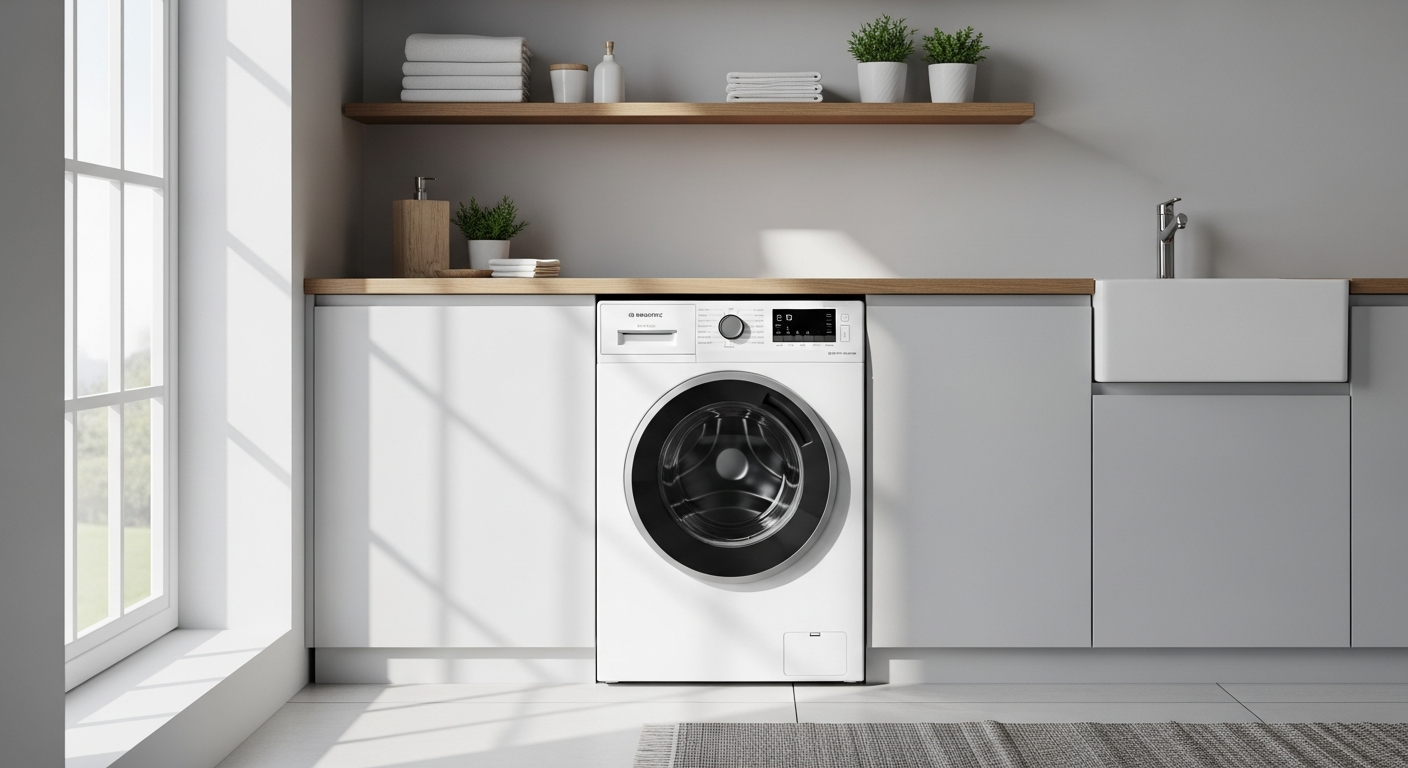
Discover why the Hanseatic HWMA814B Waschmaschine 8kg is Austria’s go-to washing machine for families. Compare features, pricing, warranty coverage, and energy efficiency to make an informed purchase decision.
An 8 kg washing machine capacity sits comfortably in the sweet spot for medium-to-large families. Rather than constantly running multiple cycles throughout the week, you can consolidate laundry into fewer, more efficient loads. This matters more than many shoppers realize when they’re standing in front of washing machines at the store.
Why 8 kg capacity suits medium-to-large families better than smaller alternatives
A typical family of four generates roughly 8–10 loads of laundry weekly. With a 6 kg capacity, you’re splitting that into more cycles, which means more water consumption, more electricity usage, and frankly, more of your time spent managing the washing routine. The 8 kg option eliminates this friction. You’ll notice the difference immediately—fewer trips to the laundry room, more flexibility in when you choose to wash, and genuinely less hassle managing household textiles.
Real-world load examples: how many towels, sheets, and clothing items fit per cycle
One 8 kg cycle accommodates roughly 40–50 clothing items (shirts, pants, underwear), or a full set of bed linens plus multiple towels, or a combination of both. A standard bath towel weighs around 600–800 grams; a fitted sheet roughly 400–500 grams. This means you can wash your entire weekly supply of towels in a single cycle without cramming or overloading. For families with children or active lifestyles, this capacity handles the realistic volume of garments that accumulate between laundry days.
Comparison of capacity against standard 6 kg and 10 kg models
The 6 kg machine forces compromises on bulkier items and creates scheduling constraints. A 10 kg machine, while larger, often commands a premium price and demands more floor space—trade-offs that don’t necessarily benefit average households. The 8 kg capacity strikes the balance: it’s genuinely larger than 6 kg but more practical and affordable than jumping to 10 kg.
Flexibility for mixed loads and bulky items (duvets, winter coats)
Winter bedding poses a particular challenge for undersized machines. A queen-sized duvet typically weighs 2–3 kg when dry. The 8 kg capacity allows you to wash a duvet alongside other items—perhaps some winter jackets and regular clothing—in a single cycle. Smaller machines force you to choose: wash the duvet alone and waste capacity, or find an alternative laundry solution.
How capacity affects washing frequency and overall time savings
Over a year, capacity differences translate into substantial time savings. A household using a 6 kg machine might run 15–20 additional cycles annually compared to an 8 kg model. Each cycle requires loading, unloading, and monitoring. The cumulative time savings from fewer cycles genuinely adds up to hours reclaimed throughout the year.
Efficiency gains when you’re not running multiple cycles per week
Running fewer cycles means lower weekly water consumption, reduced detergent usage, and less wear on the machine itself. From an economic standpoint, you’re also spreading the cost of each cycle (electricity, water, detergent) across more garments, improving your per-garment washing cost.
Spin Speed Performance: The 1400 U/min Advantage
The 1400 revolutions per minute spin speed on the Hanseatic HWMA814B operates at the higher end of standard washing machine performance. This specification matters considerably more than many buyers recognize when they’re evaluating machines.
Understanding what 1400 revolutions per minute actually means for drying time
During the spin cycle, the drum rotates 1400 times per minute, flinging water outward through the drum’s perforations. The faster this rotation, the more water centrifugal force removes from fabrics. At 1400 U/min, your clothes exit the washing machine noticeably drier than they would from a 1000 U/min machine. This translates into measurably shorter air-drying time or reduced machine-drying duration if you use a separate dryer.
Energy savings from reduced moisture retention in fabrics
Fewer water molecules trapped in fabric fibers means less energy required to evaporate moisture. If you air-dry your clothes, this reduction is practically free—you simply notice faster drying times. If you use an electric dryer, the difference becomes financial. A garment exiting the spin cycle with 20% less moisture requires meaningfully less drying time, reducing your electricity consumption per load.
Impact on electricity costs for machine drying or air-drying duration
Consider a typical household using a separate dryer for 5 loads weekly. A 10–15 minute reduction in drying time per load translates to roughly 4–6 hours fewer dryer operation monthly. Over a year, that’s 50–75 hours of electricity saved. For an electric dryer consuming approximately 3–5 kWh per hour, you’re looking at genuine annual savings—money that accumulates across a machine’s 10+ year lifespan.
Comparison with lower spin speeds (1000–1200 U/min) and higher speeds (1600+ U/min)
A 1200 U/min machine leaves slightly more moisture in fabrics compared to 1400 U/min. The practical difference is measurable but not dramatic—perhaps 5–10 minutes of additional drying time per load. Higher-end machines at 1600 U/min do spin faster, but the incremental improvement becomes smaller. The Hanseatic’s 1400 U/min represents the practical optimum where you gain meaningful performance without paying premium prices for diminishing returns.
Fabric care considerations: how spin speed affects garment longevity
Counterintuitively, higher spin speeds don’t damage fabrics when machines are properly engineered. Modern drums are designed to distribute fabrics evenly and protect them during acceleration and deceleration. The Hanseatic machine’s 1400 U/min operates safely for virtually all household fabrics, including delicates when you select appropriate cycle settings.
Noise levels during the spin cycle and household comfort
Faster spin speeds inevitably generate more sound. The Hanseatic’s 1400 U/min produces audible noise during the spin cycle—a fact worth acknowledging if your laundry room is directly adjacent to living spaces. The noise level remains within normal ranges for modern washing machines and doesn’t indicate mechanical problems or excessive vibration.
The 3-Year Manufacturer’s Warranty: Peace of Mind That Matters
Warranty coverage represents an often-overlooked component of true ownership cost. The Hanseatic HWMA814B includes a 3-year manufacturer’s warranty—substantially more generous than the 1–2 year standard coverage many budget machines offer.
What’s typically covered under Hanseatic’s extended warranty
Manufacturing defects in components fall under standard warranty protection: motor failures, drum issues, electronic control problems, and structural defects. The 3-year window covers these issues throughout the early years of ownership when manufacturing defects are most likely to surface. Normal wear and tear, user damage, and issues resulting from improper maintenance fall outside coverage.
How a 3-year warranty reduces financial risk compared to standard 1–2 year coverage
A washing machine experiencing a catastrophic failure in year two carries very different financial consequences depending on warranty status. With a 1-year warranty, you’re entirely responsible for repair costs—potentially €200–€400 for common repairs. A 3-year warranty extends your protection window, absorbing repair costs during the period when failure risk remains elevated.
Common repair costs for washing machines and how warranty protection saves money
Motor replacement runs €150–€300. Drum bearing repairs typically cost €200–€400. Electronic control board failures average €100–€250. Pump replacements fall in the €80–€150 range. Over a 3-year period, the probability of encountering at least one of these repairs justifies the warranty investment. A single covered repair essentially pays for any extended warranty cost you might have incurred.
Registration and claim process through Universal Versand AT
Universal Versand AT streamlines warranty administration through their customer service department. Registration typically occurs at purchase, and claims are processed through the retailer’s established procedures. The process is straightforward and avoids complications that can arise when warranty claims go through manufacturer-only channels.
Comparison with competitor warranty offerings in the Austrian market
Premium brands like Bosch and Siemens frequently offer 2-year or extended plans that cost additional money. Budget alternatives often include only 1-year factory warranties. The Hanseatic’s standard 3-year coverage positions it advantageously without requiring additional warranty plan purchases.
Long-term value proposition: warranty as part of total cost of ownership
When calculating true ownership cost, the warranty component deserves consideration equal to purchase price and operating expenses. A €290 machine with a 3-year warranty often represents better long-term value than a marginally cheaper model with minimal coverage.
Explore the Hanseatic HWMA814B with full warranty details at Universal Versand AT today.
Energy Efficiency Class B: Balancing Performance and Sustainability
The Energy Efficiency Class B designation carries significant practical meaning, though it often generates confusion among consumers comparing washing machines.
What Energy Efficiency Class B means in practical terms
Energy classification compares machines against standardized testing protocols. Class B machines consume more energy than Class A or A+ alternatives but operate more efficiently than Class C, D, or lower categories. For a washing machine, Class B represents solid, mainstream performance—neither premium efficiency nor poor consumption.
Annual electricity consumption estimates and typical running costs
The Hanseatic HWMA814B typically consumes approximately 190–210 kWh annually for 280 cycles per year (roughly 5–6 loads weekly). At Austrian electricity rates averaging €0.20–€0.25 per kWh, this translates to roughly €40–€50 yearly in washing machine electricity costs. Over a 10-year lifespan, you’re examining €400–€500 in cumulative energy expenses.
Comparison between Class B, Class A, and Class A+ models
A Class A machine might consume 15–20% less electricity per cycle—reducing annual costs to €35–€40. A Class A+ model could approach €30–€35 annually. These differences are meaningful across a decade but modest in year-to-year budgeting. The price premium for Class A or A+ machines often ranges €100–€200, which takes considerable time to recoup through energy savings alone.
Environmental impact: carbon footprint over a 10-year appliance lifespan
Manufacturing and transporting a washing machine generates environmental cost through carbon emissions. A Class B machine over 10 years produces a smaller total environmental footprint than repeatedly replacing cheap machines that fail after 3–5 years. The sustainability calculation encompasses the entire product lifecycle, not merely operational energy consumption.
Myth-busting: why Class B doesn’t mean poor efficiency
Class B represents mainstream efficiency. It’s not a compromise quality—it’s a practical choice where performance and cost align reasonably. The difference between Class B and Class A is genuinely modest in daily use and annual costs.
Potential savings from choosing B over lower classes (C, D)
Compared to Class C or D machines, Class B delivers measurable savings. A Class C machine might consume 20–30% more energy annually, adding €10–€15 to yearly costs. Over a decade, that’s €100–€150—which actually exceeds the price difference between Class B and Class C models in many comparisons.
Trade-offs between premium energy efficiency and upfront purchase price
The fundamental trade-off is straightforward: premium energy classes command higher purchase prices. Whether that premium is worth it depends on your usage patterns, electricity costs in your region, and how long you intend to keep the machine. For most Austrian households, Class B represents the optimal balance point.
Price Strategy: From €499 RRP to €289.99 Deals
The Hanseatic HWMA814B’s pricing narrative reveals how smart shopping and understanding retailer dynamics translate into genuine savings.
Understanding the recommended retail price (UVP) versus actual market pricing
The €499 recommended retail price establishes a reference point—essentially the manufacturer’s suggested price. Actual retail pricing typically operates significantly below this threshold. Universal Versand AT frequently discounts this model, sometimes cutting the price by 40% or more. This gap between UVP and actual market price reflects several factors: retailer competition, supplier volume discounts, and strategic pricing to drive sales volume.
Why Universal Versand AT frequently discounts this model
The Hanseatic HWMA814B appears regularly in weekly promotions because it represents a product with strong customer interest and high sales velocity. When items sell quickly, retailers maintain healthy profit margins even at discounted prices. High-volume sales justify marketing investment and promotional pricing strategies that might not work for slower-moving inventory.
Seasonal timing for best deals and promotional patterns
Late winter (February–March) often brings promotional pricing as retailers prepare for spring. Late summer (August–September) similarly features deals before fall. January clearance events and pre-holiday sales (October–November) occasionally offer compelling discounts. Monitoring Universal Versand AT’s “Deals der Woche” section consistently reveals when this model appears at its most attractive pricing.
Price comparison with direct competitors in the 8 kg washing machine category
Similar 8 kg front-loaders from other brands at comparable performance levels typically range €350–€500 at retail. The Hanseatic frequently undercuts these alternatives by €50–€100 or more during promotional periods. Bosch or Siemens equivalents often cost 50–100% more while delivering incremental rather than revolutionary feature improvements.
Hidden costs to factor in: delivery, installation, and extended protection plans
Universal Versand AT typically offers favorable delivery costs—often included for appliance purchases above certain thresholds. Installation charges vary but usually range €50–€100. Extended protection plans beyond the standard 3-year warranty are optional and should be evaluated individually. The machine’s base pricing remains competitive even before factoring in these supplementary services.
ROI calculation: how lower purchase price affects long-term value
A €290 purchase price versus a €500 alternative leaves €210 for other priorities. If that €210 funds a water softener (relevant in hard-water Austrian regions), detergent savings, or operational improvements, the financial advantage extends beyond simple price comparison. The lower entry cost also reduces the financial barrier to upgrading worn machines, improving overall household appliance quality.
Payment flexibility options available through Universal Versand AT
Universal Versand AT provides installment payment plans that make the Hanseatic HWMA814B accessible without requiring large lump-sum outlays. Spreading €290 across several months reduces any single payment burden, which matters for household budgeting.
Real-World Performance: What Owners Actually Experience
Specifications and features matter far less than what actually happens when the machine sits in your laundry room handling weekly loads.
Customer feedback patterns from Universal Versand AT reviews
Customers consistently report satisfaction with wash quality, reliable operation, and value for money. The machine handles typical household soiling effectively—everyday dirt, food stains, and general laundry accumulated through normal family life. Feedback indicates relatively few reliability issues during early ownership, which aligns with the manufacturer’s confidence in providing a 3-year warranty.
Wash quality across different fabric types and soil levels
The Hanseatic delivers solid wash performance across cotton, synthetics, and mixed fabrics. Stain removal performs adequately for typical household conditions—food stains, grass, mud—rather than exceptional. Delicate fabrics benefit from dedicated cycles. Performance doesn’t match premium brands’ specialized algorithms, but it handles standard laundry reliably.
Noise and vibration during operation compared to premium brands
The machine operates at sound levels typical for its class—noticeably louder during spin cycles than during wash phases. Vibration during spin is present but not excessive. Placement on proper flooring (not directly on wood) and ensuring the unit is level minimizes these characteristics. Premium brands don’t necessarily operate quieter; they’ve engineered for reduced noise but at substantially higher cost.
Durability expectations: typical lifespan and reliability reports
Hanseatic machines demonstrate typical durability for the mid-range category—generally 8–12 years of reliable operation with standard maintenance. Early-year failure rates are low, which explains the manufacturer’s 3-year warranty confidence. Longevity depends significantly on water quality, maintenance practices, and usage patterns.
Common user scenarios: families with children, sports equipment, pet owners
Families with children appreciate the capacity for handling frequent loads of athletic equipment, school clothes, and general wear. Pet owners successfully wash pet bedding regularly. The machine accommodates realistic household demands without strain.
Maintenance requirements and ease of cleaning
Regular descaling in hard-water regions preserves performance—using citric acid or commercial descaling products annually. The rubber gasket occasionally requires cleaning to prevent mold development, a standard maintenance task for all front-loaders. The filter traps lint and requires periodic clearing. These maintenance tasks remain straightforward without requiring special tools.
Troubleshooting common issues and customer support accessibility
Most early issues—drainage problems, unusual noises—typically resolve through simple troubleshooting: checking hoses, cleaning filters, and running cleaning cycles. Universal Versand AT’s customer service provides access to support resources. Hanseatic has established service networks throughout Austria for situations requiring professional intervention.
Hanseatic Brand Positioning: Reliability Without the Premium Price Tag
Understanding Hanseatic’s market position clarifies why this particular machine represents good value.
Brand history and manufacturing standards in the appliance industry
Hanseatic operates as an established appliance manufacturer with decades of market presence. The brand maintains manufacturing standards consistent with European regulations and quality certifications. While not a premium luxury brand commanding recognition among appliance enthusiasts, Hanseatic is a legitimate manufacturer rather than a private-label rebrand with unclear origins.
Market positioning between budget and luxury washing machine brands
Hanseatic occupies the practical middle ground—above bargain-basement brands relying on aggressive cost-cutting but below premium manufacturers charging for marketing reputation and advanced features. This positioning appeals to value-conscious households prioritizing functionality over status.
Quality control and testing procedures
Hanseatic machines undergo standard quality testing and reliability assessments. Manufacturing processes meet EU standards for electrical safety and mechanical reliability. Quality control doesn’t reach the documentation intensity of premium brands but covers essential bases adequately.
Reputation within the Austrian and European markets
Hanseatic maintains solid reputation in Austrian markets particularly through retailer relationships like Universal Versand AT. The brand isn’t controversial or problematic—it’s simply not fashionable among appliance enthusiasts comparing luxury specifications.
Why brand perception shouldn’t overshadow actual performance metrics
A Bosch washing machine performing identically to a Hanseatic machine at triple the price sells partly because the Bosch badge carries prestige value. Performance and reliability metrics matter far more than brand prestige for household appliances. The Hanseatic HWMA814B delivers practical, reliable laundry capability regardless of whether people recognize the brand name.
Comparison with Bosch, Siemens, AEG, and other established manufacturers
Bosch and Siemens machines are genuinely excellent but cost €600–€900 for equivalent capacity and performance. AEG positioning similarly targets premium markets. Hanseatic delivers 85–90% of that performance at 50–60% of the price—a compelling ratio for pragmatic household decision-making.
Customer loyalty and repeat purchase rates
Customers who purchase Hanseatic machines frequently repurchase the brand when replacement becomes necessary, suggesting acceptable satisfaction levels. This repeat purchase pattern indicates the brand neither disappoints nor inspires particular enthusiasm—it simply delivers expected performance.
The Practical Advantage: Front-Loading Design Benefits
The Hanseatic HWMA814B’s front-loading design provides multiple practical advantages worth understanding.
Water and detergent efficiency of front-load versus top-load designs
Front-loaders tumble clothes through a small water volume rather than submerging them completely like top-loaders. This approach uses roughly 40–50% less water per cycle. Detergent requirements similarly decrease since the concentrated solution works more efficiently. A household running 5–6 loads weekly saves substantial water and detergent costs annually through front-loading design alone.
Gentler on fabrics: why front-loaders extend garment lifespan
Tumbling action is inherently gentler than agitator-based washing. Colors fade more slowly, elastic fibers maintain integrity longer, and delicate items experience less stress. Over years of laundry, clothes simply last longer when washed in front-loaders. The financial benefit of extended garment lifespan often exceeds the purchase price difference between front-load and top-load machines.
Space-saving benefits for smaller kitchens and laundry rooms
Front-loaders occupy less floor space than top-loaders while providing equivalent or greater capacity. For Austrian homes where laundry rooms are often compact, front-loading eliminates the spatial constraints of top-opening designs. The machine can be positioned against walls more flexibly.
Stacking and integration options with dryers
Front-loaders pair conveniently with stackable dryers, useful for homes lacking extensive laundry space. A washing machine and dryer combination occupies roughly the same floor space as a single large appliance, doubling functionality within physical constraints.
Accessibility features for users with mobility considerations
Front-loading height positions the drum at waist level for many users, reducing bending and improving accessibility compared to top-loaders. Elderly users or those with mobility limitations often find front-loaders more comfortable to operate.
Temperature control and specialized wash programs
Modern front-loaders offer varied temperature options from cold to hot, enabling energy optimization. The Hanseatic includes specialized programs for different fabric types, spin intensity levels, and load characteristics. Temperature control alone enables significant energy savings by using lower temperatures for lightly soiled loads.
Compatibility with high-efficiency (HE) detergents
Front-loaders function optimally with high-efficiency detergents specifically formulated for low-water-volume washing. HE detergents cost less per use while performing effectively, reducing detergent expenses across the machine’s lifespan.
Making the Purchase Decision: Is This Machine Right for You?
Determining whether the Hanseatic HWMA814B suits your household requires honest assessment of several factors.
Household size and laundry volume assessment
Single occupants or couples with modest laundry volumes might find 8 kg excessive capacity. Households of three or more people, families with children, or anyone generating regular bulk loads (bedding, towels, athletic equipment) will appreciate the full capacity. Assess your typical weekly laundry volume truthfully rather than imagined future scenarios.
Budget constraints and financing options
At €290–€350 discounted pricing, the machine remains accessible to households with modest appliance budgets. Universal Versand AT’s installment options make it even more accessible. If your budget accommodates premium brands, you’re essentially choosing comfort and brand prestige over practical functionality.
Lifestyle factors: sports, children, allergies, pet care
Active families with sports equipment, children with frequent clothing changes, households with pet laundry, or members with allergies requiring frequent washing benefit from larger capacity and spin efficiency. The 8 kg capacity and 1400 U/min spin speed address these lifestyle demands effectively.
Space and installation requirements in your home
Verify your laundry space accommodates standard front-loader dimensions. Standard machines measure roughly 85 cm tall, 60 cm wide, and 55–60 cm deep. Ensure adequate clearance for the door to open fully. Confirm water supply connections are accessible and that drainage options (floor drain, standpipe, utility sink) exist near the installation location.
Long-term ownership plans and relocation considerations
If you plan to relocate within 5 years, the lower purchase price reduces financial disruption. Conversely, if you’re establishing long-term residence, a reliable 10+ year investment justifies premium pricing more effectively. Honestly assess your relocation timeline.
Warranty and after-sales service expectations
The 3-year warranty provides genuine protection. Verify that local Universal Versand AT service networks can address repairs if needed. In rural areas, service accessibility sometimes justifies purchasing from local dealers despite higher prices.
Questions to ask before finalizing your order
Are current promotions offering the lowest available pricing? Does your water hardness require descaling considerations (relevant in many Austrian regions)? Can installation be completed before your current machine fails? Are your electrical outlets adequately grounded? Does your home’s water pressure fall within the machine’s specifications? Have you verified return policies if performance proves unsatisfactory?
Your Laundry Investment Starts Here
The Hanseatic HWMA814B Waschmaschine 8kg represents a rare intersection of affordability and substance. You’re not sacrificing essential features for a lower price—you’re simply choosing a brand that prioritizes practicality over marketing hype. The 3-year warranty, 1400 U/min spin speed, and Class B energy efficiency create a package that delivers genuine value for Austrian families managing real laundry challenges week after week. When you factor in the frequent discounts at Universal Versand AT—sometimes cutting the price nearly in half—this washing machine becomes a genuinely smart financial decision. The money you save at purchase can go toward other household priorities, while the extended warranty ensures you’re protected against unexpected repair costs. Ready to upgrade your laundry routine?