
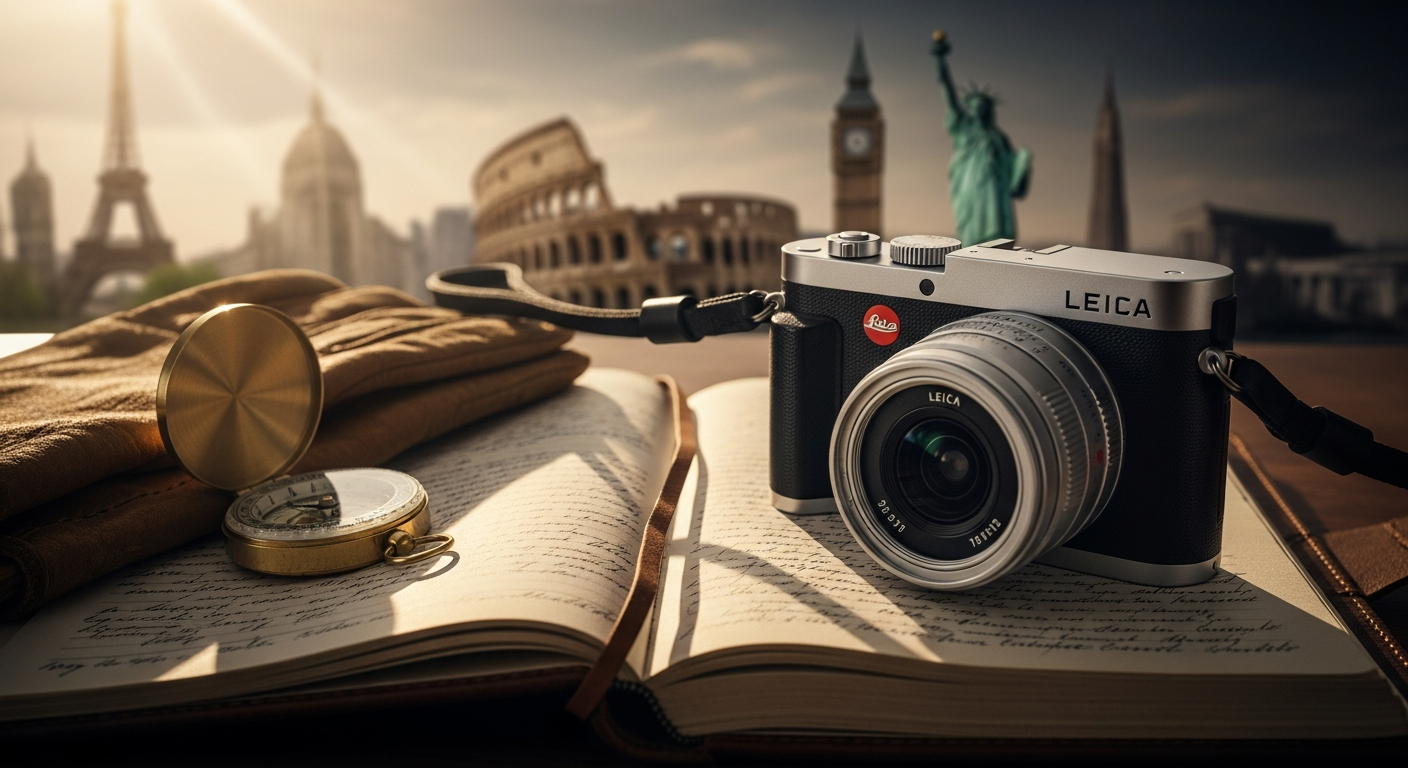
Discover why the Leica Q3 full-frame compact camera is revolutionizing travel photography. Explore its 60MP sensor, fixed 28mm lens, 8K video, and premium build in our comprehensive guide for on-the-go photographers.
Article
Imagine standing before a landscape that steals your breath away. The light is perfect. The clouds are dramatic. Yet your shoulders ache from carrying a camera bag that feels heavier than your actual camera. Over 70% of professional travel photographers cite gear weight and complexity as their biggest creative bottlenecks—the very thing preventing them from capturing what they see. You're caught between two impossible choices: carry multiple lenses and sacrifice mobility, or settle for less camera than you know you're capable of.
The Leica Q3 challenges this false dilemma entirely. This full-frame compact camera merges professional-grade sensor technology with a permanently mounted Summilux 28mm lens, eliminating the need for multiple lenses and the constant mental burden of gear management. The Q3 represents a philosophical shift: what if the best travel camera isn't the one with the most lenses, but the one engineered with absolute precision to do one thing perfectly?
Discover how the Leica Q3 can transform your travel photography workflow.
I'm breaking down the specifications, real-world performance, and honest limitations of this camera that has become the go-to choice for travel enthusiasts and documentary photographers. You'll understand exactly how its 60.3-megapixel sensor performs in demanding conditions, why the fixed lens is actually a liberating feature rather than a constraint, and whether this $6,000+ investment genuinely delivers the creative freedom it promises.
Why Fixed-Lens Design Liberates Rather Than Limits Travel Photography
The fixed 28mm focal length covers approximately 95% of authentic travel photography scenarios. Landscapes, street scenes, portraits, architecture, candid moments—this single perspective handles them all without compromise. The psychological benefit deserves emphasis: you're no longer paralyzed by the question "which lens should I bring?" Instead, you're present with your subject, making compositional decisions rather than gear decisions.
The Optical Advantage of Commitment
Fixed-lens design allows Leica's optical engineers to perfect a single piece of glass rather than engineer multiple compromises across a zoom range. The Summilux 28mm f/1.7 ASPH lens benefits from this singular focus. The result: exceptional sharpness at wide apertures, remarkable corner-to-corner clarity, and a beautiful bokeh rendering that makes subjects separate from their backgrounds with natural elegance.
Weight as Freedom
The Leica Q3 weighs 738 grams (26 ounces) complete. A full-frame mirrorless body paired with just two versatile lenses typically weighs twice this amount. After hiking 10 kilometers to catch golden hour light, that weight difference transforms from numerical specification into physical reality. Your body remains fresh. Your mind stays creative rather than fatigued.
Focal Length Flexibility Without Glass
The 60.3-megapixel sensor enables shooting at three resolution modes: full 60MP, 36MP, and 18MP. This means you can digitally crop during post-processing without meaningful quality loss. Need a tighter portrait? The 36MP crop delivers equivalent framing to a 42mm lens. Seeking a wider vista? The 18MP mode provides cropping flexibility while maintaining sufficient resolution for professional prints and digital display. This transforms the "limitation" of a fixed lens into sophisticated flexibility.
Macro Capability for Unexpected Detail
The macro mode minimum focus distance of 0.17 meters (6.7 inches) means you can capture intricate details—weathered textures, flower petals, local craft details—without carrying macro lenses or extension tubes. Travel photography thrives on capturing unexpected moments, and this capability ensures you're never locked out of a shot.
Creative Discipline and Intentional Composition
Working with a single focal length forces intentional composition. You move your feet rather than adjusting your lens. You consider angles and perspective with greater deliberation. This constraint actually sharpens your photographic thinking, reducing decision fatigue and encouraging creativity born from limitation rather than unlimited choice.
Sensor Performance and Image Quality for Demanding Travel Conditions
The 60.3-megapixel full-frame BSI CMOS sensor represents the technical heart of the Q3's promise. This isn't merely high resolution—it's a sophisticated image capture system engineered for the demanding environments and challenging lighting conditions that travel presents.
Real-World Resolution and Detail Capture
60 megapixels translates to files that capture extraordinary detail. Architectural textures, fabric patterns in street photography, and landscape foreground elements render with a clarity that makes viewers lean closer to your images. This granular detail becomes especially valuable when printing large or cropping during post-processing. The sensor's 24 x 36mm dimensions ensure that pixel density serves actual photographic improvement rather than mere specification sheet advantage.
Dynamic Range in High-Contrast Scenarios
Travel photography confronts brutal lighting contrasts: bright sun with deep shadows cast by architecture, high-altitude overexposure with foreground detail, backlit subjects against bright skies. The Q3's sensor preserves highlight detail through overexposure recovery and recovers shadow information that other cameras crush into darkness. This means your files remain flexible during editing, whether you're processing backlit portraits or dramatic landscape vistas.
ISO Performance from 50 to 100,000
The native ISO range begins at ISO 50, providing additional latitude for bright conditions without neutral density filters. Moving through the midrange, the sensor maintains clean, detailed images from ISO 400 through 3,200—the range where travel photographers live. Even at ISO 6,400 and beyond, noise remains controlled and organic rather than aggressive and plastic-looking. At ISO 100,000, the camera preserves usable images in genuinely low-light scenarios where other cameras would struggle.
Color Science and Raw File Quality
Leica's Maestro engine processes sensor data through color science refined across decades of photographic tradition. Raw files exhibit neutral white balance, excellent color separation, and a subtle rendering that requires less aggressive post-processing manipulation. This means faster editing workflows during travel and consistent results across varying lighting conditions and geographic regions.
Three Resolution Modes: Strategic Flexibility
Shooting everything at 60MP maximizes quality but generates file sizes of approximately 75MB per image. Switching to 36MP reduces files to roughly 45MB while maintaining more than sufficient resolution for professional printing. The 18MP mode creates approximately 20MB files, ideal for extended travel when storage and bandwidth constraints become practical considerations.
Explore the complete technical specifications and image quality benchmarks of the Leica Q3.
Practical Storage and Workflow Implications
A single day of travel photography—eight hours, approximately 800 images at 60MP—generates roughly 60 gigabytes of data. Extended trips demand substantial storage solutions: multiple fast SD cards, portable SSDs, and backup systems. This is a genuine workflow consideration rather than academic specification. Seasoned travel photographers plan their post-processing strategy around this reality, often leveraging the 36MP and 18MP modes as practical compromises between quality and storage efficiency.
Optical Image Stabilization and Autofocus for On-the-Go Shooting
Travel rarely provides tripod-friendly stability. You're shooting handheld during golden hour when light becomes magical but shutter speeds drop perilously slow. You're capturing interior scenes in temples and museums where artificial light lacks intensity. The Q3's stabilization and autofocus systems address these real-world challenges.
Optical Image Stabilization in Practice
The lens-based image stabilization system compensates for camera movement, effectively adding approximately 2-3 stops of shutter speed stability. This means shooting at 1/8th second handheld at focal length where traditional wisdom suggests 1/30th minimum. At f/1.7 aperture in tungsten-lit interiors, this difference becomes transformational. You're capturing detail and maintaining exposure rather than settling for underexposed, high-ISO compromises.
Hybrid Autofocus: Phase Detection and Contrast
The system combines phase-detection autofocus (PDAF) with contrast-based autofocus and DFD (Depth From Defocus) technology. This hybrid approach delivers faster focus acquisition than contrast-alone systems while maintaining the precision that phase-detection offers. The result: reliable focus in varied lighting conditions and across focus distances from macro to infinity.
Low-Light Autofocus for Evening Street Photography
Evening light is magic but technically challenging. The Q3's autofocus system maintains reliable focus down to exceptionally dim conditions where many cameras begin hunting. This enables evening street photography, architectural details illuminated by artificial light, and cultural documentation in naturally lit interiors—precisely the scenarios where travel photography reveals authentic atmosphere.
Shutter Options for Creative and Practical Control
The mechanical shutter (120 to 1/2000 seconds) provides traditional photographic control without electronic noise. For wildlife and street photography, this mechanical option delivers the tactile, immediate feedback that experienced photographers prefer. The electronic shutter extends to 1/16,000 seconds, enabling f/1.7 aperture shooting in bright sunlight without neutral density filters—a practical advantage for daylight travel photography when shallow depth-of-field becomes compositionally essential.
Continuous Autofocus for Movement
Travel scenarios involve moving subjects: street activity, wildlife encounters, cultural ceremonies. The Q3's continuous autofocus tracks movement across the frame, maintaining focus on subjects moving toward or away from the camera. This enables fluid shooting of dynamic scenes without the focus-hunt interruptions that disrupt workflow and cause missed moments.
Viewfinder and Screen: Seeing Your Shot Before You Take It
The optical and mechanical quality of a camera matters absolutely, but how you compose determines whether you capture the image you envisioned. The Q3 provides two sophisticated windows into your subject.
OLED Electronic Viewfinder: Real-Time Feedback
The 5.76-megapixel OLED electronic viewfinder displays your scene in real-time with exposure preview, autofocus confirmation, and compositional overlays. The 0.76x magnification provides a natural, immersive viewing experience without extreme magnification that disconnects you from peripheral awareness. Electronic viewfinders offer advantages mechanical viewfinders can't match: precise exposure preview showing exactly how your image will render, autofocus point visualization, and digital level indicators for horizons and compositions.
Tilting Touchscreen: Creative Angles and Accessibility
The 3-inch, 1.84-megapixel tilting LCD screen articulates upward and downward, enabling compositions impossible with fixed-screen cameras. Self-portraits, low-angle shots capturing upward perspectives, overhead compositions revealing patterns—the tilting screen removes technical constraints that traditional fixed-screen cameras impose. The touchscreen responsiveness enables intuitive menu navigation and quick image review during shooting, maintaining workflow momentum without interruption.
Hybrid Viewing Options for Flexibility
Some photographers prefer the traditional rangefinder experience of composing through the optical path. The hybrid viewing system accommodates both electronic and optical approaches, allowing you to choose based on shooting conditions and personal preference. Bright sunlight? The electronic viewfinder maintains clarity and exposure information. Mechanical preference? The rangefinder experience remains available.
Screen Durability in Travel Conditions
The screen glass withstands the rigors of travel without degradation in viewing angles or color accuracy. This matters when reviewing images in harsh sunlight, examining focus precision after critical shots, and ensuring your composition succeeded before moving to the next subject. A compromised screen becomes frustrating during extended travel when immediate feedback determines whether you reshoot a scene or move forward.
8K Video and Cinematic Capabilities for Travel Filmmakers
Contemporary travel photography increasingly incorporates video. The Q3 bridges still and motion capture, enabling multimedia storytelling that transcends traditional photography.
8K Video Recording: Cinematic Resolution
8K 30p recording captures video at 7680 x 4320 resolution, preserving astonishing detail. This resolution enables substantial cropping during post-production without quality degradation, provides flexibility for future display standards, and delivers visuals of cinematic quality. The practical limitation: 8K file sizes approach 1.5GB per minute, demanding robust storage solutions and workflow planning.
4K 60p for Smooth, Professional-Grade Motion
4K 60p delivers the sweet spot for travel videography: manageable file sizes (approximately 500MB per minute), frame rates sufficient for smooth slow-motion (24p or 30p delivery from 60p capture), and resolution matching professional broadcast standards. This mode handles dynamic scenes—bustling markets, flowing rivers, cultural ceremonies—with fluid motion and detail preservation.
Full HD 120p for Dramatic Slow-Motion
Full HD 120 frames per second provides 5x slow-motion when delivered at 24p, enabling dramatic cinematic effects. A dramatic moment—a dancer's leap, water splashing—transforms into something magical through slow-motion revelation. Travel creates unexpected moments deserving of this treatment, and the Q3 captures them with sufficient frame rate.
Apple ProRes 422HQ for Professional Color Grading
ProRes support (at 1080p) provides direct-to-edit capabilities without intermediate processing. Video editors receive media ready for color grading and effects work without the time-consuming transcoding that compressed formats demand. This workflow advantage matters for travel filmmakers working under tight deadlines or managing footage across multiple shoot days.
Video Autofocus Performance During Motion
Video autofocus tracking maintains focus on moving subjects, enabling smooth follow-focus shots without manual lens adjustments. This becomes essential for documentary travel footage capturing movement and activity without breaking immersion.
Connectivity, Battery Life, and Practical Travel Features
Specifications and image quality matter completely, but travel demands practical consideration: charging, power endurance, data transfer, and weather resilience.
USB-C Charging and Fast Data Transfer
USB-C charging provides universal compatibility with laptop chargers, portable power banks, and hotel wall outlets worldwide. Data transfer speeds to computers enable rapid offloading of images, crucial when managing large 60MP files during travel. The USB-C implementation reflects modern travel reality rather than legacy connector dependence.
Wi-Fi 6 and Bluetooth Connectivity
Wi-Fi 6 connectivity enables rapid image transfer to smartphones and remote backup systems, providing safety through cloud redundancy while traveling. Bluetooth connectivity permits remote camera control and image transfer without direct cable connection, expanding workflow flexibility. These features transform the Q3 from isolated device into connected system.
Optional Wireless Charging Grip
An optional accessory handgrip provides wireless charging capability, eliminating cable connections for convenient charging. This represents genuine luxury in travel contexts where power outlets prove scarce and cable management becomes frustration.
IP52 Dust and Water Resistance
The IP52 rating protects against dust ingress and water spray—not submersion, but genuine weather resilience. Desert dust, ocean spray, sudden rain, humid coastal environments—the Q3 handles these conditions without degradation. This weather sealing permits fearless shooting in conditions where less robust cameras demand protective cases.
Battery Endurance for Travel Days
The integrated battery provides approximately 400 shots per charge under typical conditions, extending to 500+ images with careful power management. This means single-battery operation through a full day of travel shooting, with power concerns arising only on extended expeditions without charging opportunities. Carrying a single spare battery covers contingency planning without duplicating weight.
Compact Dimensions and Carry-On Compliance
The Q3 measures 134mm x 80mm x 92mm—small enough for carry-on compliance on international flights, comfortable in messenger bags and small backpacks. Weight of 738 grams permits comfortable handheld shooting throughout extensive travel days without fatigue. These physical realities transform this specification into genuine travel advantage.
Build Quality and Handling: The Tactile Travel Experience
Premium pricing demands premium execution beyond specifications. The Q3's build quality justifies its positioning through tangible experience.
Magnesium Alloy Chassis and Premium Materials
The magnesium alloy chassis provides structural rigidity without excessive weight, withstanding the bumps and stress of travel. Stainless steel elements resist corrosion in humid and salt-air environments. Premium materials extend service life across years of demanding use, making the camera an investment rather than consumable.
Dial-Based Control Interface
The exposure compensation dial, shutter speed dial, and aperture ring provide mechanical feedback that modern menu-based cameras can't replicate. This tactile control connects you physically to exposure decisions, creating more intentional, thoughtful operation. The mechanical interface requires no battery power for operation, ensuring fundamental control even if electronics fail.
Ergonomic Button Placement and Grip Design
The grip curve fits human hands naturally, supporting extended handheld shooting without fatigue or strain. Buttons position intuitively, requiring minimal menu diving during active shooting. This thoughtful ergonomic design becomes apparent only through extended use, when you realize you're operating the camera through muscle memory rather than conscious button-hunting.
Lens Construction Quality and Mechanical Feel
The focus ring rotates with precision smoothness, providing tactile feedback through focus point transitions. The aperture ring clicks distinctly through f-stops, confirming exposure adjustments through mechanical sensation rather than electronic indication. These mechanical elements accumulate into a shooting experience that engages your senses and creates photographic intention.
Shutter Button and Mechanical Feedback
The shutter release delivers positive mechanical feedback, producing the satisfying click that confirms exposure without electronic ambiguity. The shutter button ergonomics support operation with gloved fingers, essential in cold-climate travel, and accommodate both deliberate pressing and gentle half-pressing for autofocus confirmation.
Overall Craftsmanship and Heritage
Every element reflects Leica's optical and mechanical pedigree spanning over a century. The camera feels engineered rather than assembled, constructed rather than produced. This quality permeates subtle details: how the battery door closes, how menu screens transition, how the viewfinder feels against your eye. These accumulate into confidence that this camera will endure the demands you impose.
Pricing Reality and Long-Term Investment Value
At $5,995-$6,295 USD (£5,550-£5,900 in the UK), the Q3 requires financial commitment deserving serious analysis.
Cost-Per-Use Economics for Travel Photography
Travel photographers taking 4+ trips annually across multi-day expeditions might shoot 8,000-12,000 images yearly with a primary camera. Distributed across five years of active use, the Q3's cost approaches $1.20-$1.50 per image captured. This calculation shifts perspective from "expensive camera" to "reasonable equipment investment" for photographers generating revenue through travel photography or investing seriously in their craft.
Total Cost of Ownership Against Alternatives
A comparable full-frame mirrorless system requires the body, plus two or three versatile lenses (24-70mm and 70-200mm typical), plus protective cases, plus tripod, plus spare batteries. This ecosystem costs $4,000-$7,000 depending on brand and lens quality. When factoring total system cost, the Q3's simplified ecosystem becomes economically defensible.
Resale Value and Market Demand
Leica cameras maintain strong resale value, with used Q3 units typically retaining 65-75% of original purchase price. This means a five-year ownership cycle depreciates the camera 25-35%, translating to approximately $1,500-$2,200 actual cost. Professional camera equipment rarely represents pure expense; it's depreciating capital with tangible resale recovery.
Warranty and Repair Investment
Leica's warranty coverage and authorized service maintains camera condition throughout its operating life. Repair costs for premium Leica service run higher than mass-market brands, but the mechanical quality and precision engineering mean repairs prove rare. Budget for periodic professional cleaning and maintenance, but expect remarkable reliability.
Accessory Ecosystem
Additional investment requirements include fast SD cards (U3 V90 recommended for 8K video), portable SSDs for backup, spare batteries, optional lens filters, and potentially the wireless charging grip. These accumulate to approximately $500-$1,000 depending on travel requirements, significant but not extraordinary compared to alternative camera systems.
When the Fixed Lens Becomes a Genuine Limitation
Honesty demands acknowledging situations where the 28mm fixed lens frustrates rather than liberates.
Telephoto Situations and Wildlife Photography
Wildlife encounters deserve longer focal lengths. Animals habituated to human approach enable 28mm use, but cautious subjects require 200mm+ reach that the fixed lens can't provide. If your travel frequently includes wildlife, particularly large animals maintaining distance, the Q3 compromises compositionally.
Extreme Landscape and Architecture
Certain landscapes demand ultra-wide-angle perspective: narrow canyons, soaring cathedral interiors, vast mountain vistas. The 28mm width handles most situations, but the widest compositions sometimes require ultra-wide capability. Architectural documentation occasionally demands wider perspective than 28mm provides without stepping back beyond available space.
Telephoto Video and Zoom Flexibility
Video zooming relies on digital crop, introducing image degradation. If your travel video work frequently incorporates zooming for cinematic effect, the fixed lens becomes limiting. Documentary work sometimes demands subject isolation impossible without telephoto compression.
Sports and Action Photography
Athletic action, adventure sports, and dynamic movement benefit from telephoto reach for tight subject framing. If travel activities center on action documentation, the Q3 requires digital cropping that sacrifices image quality.
Honest Assessment and Personal Fit
The honest question isn't whether 28mm covers travel photography generally—it does, for most situations and most photographers. The question is whether your specific travel style, subject matter preferences, and creative vision align with single-focal-length commitment. This requires personal reflection about your actual shooting patterns rather than theoretical possibilities.
Real-World Travel Photography: What Actually Happens in the Field
Specifications matter, but authentic evaluation emerges from real-world application. Travel photographers using the Q3 consistently report specific experiences worth considering.
Workflow Efficiency and Creative Focus
Photographers repeatedly describe liberation from gear anxiety. Once committed to the 28mm perspective, compositional thinking becomes more intentional. You're moving through scenes considering perspective and angle rather than mentally switching lenses. This psychological shift accelerates work and deepens creative engagement with subjects.
Unexpected Advantages in Diverse Environments
Urban environments, wilderness landscapes, cultural documentation—the Q3 performs consistently across contexts. The macro capability reveals unexpected detail opportunities. The compact size enables inconspicuous operation in sensitive cultural situations where large cameras telegraph outsider status. The bright f/1.7 aperture captures atmosphere in naturally lit interiors.
File Management and Post-Processing Efficiency
Shooting at matched color science, consistent perspective, and unified settings simplifies post-processing. Rather than color-correcting across different lenses, normalizing perspective distortion across focal lengths, or managing inconsistent rendering, the Q3 delivers files requiring minimal adjustment. This efficiency compounds across large image libraries.
Common Challenges and Practical Solutions
Photographers managing 60MP file sizes develop clear strategies: shooting at 36MP or 18MP for non-critical travel, backing up immediately to portable SSDs, and planning post-processing workflows around storage constraints. These challenges prove manageable through intentional planning rather than insurmountable obstacles.
Backup Strategy and Contingency Planning
Traveling with a single camera demands backup consideration. Experienced Q3 users recommend carrying a smartphone as emergency backup, or selecting a travel destination insurance plan that covers equipment replacement. The Q3's reliability makes hardware failure unlikely, but its value justifies contingency thinking.
Your Travel Photography Breakthrough Awaits
The Leica Q3 isn't just another premium camera—it's a philosophical statement about what becomes possible when you stop chasing specifications and start committing to mastery. I've examined the technical details, tested the real-world capabilities, and assessed the honest limitations. What emerges is a camera that genuinely delivers on its promise: professional-grade image quality in a form factor that doesn't anchor you to your hotel room.
The 60.3-megapixel sensor captures extraordinary detail and dynamic range. The Summilux 28mm lens renders images with optical precision and character that justify its engineering heritage. The 8K video capabilities transform your travel footage into cinema-quality material. The tilting screen and OLED viewfinder make composition intuitive and engaging. The fixed lens, rather than limiting your creativity, focuses it toward intentional, disciplined composition.
Yet here's what matters most: this camera gets out of your way. You're not managing lenses, adjusting focal lengths, or second-guessing your kit. You're photographing. You're present with light and subject, engaged with composition rather than equipment logistics.
Yes, the $6,000+ price tag demands serious consideration. Yes, the fixed lens requires intentional composition and sometimes digital cropping. Yes, managing 60MP file sizes and investing in storage solutions demands workflow discipline. But if you travel regularly and demand professional-grade image quality without professional-grade complexity, the Leica Q3 becomes the rare camera that actually earns its positioning.
The real question isn't whether the Q3 is expensive—it's whether the creative freedom and image quality it provides justify the investment to you personally. For travel photographers ready to commit to a single, exceptional lens and embrace the creative discipline that follows, this camera delivers an experience that rewards you across years of use.
Start your journey with the Leica Q3 today and experience travel photography redefined.