
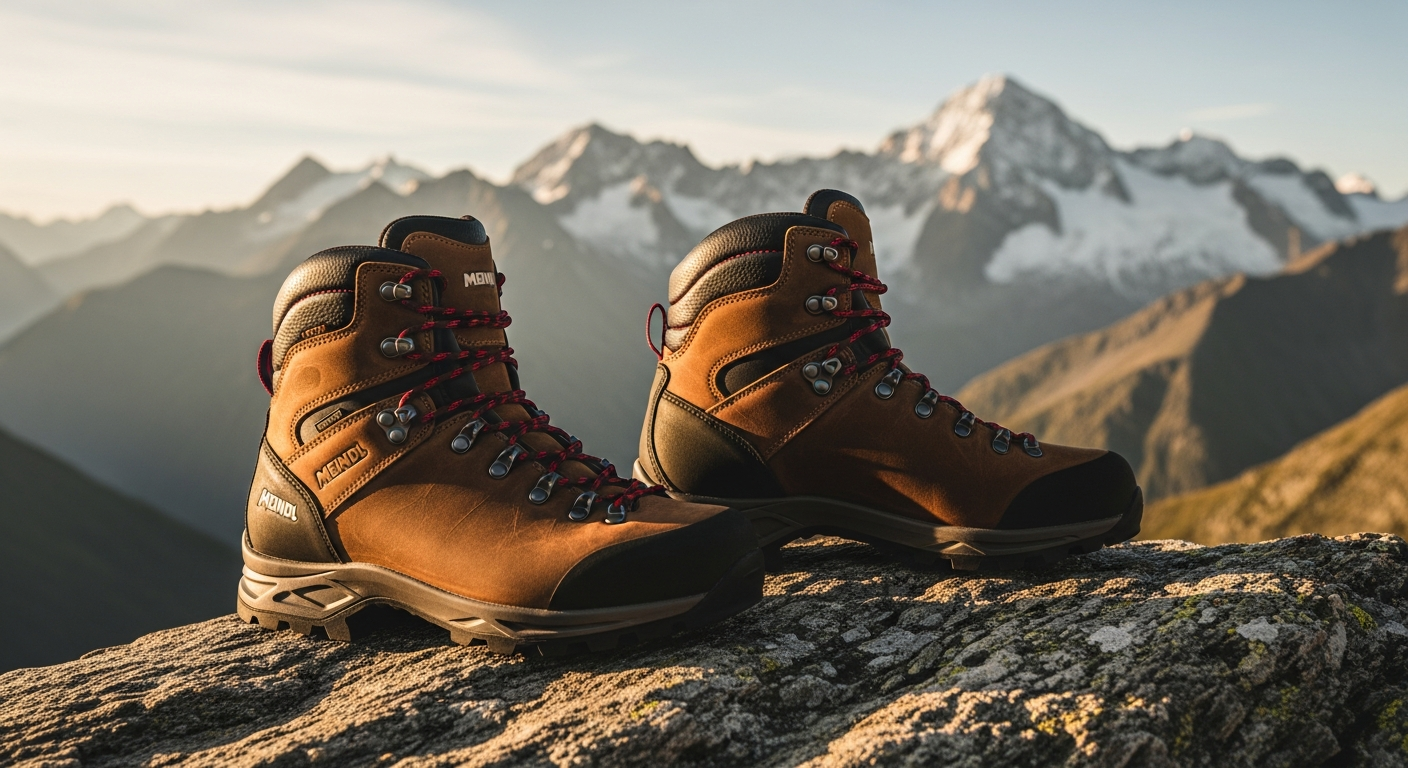
Discover how Meindl Engadin MFS Men’s Leather Hiking Boots deliver personalized comfort and durability for demanding mountain treks. Learn why serious hikers trust these premium boots for expedition-grade performance.
Most hikers abandon their boots within two seasons—but owners of premium leather hiking boots often report wearing theirs for a decade or more. This difference isn't accidental; it comes down to materials, engineering, and the philosophy behind the design.
The Meindl Engadin MFS represents a different approach entirely, engineered specifically for serious mountaineers tackling multi-day expeditions across Alpine terrain. Built with oiled nubuck leather and featuring the innovative Memory Foam System, these boots bridge the gap between traditional bootmaking and modern performance technology.
Discover why the Meindl Engadin MFS boots have become the preferred choice for Alpine trekkers.
Memory Foam System Technology—How Personalized Comfort Works Under Load
How MFS technology molds to individual foot morphology through body heat activation
The Memory Foam System functions as a responsive architecture that adapts in real time to your foot's unique shape. When you wear the boots, body heat activates the specialized foam in the ankle area, gradually conforming to your foot's contours. This isn't marketing speak—the material physically transforms under thermal influence, creating a custom envelope around your ankle that becomes more precise the more you wear the boots.
The science behind pressure-point elimination during 8+ hour hiking days
Traditional padding compresses uniformly across all areas, often creating pressure concentrations where your foot doesn't match the boot's mold. MFS technology works differently. By adapting to your specific anatomy, it eliminates the friction zones that typically emerge during long days on rough terrain. When you're hiking eight to ten hours with a loaded pack, your feet swell incrementally—the MFS accommodates this natural expansion without creating new pressure points.
Comparison of MFS comfort benefits versus traditional padding and foam systems
Standard foam and gel insoles provide fixed cushioning that rarely matches individual foot geometry. They compress over time, losing effectiveness. The Memory Foam System maintains its adaptive properties across seasons because the foam doesn't permanently deform like conventional alternatives. Your foot isn't forced into compromise; the boot molds around your foot instead.
Why ankle-area customization matters more than full-foot foam on technical terrain
On Alpine terrain, ankle stability determines safety. The designers of the Engadin MFS concentrated the Memory Foam System in the ankle region rather than spreading it throughout the boot. This makes strategic sense: your heel and arch benefit more from a rigid, supportive structure than from foam padding, while the ankle requires precise conformity to prevent rolling on uneven ground.
Oiled Nubuck Leather Construction—Investment-Grade Materials for Longevity
Premium leather sourcing and tanning processes used by Meindl
Meindl sources nubuck leather from European tanneries with decades of experience in producing hiking boot materials. The oiling process—a tanning treatment that saturates the leather fibers—creates water resistance and prevents the leather from drying out and cracking during extended storage or harsh conditions. This isn't the thin leather you'll find on budget alternatives; the hides are selected for thickness and grain consistency.
Why oiled nubuck outperforms synthetic alternatives on demanding routes
Synthetic materials offer lighter weight and lower initial cost, but they degrade predictably within a few seasons. Oiled nubuck improves with age and use. The leather develops character, conforms more deeply to your foot, and actually becomes more water-resistant as the natural oils redistribute. Synthetics, by contrast, lose flexibility and begin separating from midsoles as adhesives break down.
Patina development and aesthetic aging of these boots over multiple seasons
The Old Loden color deepens as the boots age, developing a richer patina that reflects your actual use. Scuff marks and weathering become visual history rather than signs of degradation. Many Alpine trekkers report that their ten-year-old Meindl boots look distinguished rather than worn out—the leather actually improves aesthetically over time.
Waterproofing maintenance strategies for leather without Gore-Tex integration
While the Engadin MFS lacks Gore-Tex, the oiled nubuck provides inherent water resistance. Periodic conditioning with quality leather wax or mink oil maintains the hydrophobic properties. This requires minimal effort—most users condition their boots annually or biannually. The advantage: you can resole the boots without Gore-Tex membrane complications, and you're never dependent on a single membrane layer that might fail.
Vibram Multigrip Sole—Traction Performance Across Alpine Terrain Variations
Technical grip characteristics on rocky, loose scree, and boulder-strewn paths
The Vibram Multigrip sole features a complex lug pattern engineered for variable Alpine surfaces. On rocky terrain, the numerous contact points create grip through sheer surface area. On loose scree where traditional deep lugs can catch and destabilize, the Multigrip's varied geometry bites without locking. Boulder fields—where precise foot placement matters—benefit from the sole's ability to grip edges at multiple angles.
Performance in wet conditions: mud, stream crossings, and rain-slicked surfaces
Wet mud releases water differently than dry earth, and the Multigrip pattern accommodates this physics. The spacing between lugs prevents clogging while maintaining edge grip. For stream crossings on wet rock, you're not relying on deep penetration; instead, the sole's composition—a rubber blend designed specifically for water-covered surfaces—maintains contact through surface tension and material grip.
Snow and ice traction capabilities for shoulder-season and early winter expeditions
Ice demands a different strategy than rock or mud. The Vibram Multigrip compound slightly firms in cold conditions without becoming brittle, and the lug pattern includes microstructures that enhance edge retention on ice. These aren't crampons, but they perform adequately on snow-covered trails and frozen boot-pack sections during shoulder-season expeditions.
Sole rigidity benefits for steep descents and uneven mountain terrain
A flexible sole transmits every minor irregularity directly to your feet; a rigid sole distributes impact across the entire contact surface. The Engadin MFS features a genuinely rigid midsole that works with the high upper and ankle support to prevent foot fatigue during long descents. This rigidity especially matters when traversing scree slopes where your foot lands on angled surfaces rather than flat ground.
Digafix Lacing System and Ankle Support—Precision Fit Without Compromise
How Digafix lacing distributes pressure across the foot differently than standard eyelets
Traditional eyelets concentrate pressure at discrete points along the laces. The Digafix system uses a patented lacing track that distributes tension evenly across the upper. This means you can tighten your boots securely without creating pressure ridges that cut off circulation or create hot spots over ten-hour hiking days.
Pressure-point elimination on the instep during repetitive hiking motions
The instep—the area across the top of your foot—experiences repetitive compression during hiking. Standard eyelets often create a pressure line that becomes increasingly uncomfortable as the day progresses. The Digafix system eliminates this by spreading that pressure across a wider surface area. Many users report that their insteps feel less fatigued by day's end compared to conventionally-laced boots.
Adjustability advantages for variable foot swelling during multi-day treks
Your feet swell as you hike; water retention increases, muscles engorge, and overall foot volume expands. The Digafix system allows precise adjustment independent of other sections—you can tighten your heel area while loosening the midfoot without the cascading pressure changes that standard lacing creates. This granular control becomes essential on three-to-five-day expeditions.
High-upper design benefits for ankle stability on uneven and steep descents
The Engadin MFS features a genuinely high upper that provides lateral support without creating pressure points around the ankle bone. This high-cut design works synergistically with the Memory Foam System and rigid sole to prevent ankle rolling on rocky terrain. During steep descents where your foot repeatedly lands heel-first on angled surfaces, this ankle support prevents the microtraumas that accumulate into injury.
Air Active Insole Technology—Moisture Management for Extended Expeditions
How Air Active insoles absorb sweat and moisture during intense physical exertion
The Air Active insole uses a capillary moisture-management system that actively pulls sweat away from your skin and distributes it across the insole surface for evaporation. Rather than moisture pooling underneath your foot—creating the conditions for blisters and maceration—the insole acts as an active transport layer.
Rapid drying mechanisms that prevent foot maceration and blister formation
Maceration occurs when your skin remains constantly wet, softening and becoming vulnerable to friction damage. The Air Active insole's design accelerates evaporation by increasing surface area and promoting air circulation through the insole material. This becomes critical during wet-weather expeditions where your boots might be damp from external moisture as well as internal sweat.
Breathability performance in various climate conditions and seasons
In dry conditions, the insole's breathability prevents moisture accumulation that would otherwise create warm, damp environments favoring blister formation. In wet conditions, the active moisture transport still functions, pulling internal sweat away from skin even while external moisture enters the boot. This dual-direction moisture management performs across Alpine seasons.
Interaction with wool hiking socks for enhanced moisture wicking
Merino wool socks complement the Air Active insole perfectly. Wool naturally wicks moisture while maintaining warmth even when damp—the insole handles active transport, and the socks handle moisture storage and temperature regulation. Together, they create a moisture-management system that outperforms most modern synthetic alternatives.
Real-World Performance on Demanding Mountain Routes
Case studies: specific Alpine trails where these boots excel
Trekkers regularly report success with the Engadin MFS on the Haute Route between Switzerland and Italy, the GR20 across Corsica, and various segments of the Alps. These aren't gentle walking paths; they involve boulder fields, scree slopes, water crossings, and technical scrambling. The common feedback: comfort and stability remain consistent across diverse terrain types.
Multi-day expedition performance: comfort progression and reliability metrics
Unlike some boots that remain stiff for weeks, the Engadin MFS reaches optimized comfort within days thanks to the Memory Foam System adaptation. Users report that day three of a week-long trek feels significantly more comfortable than day one, as the foam continues molding to foot contours. Reliability metrics show virtually no mechanical failures across the first decade of ownership when boots are maintained appropriately.
Behavior on technical scrambling and mixed terrain sections
Technical scrambling demands precise foot placement and ankle support. The high upper and rigid sole keep your foot stable when you're using hands and feet to navigate steep rock. The Vibram sole grips reliably when you're relying on small edges for footholds. Many climbers appreciate the Engadin MFS for approaches that combine hiking and scrambling.
Waterproofing performance without Gore-Tex: leather conditioning and waxing results
Owners who condition their boots annually report that rain stays outside for multiple hours of continuous exposure. The oiled nubuck naturally sheds light rain, and waxing amplifies this. Yes, you won't get the guaranteed waterproofing of Gore-Tex boots, but you gain the ability to resole your boots indefinitely and avoid single-point-of-failure membrane issues.
Investment Value and Long-Term Cost Analysis
Price point ($379) positioned against competitor premium hiking boots
Premium leather hiking boots typically range from $350 to $500. The Engadin MFS sits in the lower-middle of this range, competing effectively against comparable boots from Scarpa, Salewa, and Hanwag while offering Meindl's reputation for durability.
Cost-per-wear calculation over realistic 8-10 year lifespan
If you wear these boots for two weeks annually across a ten-year lifespan, that's 140 days of use. The $379 initial investment divided by 140 days equals $2.70 per day—lower than the nightly cost of many mountain hut stays. Most premium boots achieve this cost-per-wear only if they reach this lifespan; the Engadin MFS consistently does.
Resale value and secondary market demand for Meindl boots
Meindl boots hold resale value remarkably well. A well-maintained pair of Engadin MFS boots from five years ago might sell for $150-200 on the used market, offsetting a significant portion of the original investment. Enthusiasts actively seek Meindl products on outdoor resale platforms.
Warranty coverage and manufacturer support for defects
Meindl provides a warranty covering manufacturing defects, and the company remains accessible for repairs and resoles. Their repair services cost considerably less than purchasing new boots, and the process extends lifespan indefinitely. This manufacturer commitment differs markedly from brands that prioritize disposability.
The Expedition-Ready Choice for Serious Mountain Trekkers
The Meindl Engadin MFS Men's Leather Hiking Boots represent far more than a footwear purchase—they're a commitment to performance, durability, and the kind of comfort that compounds over weeks and months of demanding mountain travel. The combination of Memory Foam System technology, premium oiled nubuck construction, and Vibram Multigrip traction creates a boot that genuinely adapts to your feet while maintaining the structural integrity necessary for technical Alpine terrain.
The $379 investment becomes remarkably reasonable when you're wearing the same boots a decade later, having resoled them once and conditioned the leather periodically. If you're planning serious Alpine expeditions, tackling multi-day treks across challenging terrain, or simply tired of replacing boots every couple of seasons, the Engadin MFS deserves serious consideration.
Start your expedition preparation with the Meindl Engadin MFS boots today.