
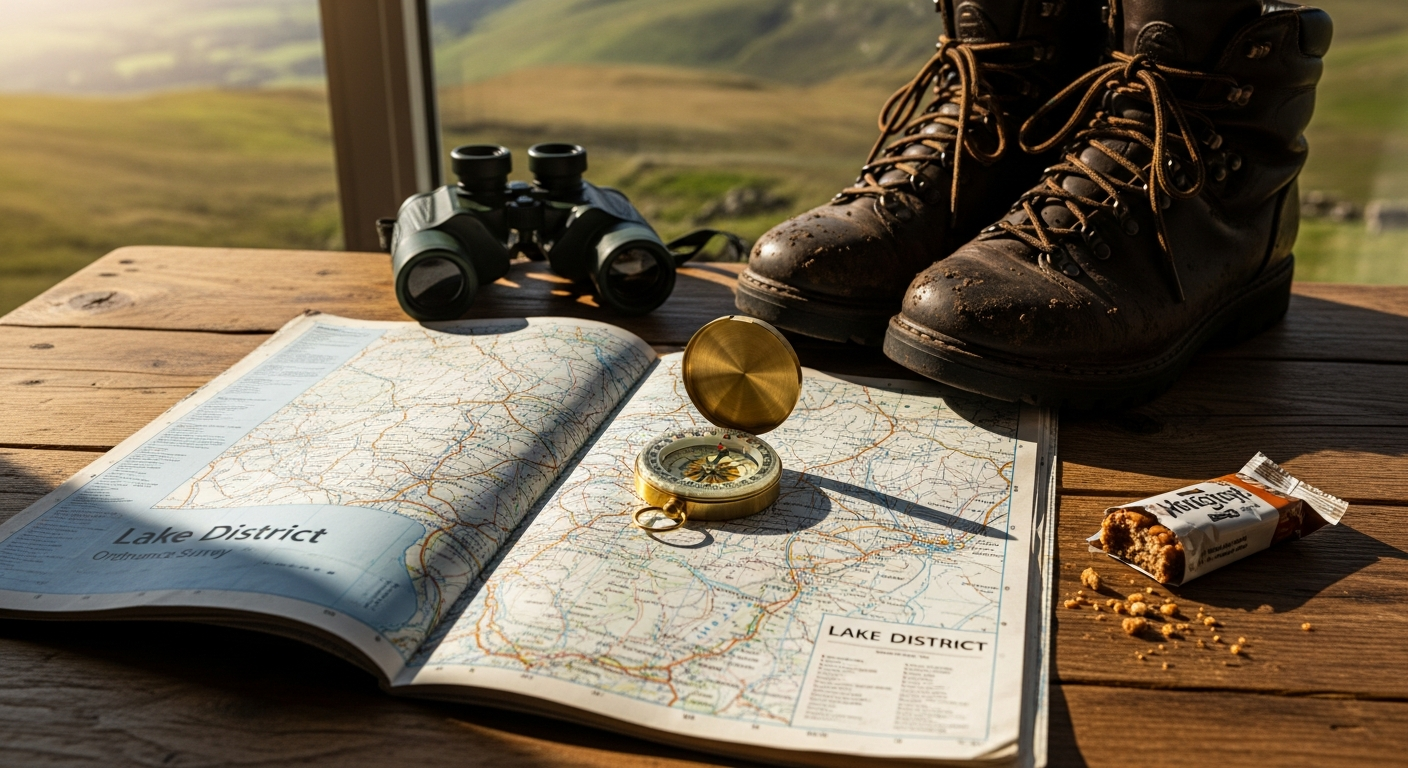
Discover why OS Explorer Maps are the gold standard for British outdoor navigation. Learn about their 1:25,000 scale detail, weatherproof options, and how they compare to other mapping solutions for hiking, walking, and cycling adventures.
More than 70% of UK outdoor enthusiasts rely on physical maps for navigation—and Ordnance Survey Explorer Maps command that market for solid reasons. Whether you’re tackling a challenging fell walk or planning a weekend countryside escape, the accuracy and detail these maps provide can mean the difference between a confident adventure and a frustrating detour.
Ordnance Survey, Britain’s national mapping agency, has been producing authoritative maps for over two centuries. The Explorer series represents their most detailed leisure mapping offering, specifically designed for outdoor pursuits that demand precision and reliability. This range has achieved genuine cult status among serious adventurers, with maps like the Snowdon edition (Explorer OL17) consistently ranking among bestsellers.
Understanding the 1:25,000 Scale: What Sets Explorer Maps Apart
The practical application of 1:25,000 scale mapping
The 1:25,000 scale means 4cm on the map represents 1km on the ground. This ratio delivers the most detailed leisure mapping available from Ordnance Survey, enabling you to identify subtle terrain features, narrow paths, and specific landmarks that larger-scale maps simply cannot capture. Each map sheet covers approximately 20km by 20km, striking a balance between comprehensive coverage and manageable portability.
How Explorer Maps compare to alternatives
The Landranger series operates at 1:50,000 scale—meaning each sheet covers twice the distance but with significantly less detail. For casual walking or long-distance touring, Landranger maps suffice. But when you’re navigating complex fell terrain, planning a precise fell run, or following intricate bridleway networks, Explorer’s superior detail becomes indispensable. Other leisure map providers exist, but none match the institutional credibility and comprehensive accuracy of Ordnance Survey’s official mapping.
Why this detail level matters for route planning
Accurate terrain assessment depends on precise contour information. Explorer Maps display 5-meter contour line intervals, revealing gradient changes that affect difficulty levels and energy expenditure. You can identify steep sections, gentler alternatives, and optimal ascent routes before stepping onto the trail. This level of detail transforms route planning from guesswork into informed decision-making.
Coverage implications and terrain complexity
The approximately 20km by 20km coverage area means multi-day expeditions require multiple maps. Rather than a limitation, this encourages detailed planning and systematic exploration of specific regions. The format suits day walks and weekend trips perfectly, while long-distance walkers simply carry multiple sheets organized by region.
Essential Features That Make Navigation Foolproof
Comprehensive footpath and bridleway markings
Explorer Maps clearly delineate public rights of way with solid lines distinguishing footpaths (walkers only) from bridleways (walkers, cyclists, and horses). This distinction proves crucial for respecting landowner permissions and planning appropriate routes. Open access land appears visually distinct, empowering adventurers to explore designated areas legally and confidently.
Contour lines and elevation visualization
Those 5-meter interval contours tell you everything about terrain steepness. Closely spaced contours indicate dramatic elevation changes; wider spacing suggests gentler gradients. Combined with hillshading on many maps, contours enable you to visualize three-dimensional terrain before setting foot on it. This capability prevents dangerous misjudgments in mountainous areas.
Field boundaries and landmark identification
Small-scale features like field gates, walls, and hedgerows appear on Explorer Maps, enabling precise position-fixing during navigation. You can match map features directly to landscape features, confirming your exact location with confidence. This tactical-level detail distinguishes Explorer Maps from tourism-focused alternatives that generalize landscape features.
Points of interest and amenity locations
Youth hostels, picnic sites, information centers, and water sources appear marked on every sheet. Tourist information centers and national park boundaries guide your planning. You can identify rest spots, emergency shelter locations, and refreshment opportunities without carrying additional guidebooks.
Symbols and intuitive interpretation
The OS symbol legend remains consistent across all maps, enabling you to develop automatic recognition of features. Once familiar with key symbols—the difference between track types, building designations, and vegetation patterns—you navigate more intuitively and efficiently.
Paper vs. Active: Choosing Your Map Format
Classic paper Explorer Maps
Standard paper versions balance affordability (typically £10-£15) with the tactile reliability outdoor enthusiasts appreciate. They weigh virtually nothing, require no batteries, and prove entirely weather-resistant when used sensibly. For casual walkers, day trippers, and those building comprehensive map collections economically, the classic format delivers excellent value.
Active weatherproof format
The Active range employs durable waterproof coating and tear-resistant materials, surviving rain, mud, and rough handling that would destroy standard paper. At a modest premium (typically £13-£18), the Active format justifies itself through longevity. Maps subjected to repeated outdoor use—particularly in mountainous terrain where conditions deteriorate rapidly—benefit significantly from Active’s enhanced durability.
The digital companion advantage
Many physical Explorer Maps include digital downloads for use with the award-winning OS Maps app. This hybrid approach offers flexibility—consult the physical map for detailed planning and primary navigation, then reference the smartphone version for quick position checks when convenient. The combination provides backup navigation without sacrificing offline reliability.
Real-World Navigation: Activities Where Explorer Maps Excel
Mountain navigation in complex landscapes
Fell running, mountaineering, and serious hillwalking demand the precision that Explorer Maps provide. In the Lake District, Snowdonia, and Scottish Highlands, terrain complexity makes detailed contour information literally lifesaving. You can identify safe descent routes, navigate ridge systems confidently, and avoid dangerous cliffs or gullies visible on the map but potentially obscured by cloud.
Long-distance walking and multi-day treks
Despite requiring multiple sheets, Explorer Maps enable meticulous planning of multi-day routes. You can trace exact paths, identify overnight accommodation, locate water sources, and assess daily elevation gain with precision. The detail supports strategic planning across varied terrain.
Cycling and bridleway exploration
Cyclists benefit substantially from Explorer Maps’ bridleway clarity and terrain detail. You can identify rideable routes, assess gradient difficulty, and discover lesser-known paths that wouldn’t appear on standard road maps. The contour information reveals which hills present genuine challenges.
Fell running and trail running
The detailed contour work proves invaluable for fell runners planning technical routes. You can identify suitable terrain, assess elevation profiles, and locate water crossings or technical sections that demand preparation.
Outdoor education and group navigation
Schools and adventure centers rely on Explorer Maps for teaching navigation skills. Their clarity and comprehensive feature sets support educational purposes, enabling instructors to teach map reading systematically across diverse terrain types.
Honest Limitations: When Explorer Maps Might Not Be Enough
Limited geographical coverage per sheet
Extended journeys across regions require carrying multiple maps. For long-distance trails crossing multiple 1:25,000 sheets, organization becomes essential. Some adventurers find managing multiple sheets inconvenient compared to single-sheet 1:50,000 alternatives.
Potential visual complexity in mountainous terrain
In extremely complex mountain landscapes with numerous contour lines, peaks, and features, some users report that the map appears visually busy. The sheer detail, though fundamentally valuable, can occasionally make contour patterns difficult to parse quickly. Experience and familiarity mitigate this substantially.
Update frequency and landscape changes
Maps become outdated as paths change, infrastructure develops, and landscapes evolve. Footpaths may be rerouted; bridges may become impassable; new buildings appear. While Ordnance Survey updates maps periodically, adventurers relying on older editions may encounter outdated information. Regular updates or supplementary guidebooks address this limitation effectively.
Replacement costs for damaged maps
Extended use in challenging conditions eventually damages even weatherproof maps. Wear, fading, and deterioration necessitate replacement. Unlike digital maps, physical maps incur ongoing costs as they wear out.
Why the Pandemic Sparked a Navigation Renaissance
Reconnecting with local landscapes
As travel restrictions limited distant adventures, people discovered outdoor possibilities within their immediate regions. Explorer Maps enabled detailed exploration of previously overlooked local areas, transforming weekend walks into meaningful adventures.
Renewed trust in reliable technology
Amid pandemic uncertainty, proven navigation tools provided reassurance. Physical maps offered dependable functionality without digital anxiety—no connection failures, no battery drain, no uncertainty about accuracy.
Generational knowledge transfer
Experienced outdoor enthusiasts introduced maps to younger adventurers, reviving traditional navigation skills. Map literacy declined as smartphone navigation dominated, but the pandemic triggered renewed interest in foundational skills and trustworthy methods.
Mental health benefits of offline exploration
Disconnecting from digital devices to explore landscapes provided psychological relief during isolating periods. Maps facilitated genuine outdoor engagement without constant connectivity demands. This shift proved sustained rather than temporary.
Making the Investment: Cost, Value, and ROI for Outdoor Enthusiasts
Pricing structure and value comparison
Individual Explorer Maps cost £10-£18, positioning them competitively against digital subscription services. For regular adventurers covering different regions, purchasing specific maps costs less than ongoing app subscriptions while eliminating digital dependency.
Durability and lifespan
Quality maps, particularly the Active format, remain useful and accurate for years. Calculate cost per adventure: a £15 map used across 20 expeditions costs 75p per outing—excellent value. Digital subscriptions demand continuous payment regardless of usage frequency.
Building comprehensive collections strategically
Rather than purchasing randomly, systematic collection building focuses on regions you explore regularly. Retail discounts and bundle offers reduce per-map costs. Many outdoor groups share maps, distributing costs across communities.
Resale and community value
Used Explorer Maps retain modest resale value. Maps covering popular areas or iconic routes circulate through outdoor communities, extending value beyond individual ownership.
The Trust Factor: Why Generations Choose Ordnance Survey
Two centuries of mapping heritage
Ordnance Survey traces its origins to 1791, establishing unmatched credibility and institutional reliability. Government backing ensures mapping standards remain authoritative and consistently updated. This heritage instills genuine confidence that extends beyond marketing claims.
Iconic status within outdoor communities
The distinctive orange covers symbolize trustworthy navigation throughout UK outdoor culture. Generations of adventurers learned navigation using OS maps, embedding them into collective experience. This cultural significance transcends product specifications.
Professional endorsement and validation
Mountain guides, outdoor educators, expedition leaders, and rescue services rely on Ordnance Survey maps professionally. This validation reflects genuine accuracy rather than casual preference. When lives depend on navigation reliability, OS maps remain the standard choice.
Consistency and predictable quality
Explorer Maps maintain consistent quality across the entire range. You can purchase any regional sheet confident the standards match previous purchases. This reliability eliminates surprises and inconsistency plaguing lesser competitors.
Getting Started: Selecting the Right Explorer Map for Your Adventure
Identifying your region and map numbers
Ordnance Survey’s online map finder enables quick identification of which Explorer sheets cover your planned area. Simply enter your destination or postcode, and the system displays relevant map numbers. Familiarity with map numbering systems develops quickly.
Matching map choice to activity type
Consider your specific activity when purchasing. Mountain navigation demands Explorer detail; casual local walks might accept simpler alternatives. Route length and terrain complexity guide purchasing decisions logically.
Building systematic collections
Rather than random purchases, identify your primary exploration regions and systematically collect maps covering those areas. This approach builds functional navigation capabilities efficiently while avoiding wasteful purchases.
Integration planning for extended journeys
When planning routes crossing multiple sheets, organize maps in sequence, marking boundaries clearly. Establish systems for managing overlapping areas to avoid navigation confusion where sheets meet.
Beyond the Map: Building a Complete Navigation Toolkit
Compass fundamentals and map-and-compass navigation
Explorer Maps achieve full potential when combined with quality compasses and basic navigation training. Map-and-compass skills provide backup when technology fails and develop fundamental outdoor competency.
GPS devices and smartphone backup systems
Rather than replacing maps, GPS devices and smartphone navigation complement them. Carry physical maps as primary navigation tools, reference digital alternatives for quick position verification. This redundant approach ensures navigation capability regardless of individual system failures.
Weather integration and route optimization
Combine Explorer Map terrain data with weather forecasting when planning expeditions. Detailed contour information reveals how wind funnels through valleys or elevation zones experience different conditions. Strategic planning addresses weather challenges systematically.
Navigation training and skills development
Formal navigation courses or self-directed learning transform maps from intimidating documents into intuitive tools. Invest time in fundamental skills—map orientation, contour interpretation, compass work—before attempting complex terrain.
Emergency protocols and communication tools
Remote exploration demands communication backup beyond maps. Personal locator beacons, satellite messengers, or pre-planned check-in systems provide safety redundancy. Maps ensure navigation capability; communication systems address emergency response.
Your Next Adventure Awaits: Taking Action With Confidence
The journey from casual countryside stroller to confident navigator begins with a single map. Ordnance Survey Explorer Maps provide the foundation—reliable, detailed, trustworthy information—that transforms uncertainty into capability. Whether you’re conquering Snowdon, exploring hidden valleys in the Lake District, or discovering new trails near your home, these maps deliver the precision and clarity that outdoor adventurers demand.
The real magic happens when you fold that orange-covered map, clip it to your rucksack, and step onto the trail knowing exactly where you’re going. No battery anxiety. No signal worries. Just you, the landscape, and a map trusted by millions of British adventurers before you.
Start with the map covering your favorite local area. Master its symbols and contours, then expand your collection as your confidence and ambitions grow. Each new region becomes an opportunity to develop deeper navigation skills and expand your outdoor capabilities systematically.
Your outdoor adventures deserve nothing less than the accuracy and reliability that only Ordnance Survey Explorer Maps provide. The investment in quality navigation tools today translates directly into more confident, safer, and ultimately more rewarding expeditions tomorrow.