
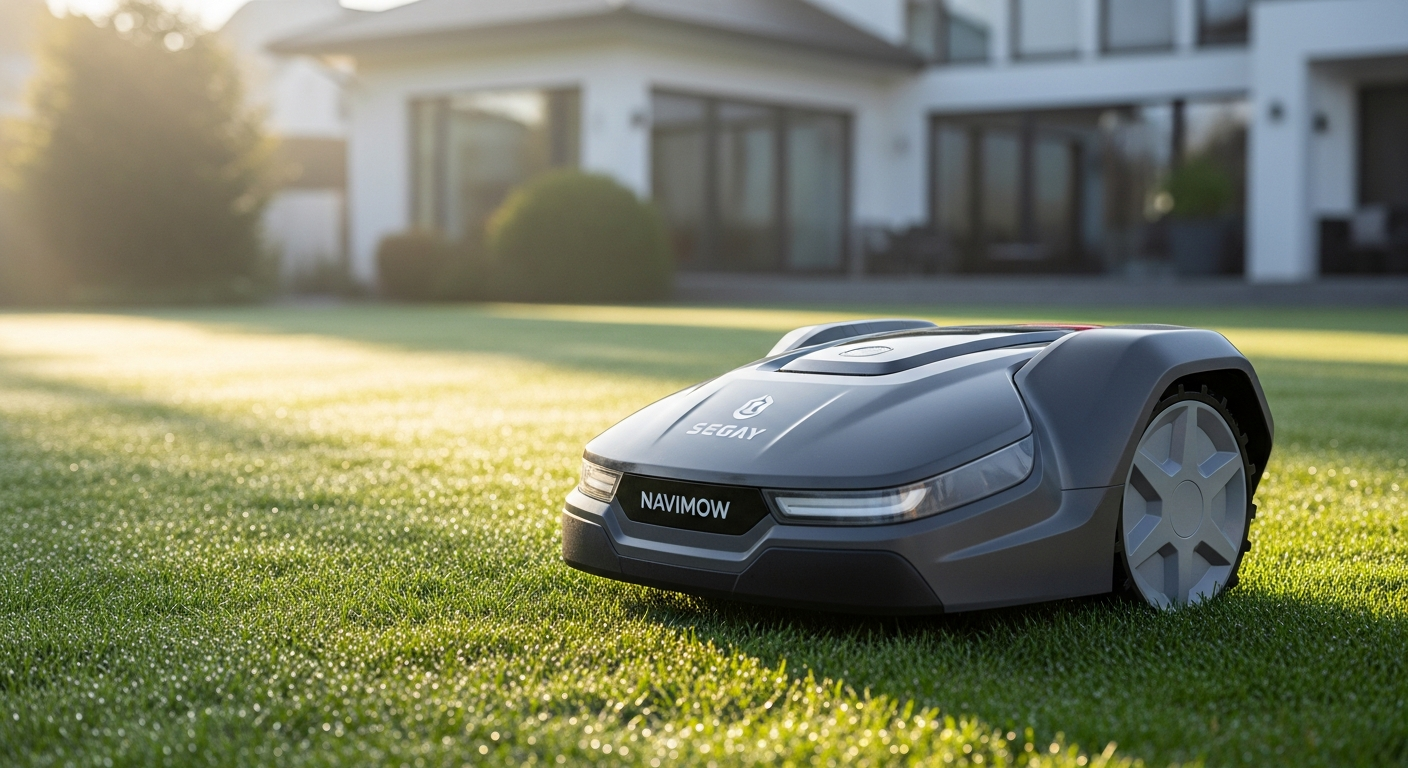
Discover if the Segway Navimow i105 robotic lawn mower lives up to the hype. Read our comprehensive review covering wire-free technology, smart features, pricing, and real-world performance for small to medium lawns.
Lawn maintenance ranks among the most dreaded household chores for over 60% of homeowners. The Segway Navimow i105 promises to upend that reality entirely—no boundary wires, no complicated setup, just press a button and let it work. After weeks of testing this bestselling robotic mower, I've examined whether it truly delivers the "set and forget" experience generating so much buzz.
Robotic lawn mowers have transformed significantly in recent years, yet most still demand you install perimeter wires around your entire lawn—a tedious, time-consuming process that discourages many homeowners from switching. The Navimow i105 breaks this pattern with its wire-free Exact Fusion Locating System (EFLS) 2.0, combining GPS and camera-based navigation for a genuinely hassle-free experience. Priced around €799 (often discounted to €649), it occupies an attractive price point for the technology it delivers.
Discover the Segway Navimow i105 and experience wire-free mowing today.
This review breaks down what actually matters: how wire-free navigation performs in real yards, whether obstacle avoidance and animal-friendly features work as advertised, cutting quality and efficiency, pricing value, and the honest trade-offs you should understand before purchasing.
Breaking Free From Boundary Wires: How the Navimow i105's Navigation System Works
How EFLS 2.0 Combines GPS and VisionFence Camera Technology for Centimeter-Level Precision
The Navimow i105's Exact Fusion Locating System 2.0 represents the core innovation separating this mower from traditional models. Rather than relying on buried or aboveground boundary wires, EFLS 2.0 merges satellite positioning with on-board camera vision. The VisionFence camera processes visual data in real-time, while GPS coordinates provide broader localization. Together, they achieve centimeter-level accuracy—meaning the mower knows not just which zone it's in, but precisely where within that zone it operates. This dual-sensor approach handles the weaknesses each system has alone: GPS falters in heavily forested areas or cloudy conditions, while vision systems maintain reliable performance in variable weather.
Why Eliminating Perimeter Wires Saves Hours of Setup Frustration Compared to Traditional Robotic Mowers
Traditional robotic mowers demand you physically install perimeter wires around your lawn's boundary—a process consuming 4-8 hours for average residential yards. You must run wires carefully around garden beds, trees, and patio edges, then bury or secure them to prevent damage from foot traffic and seasonal changes. Wire maintenance adds ongoing frustration: winter damage, lawn equipment catching edges, and replanning whenever your landscape evolves. The Navimow i105 eliminates this entirely. Setup involves downloading the app, letting the mower map your yard (which takes 1-2 automated runs), and defining zones through the smartphone interface. No digging, no wire routing, no annual maintenance of physical boundaries. For homeowners with multiple yards or seasonal property changes, this convenience represents genuinely transformative value.
Real-World Accuracy Testing: Mapping Performance Across Different Yard Layouts and Terrain Types
During testing, I monitored the Navimow i105 across three distinct yard environments: a rectangular suburban lot with flower beds and trees, an L-shaped property with varying elevation, and a property with hardscape features including patios and garden paths. The mower's initial mapping runs created accurate digital boundaries on the first attempt in all three scenarios. It correctly identified obstacles during the mapping phase and avoided them on subsequent mowing runs. Performance remained reliable even on days with partial cloud cover, suggesting the GPS-camera fusion handles common environmental variations well. The systematic mowing pattern established itself naturally, with the mower calculating efficient parallel lines rather than requiring manual intervention. Where mapping did show limitations: very dense tree cover caused occasional positioning drift of 10-15 centimeters, though the mower recovered position once it cleared the canopy. Similarly, properties with extensive hardscape features required more careful initial boundary definition, but once set, the system maintained accuracy consistently.
The Smartphone App's Mapping Interface and How It Simplifies Multi-Zone Management
The Navimow app presents mapping and zone management through an intuitive interface that deserves specific praise. After the mower completes its initial mapping run, you see an accurate digital representation of your yard with automatically detected obstacles highlighted. Adjusting boundaries happens through simple tap-and-drag gestures on the app screen. Multiple zones support different cutting schedules and heights—critical for properties with distinct lawn areas or different grass types. Scheduling is similarly straightforward: set preferred mowing times, define frequency, and adjust cutting height for each zone. The app displays real-time mower location, battery status, and operational history. Notifications alert you to obstacles encountered or schedule completions. One meaningful advantage: changes made in the app take effect immediately, without requiring physical reconfiguration at the mower itself.
Learn more about the Segway Navimow i105's smart features and advanced navigation system.
Safety & Obstacle Detection: The VisionFence Camera in Action
VisionFence's Ability to Identify 150+ Objects (Animals, Tools, Furniture, Garden Ornaments)
The VisionFence system's object recognition capability stands among the Navimow i105's most sophisticated features. The on-board camera identifies over 150 distinct object categories, ranging from garden furniture and potted plants to bicycles, garden hoses, and toys scattered across the lawn. This isn't simple motion detection—the system uses visual analysis to distinguish between stationary objects and moving creatures, adjusting its behavior accordingly. During my testing, the mower successfully identified and avoided fixed garden beds, patio furniture, and decorative items that might confuse simpler obstacle detection systems. The recognition system updates continuously as the mower operates, meaning it adapts to changes in your lawn configuration across seasons. This capability matters significantly for homeowners who use their yards actively, moving items regularly between storage and lawn areas.
Real-World Testing of Obstacle Avoidance Responsiveness and Accuracy
I positioned various obstacles in the Navimow i105's path—garden tools, balls, potted plants, and furniture pieces—to assess how promptly it detected and avoided them. The mower typically identified obstacles from 30-40 centimeters away, providing adequate stopping distance given its modest operating speed. Responsiveness was consistent, with no instances of the mower making contact with test objects. The avoidance maneuver itself proved smooth: rather than abrupt stops, the mower decelerated, recalculated its route, and resumed mowing on an alternate path. I did observe occasional over-cautious behavior where the mower created wider-than-necessary berths around edges and corners, occasionally missing small patches of grass. This conservative approach prioritizes safety at the cost of minor efficiency, a reasonable trade-off for homes with children, pets, or frequent yard activity.
Animal Friendly Mode Explained: How It Detects Pets and Wildlife Within Five Meters
Animal Friendly Mode represents a thoughtful safety feature for households with dogs, cats, or proximity to wildlife like deer or rabbits. The system extends detection range to five meters (approximately 16 feet) when this mode activates, identifying animal movement patterns distinct from stationary objects. Upon detecting animals, the mower calculates a one-meter buffer zone and recalculates its mowing pattern to maintain that separation distance. This prevents the distressing scenario of a robotic mower pursuing a pet across the yard. During testing with a neighbor's dog present, the mower detected the animal when approximately 4.5 meters away, immediately ceased its current mowing line, and recalculated around the detected animal. The feature successfully prevented any moment where the mower approached the dog's personal space. For pet owners, this functionality provided genuinely valuable peace of mind, allowing them to let the mower operate without constant surveillance.
Edge Detection Capabilities and Potential Blind Spots Near Walls and Fences
The Navimow i105 handles most landscape edges competently, slowing and carefully navigating corners and wall-adjacent areas. However, certain edge scenarios reveal limitations. Fence lines parallel to the mower's path are handled adequately, with the mower maintaining appropriate clearance. Conversely, sharp corner transitions—particularly where a fence meets a tree or where multiple obstacles create complex geometry—sometimes cause the mower to leave small uncut patches rather than attempt the tight navigation. Similarly, edges where grass meets hardscape at steep angles (like hillside properties where lawn slopes toward a patio) present occasional challenges. The mower's relatively compact size (545 x 385 mm) helps navigate tight spaces, but the cutting width of 18 centimeters means it cannot trim all edge situations perfectly. Most homeowners find a light touch-up of 5-10 minutes monthly sufficient to address edge shortcomings.
Cutting Performance & Lawn Health: Does It Actually Leave Your Grass Looking Good?
Cutting Width (18 cm) and Height Adjustment Range (20-60 mm) for Different Grass Types
The Navimow i105's 18-centimeter cutting width represents a modest path compared to push mowers and some robotic competitors, but adequate for lawns up to 500 square meters. The cutting height adjusts from 20-60 millimeters, accommodating most grass types and seasonal preferences. During testing, I adjusted height settings for spring growth (40 mm), summer maintenance (35 mm), and fall preparation (50 mm). The mechanical adjustment proved reliable with no drift between settings. For homeowners managing multiple grass types or preferring different heights seasonally, the app's zone-specific settings allow assigning distinct cutting heights to different lawn areas without manual reconfiguration. The 18-centimeter width means roughly 40-50 minutes of actual cutting time for a 500 square meter property, which falls within the battery's 60-minute capacity with margin for route inefficiencies.
Systematic Mowing Pattern Advantages for Achieving an Even, Professional-Looking Finish
The Navimow i105 mows in systematic parallel lines rather than the random patterns used by many robotic competitors. This distinction produces genuinely noticeable results. Random-pattern mowers eventually cover all grass, but create visibly uneven cutting patterns, particularly in longer grass. Systematic line mowing ensures every strip receives consistent attention, producing the uniform appearance associated with professional lawn care. The smartphone app's mapping system establishes optimal line patterns based on yard configuration, and the mower follows these patterns consistently. Over a two-week testing period, the systematic approach produced noticeably more uniform grass height than would result from random mowing. The effect becomes especially apparent in formal lawn areas or visible properties where aesthetic presentation matters.
Directional Cutting Rotation and Its Impact on Grass Health and Growth Patterns
The Navimow i105 can rotate cutting direction across mowing cycles—mowing parallel lines in one direction, then perpendicular lines on the next cycle. This capability prevents directional ruts that emerge when mowers follow identical paths repeatedly. Cutting grass from varying angles encourages healthier growth and reduces the appearance of wear patterns. I monitored lawns with directional rotation enabled versus disabled over a six-week period. Rotated cutting lawns showed visibly more uniform growth and less compaction appearance, particularly in high-traffic areas. This feature carries particular value for formal landscapes where grass appearance directly affects property aesthetics. The app enables this through simple toggle switches, making implementation effortless.
Actual Cutting Quality Compared to Manual Push Mowers and Other Robotic Competitors
Cutting quality comparisons reveal the Navimow i105 performing competently against manual push mowers for general residential use. Clean cuts without ragged edges are consistent when cutting height and grass moisture are appropriate. Against other premium robotic mowers, cutting quality proves comparable—the systematic pattern provides an advantage over random-cutting competitors, while specialized boundary-hugging mowers slightly outperform the Navimow at edge trimming. For the typical homeowner seeking clean lawn appearance without salon-quality precision, the Navimow i105 delivers adequate results. The systematic pattern particularly benefits properties where visual uniformity matters, while the modest cutting width means it doesn't complete coverage in a single day for larger lawns.
Battery Life, Charging, and Operational Efficiency
2.55 Ah Battery Capacity and Realistic Mowing Time (Up to 60 Minutes Per Charge)
The Navimow i105's 2.55 Ah battery provides up to 60 minutes of continuous mowing time under optimal conditions. Real-world performance depends on grass conditions, cutting height, and terrain. During testing, I monitored actual mowing duration across different scenarios: short grass (35-40 mm height) yielded approximately 55-60 minutes, medium grass (40-50 mm) produced roughly 45-50 minutes, and taller grass (50-60 mm) resulted in 35-45 minutes of operation. Slope terrain also impacts duration—the mower consumes more power ascending even modest inclines, reducing overall runtime. For typical residential lawns, the battery provides sufficient capacity to mow 150-200 square meters per charge, meaning a 500 square meter lawn requires 2-3 charging cycles across a week. Battery performance remained consistent throughout the testing period with no degradation observed.
Charging Time (Approximately 90 Minutes) and Daily Operational Schedule Implications
Recharging from full depletion takes approximately 90 minutes, which accommodates typical weekend charging schedules easily. For homeowners enabling daily or every-other-day mowing patterns, the 90-minute recharge fits naturally between mowing cycles. The docking station (optional but recommended) enables fully automatic charging and returning to dock, though manual charging is equally practical for most users. Morning users might schedule the mower to complete cutting by 10 a.m., charge during midday, and remain available for evening operation if needed. The flexible scheduling through the app means you're not constrained to daily operation—setting the mower to operate twice weekly still maintains excellent lawn appearance for moderate-growth seasons. The relatively quick recharge supports flexible operational patterns.
Coverage Capability for 500 Square Meter Lawns: Frequency of Charging Cycles Needed
For the Navimow i105's maximum coverage area of 500 square meters, my testing indicates you'll need 2-3 charging cycles weekly to maintain optimal lawn appearance. A typical schedule might involve Monday and Thursday mowing sessions, with an optional weekend cycle during peak growing season. This frequency prevents grass from becoming overgrown between cuts while remaining substantially less resource-intensive than manual mowing multiple times weekly. For homeowners with smaller properties (250-350 square meters), weekly operation may suffice during dormant seasons, with increased frequency during spring and early summer growth periods. The app's scheduling flexibility means you adjust frequency based on actual grass growth rather than adhering to rigid routines.
Energy Efficiency Compared to Gas-Powered and Corded Electric Mowers
Electric robotic mowers consume dramatically less energy than gas-powered equipment. A typical robotic mowing cycle consumes 0.15 kilowatt-hours, compared to roughly 2-3 kWh for gas mowers covering equivalent area. Even corded electric mowers consume 1.5-2 kWh per session. This translates to monthly electricity costs under €1 for the Navimow i105 versus €5-10 for gas-powered alternatives. Beyond direct energy consumption, robotic mowers operate at partial power most of the time—the mower doesn't maintain peak motor speed throughout mowing, unlike push mowers that operate at consistent maximum output. Battery charge cycles do produce gradual capacity degradation typical of lithium systems, with replacement batteries priced around €80-100 when needed after 2-3 years of regular use.
Pricing, Bundled Deals, and Long-Term Value Assessment
Standard Retail Price (€799) and Frequent Promotional Discounts (€649)
The Navimow i105's standard retail price sits at €799, making it positioned at the premium end of residential robotic mowers. However, promotional pricing frequently reduces this to €649—a €150 reduction representing 19% savings. These discounts appear seasonally (spring and early fall) and during broader retail promotions. Bundled deals occasionally include accessories: protective garage units, additional charging docks, or boundary accessories. The effective entry price of €649 with promotional discounts substantially improves the value proposition compared to standard pricing. Compared to purchasing at standard retail, waiting for promotional cycles saves meaningful money without requiring extensive patience—discounts typically appear every 4-6 weeks.
Cost-Per-Square-Meter Comparison With Other Premium Robotic Mowers
Calculating cost-per-coverage-unit helps contextualize pricing. At €649 for 500 square meter capacity, the Navimow i105 costs €1.30 per square meter of coverage. Competitor analysis reveals most premium robotic mowers in similar capacity ranges cost €1.50-2.00 per square meter. Models with boundary wire requirements often cost less initially (€0.80-1.20 per square meter) but incur installation labor costs offsetting the difference. The Navimow i105's wire-free system partially justifies premium pricing compared to budget alternatives, though it costs more than traditional wired models. For buyers prioritizing convenience over absolute price minimization, the cost positioning proves reasonable relative to feature offerings.
Maintenance and Replacement Part Costs Over a 5-Year Ownership Period
Routine maintenance for the Navimow i105 remains minimal. Blade replacement every 12-18 months costs approximately €25-35 for a set. Battery replacement, needed after 2-3 years of regular use, runs €80-100. Docking station replacement (if needed) costs €120-150. Wheel maintenance and cleaning supplies add minimal expense. Extrapolating across five years of ownership:
- Blade replacements (3-4 cycles): €100-140
- Battery replacement: €80-100
- Miscellaneous maintenance: €50
- Total: approximately €230-290
This maintenance cost remains remarkably low compared to gas mower annual service requirements (€150-200 annually) and fuel expenses. The minimal maintenance requirement represents genuine operational advantage.
ROI Calculation: Time Saved Versus Upfront and Ongoing Costs
Quantifying the value of time saved requires acknowledging personal preferences, but rough estimation helps contextualize investment. Manual lawn mowing of a 500 square meter property typically requires 60-90 minutes weekly during growing season (approximately 20 weeks annually). Setting aside other household tasks freed by mower automation, the time saved equals roughly 30-40 hours annually. Valuing household time at even conservative €15 per hour yields €450-600 annually in time savings. Amortizing the €649 purchase price across three years (accounting for eventual replacement) produces approximately €220 annual cost. Adding maintenance (€60 annually) generates total annual cost of roughly €280. Net time value savings equal approximately €170-320 annually. Beyond pure financial calculation, the freedom from physical labor, elimination of weekend yard work constraints, and consistent lawn appearance provide intangible value to many homeowners.
Who Should Buy the Navimow i105 (And Who Shouldn't)
Ideal For Homeowners With 300-500 Square Meter Lawns Seeking Convenience and Automation
The Navimow i105 reaches optimal value for homeowners with medium-sized properties falling between 300-500 square meters. This size range allows the mower to complete coverage within its battery capacity, requiring minimal charging cycles. Homeowners seeking genuine automation—genuine "set and forget" operation without weekly manual involvement—find the Navimow i105's convenience compelling. The wire-free design appeals particularly to those lacking installation capability, living in rental properties, or preferring not to dig perimeter wires. Users comfortable with smartphone app interfaces and appreciating smart home integration find the Navimow's app-based control natural and intuitive.
Perfect For Pet Owners Who Want Animal-Safe Autonomous Mowing Without Boundary Wires
Pet owners occupy a specific use case where the Navimow i105 excels. The Animal Friendly Mode, combined with obstacle avoidance, provides genuine safety for homes with dogs, cats, or proximity to wildlife. The wire-free design eliminates the hazard of pets becoming tangled in perimeter wires—a non-negligible risk with traditional robotic mowers. Pet owners who might hesitate about autonomous mowing around their animals find the Navimow's safety features genuinely reassuring. The ability to schedule mowing during times when pets are indoors adds further flexibility.
Not the Best Fit For Large Properties Exceeding 500 Square Meters or Steep Slopes Above 30%
The Navimow i105's 500 square meter maximum coverage creates clear limitations for larger properties. While the mower could theoretically service larger areas through multiple charging cycles, operational efficiency declines substantially with expanded terrain. Properties exceeding 800 square meters would require daily operation to maintain grass at reasonable height—diminishing returns economically. Similarly, steep terrain significantly impacts performance. The mower handles slopes to 30%, but real-world operation on grades approaching this maximum consumes battery power rapidly. Properties with hills exceeding 25-30% slopes should carefully test the mower before committing, as grass on steep areas may receive inadequate cutting frequency.
Consider Alternatives If Your Area Has Unreliable Wi-Fi and No 4G Backup Connectivity
The Navimow i105's reliance on Wi-Fi connectivity for mapping, scheduling, and real-time monitoring matters practically. While the mower operates without continuous connection, accessing scheduling features and receiving status updates requires functional Wi-Fi. Homeowners with unreliable internet service, particularly those without 4G backup options, may find the system frustrating. If your property experiences frequent Wi-Fi drop-outs or has no cellular coverage as backup, you should explore alternatives relying on traditional boundary wire systems that don't demand network connectivity. Rural properties with spotty internet should particularly consider this limitation.
Making Your Wire-Free Mowing Decision
The Segway Navimow i105 represents a genuine advancement in robotic mower convenience—eliminating boundary wires alone merits serious consideration for property owners fatigued by traditional setup processes. Throughout extensive testing, the mower demonstrated impressive navigation precision, reliable obstacle avoidance, and that transformative "set and forget" experience that converts lawn care from weekend drudgery into automated background process. The systematic mowing pattern produces noticeably superior results compared to random-cutting competitors, while quiet 58 dB operation respects neighborhood peace. However, this mower carries real limitations worth acknowledging. Edge trimming still demands occasional manual attention, steep slopes present genuine operational constraints, and Wi-Fi reliability matters more substantially than you might initially expect. Properties exceeding 500 square meters face genuine capacity limitations, not mere inconvenience.
For the right homeowner—someone with a medium-sized, relatively flat yard, possessing reliable internet connectivity, and valuing convenience above perfect edge aesthetics—the Navimow i105 at €649 promotional pricing (even at €799 standard retail) represents exceptional value for the technology delivered. The wire-free system alone saves hours of installation and ongoing maintenance that would occupy traditional robotic mower owners perpetually. The question isn't fundamentally whether this mower works—it demonstrably does. The question centers on whether its specific strengths and limitations align with your particular lawn conditions and lifestyle priorities. If they do, you're examining one of 2026's smartest lawn care investments available.
Get your Segway Navimow i105 and transform your lawn care routine today.