
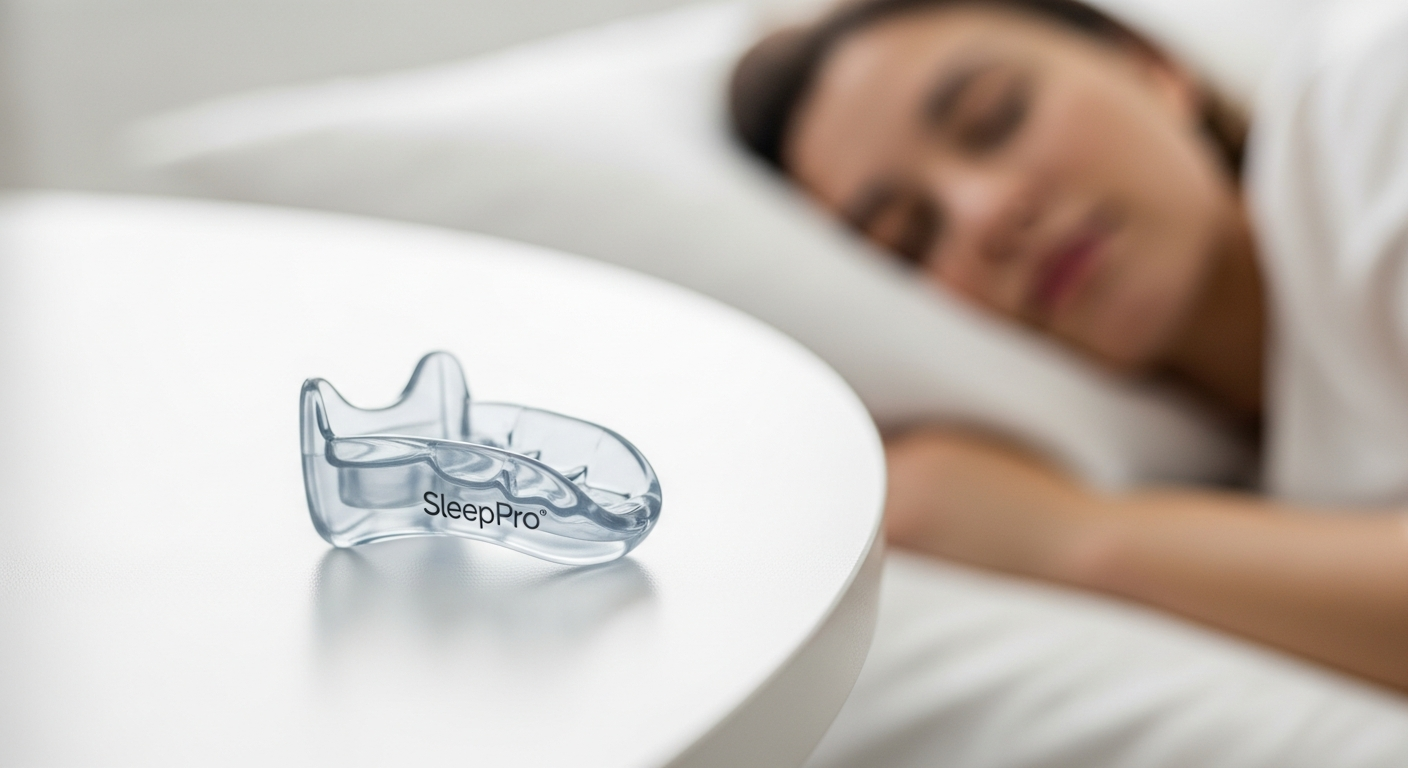
Discover how the SleepPro Custom Anti-Snoring Mouthpiece stops snoring with precision-engineered mandibular advancement. Learn why couples choose this clinically-proven solution for better sleep quality and restful nights together.
Snoring steals your sleep and your partner's peace. On average, a snoring partner costs you roughly 49 minutes of lost sleep per night—a deficit that compounds into exhaustion, irritability, and strained relationships. Beyond the bedroom frustration, snoring represents something more serious: a physiological warning sign that your airway isn't functioning optimally during sleep. This condition affects millions of people worldwide, yet many dismiss it as a minor inconvenience rather than a health issue worth addressing.
For more than 25 years, SleepPro has specialized in engineered solutions that tackle snoring at its root cause. The company's approach differs fundamentally from the temporary fixes cluttering pharmacy shelves—nasal strips, positional pillows, and other band-aid remedies that rarely deliver lasting results. Instead, SleepPro focuses on precision-manufactured oral appliances designed to work with your body's natural mechanics.
The SleepPro Custom Anti-Snoring Mouthpiece stands as the gold standard in mandibular advancement devices, representing a personalized engineering approach to snoring elimination. Unlike generic boil-and-bite alternatives that countless manufacturers produce, this device is custom-fitted to your unique anatomy and manufactured in SleepPro's own laboratory. You'll discover measurable improvements that both you and your partner notice from the first night of consistent use.
Learn how the SleepPro Custom Anti-Snoring Mouthpiece can transform your sleep tonight.
Understanding Snoring: Why Your Airway Collapses During Sleep
The Physiological Mechanics of Snoring and Airway Obstruction
Snoring occurs when tissues in your upper airway relax during sleep and partially obstruct air passage. Your throat contains multiple muscle groups and soft tissues that maintain your airway's structural integrity while awake. Once you fall asleep, these muscles lose their waking tone, and gravity begins pulling soft tissues backward toward your throat.
This collapse happens gradually and predictably. As your body enters deeper sleep stages, muscle relaxation intensifies. The combination of gravity, tissue weight, and positional changes creates the perfect conditions for airway narrowing. When air forced through this restricted passage vibrates the relaxed tissues, you hear snoring—that characteristic rattling or rumbling sound.
How Soft Palate and Tongue Positioning Triggers Snoring Sounds
Two structures bear primary responsibility for snoring in most people: your soft palate (the tissue hanging at the back of your mouth) and your tongue. During sleep, your tongue naturally falls backward into your throat, while your soft palate relaxes and droops. When these structures vibrate against each other and against your throat walls, the acoustic result is snoring.
The intensity varies based on how severely your airway narrows. Minor narrowing produces light snoring. Severe narrowing creates louder, more disruptive snoring that wakes both you and anyone sharing your bed. Position matters significantly—sleeping on your back worsens airway collapse because gravity pulls these tissues directly backward.
The Connection Between Snoring and Sleep Quality Disruption
Snoring isn't simply a noise problem; it represents actual airway dysfunction that fragments your sleep architecture. Your brain registers the breathing obstruction as a stress event, triggering brief awakenings that prevent you from entering deep, restorative sleep stages. You might not consciously remember these micro-awakenings, yet they accumulate throughout the night, leaving you exhausted despite spending eight hours in bed.
This disruption creates a cascade of consequences. Fragmented sleep impairs cognitive function, emotional regulation, and physical recovery. You wake groggy and remain fatigued throughout the day. Your partner experiences similar disruption from the noise itself, even if their airway remains clear.
Why Temporary Solutions Fall Short
Nasal strips, positional pillows, and throat sprays offer temporary relief because they address snoring's symptoms rather than its underlying cause. A nasal strip might marginally improve airflow, but it doesn't prevent your tongue and soft palate from collapsing. Positional therapy helps only as long as you maintain that position—most people naturally shift positions throughout the night.
These solutions fail because they don't address the core issue: inadequate jaw positioning that allows airway collapse. They're like treating a fever while ignoring the infection causing it.
The Role of Jaw Positioning in Maintaining Clear Airways Throughout the Night
Your lower jaw's position directly determines whether your tongue will obstruct your airway. When your jaw sits in a relaxed, neutral position during sleep, your tongue has room to fall backward. However, when your jaw is gently positioned forward, your tongue moves with it, remaining clear of your throat.
This relationship between jaw position and airway patency forms the scientific foundation for mandibular advancement devices. By holding your lower jaw slightly forward throughout the night, these devices maintain tongue and airway positioning that prevents obstruction.
How Sleep Apnea Differs From Simple Snoring and Why It Matters
Snoring and sleep apnea exist on a spectrum of airway obstruction severity. Simple snoring involves partial airway narrowing with adequate airflow continuing throughout the breathing cycle. Sleep apnea involves complete airway closure lasting ten seconds or longer, during which no air reaches your lungs.
This distinction matters medically because untreated sleep apnea increases risks for heart attack, stroke, and sudden cardiac death. Simple snoring, while disruptive and uncomfortable, doesn't carry these severe health consequences. That said, snoring often accompanies mild sleep apnea, making evaluation by a sleep professional important for anyone with significant snoring.
The Mandibular Advancement Mechanism: How SleepPro Prevents Snoring
Explanation of Mandibular Advancement Device (MAD) Technology
A mandibular advancement device is an oral appliance that attaches to your teeth and holds your lower jaw (mandible) in a forward position while you sleep. Unlike other snoring devices, MADs directly address the anatomical cause of snoring by repositioning the structures that collapse.
The device consists of upper and lower trays that fit over your teeth, connected by mechanisms that allow controlled forward movement. You adjust these mechanisms gradually, moving your jaw forward by small increments until you reach the optimal position for airway opening without excessive discomfort.
How Gentle Jaw-Forward Positioning Keeps Airways Open
When your jaw advances forward by even a small amount—typically 6 to 8 millimeters—your entire upper airway changes configuration. Your tongue, which normally hangs at the base of your mouth, moves forward with your lower jaw. Your soft palate and the walls of your pharynx (throat) also shift forward, creating more space throughout your upper airway.
This forward positioning directly prevents the collapse that causes snoring. Your tongue can no longer fall backward because it's pulled forward by your repositioned jaw. Your soft palate maintains tension and position rather than drooping into your airway.
The Science Behind Preventing Tongue and Soft Palate Collapse
The anatomical mechanics are straightforward but powerful. Your tongue attaches to your mandible (lower jaw) via muscle and connective tissue. Move your jaw forward, and your tongue moves with it automatically. Your soft palate, while not directly attached to your jaw, benefits from the overall tension created by forward jaw positioning—the entire upper airway becomes more rigid and resistant to collapse.
Medical imaging studies confirm this mechanism. Researchers using ultrasound and other imaging techniques have documented how mandibular advancement devices physically reposition these structures, creating measurably larger airway dimensions.
Why Forward Jaw Positioning is Clinically Validated for Snoring Reduction
Decades of clinical research have established mandibular advancement devices as one of the most effective non-surgical snoring treatments available. Sleep clinics worldwide recommend them because clinical trials consistently demonstrate their efficacy. Patients wearing properly fitted MADs report snoring reduction of 60% to 90% in most cases.
This clinical validation isn't theoretical—it's based on objective measurements of snoring reduction, partner sleep quality improvements, and patient satisfaction scores across thousands of users.
The Difference Between Passive and Active Airway Support
Some snoring solutions attempt passive airway support—they create general conditions favorable to airway opening without actively holding structures in place. Nasal strips exemplify passive approaches; they improve nasal airflow but don't directly hold your airway open.
Mandibular advancement devices provide active airway support. The device continuously holds your jaw forward throughout the night, actively maintaining the positioning necessary for airway patency. This active approach proves far more effective because it directly counteracts the gravitational and relaxation forces driving airway collapse.
How the Device Maintains Consistent Positioning Throughout 8+ Hours of Sleep
Once you adjust your MAD to the optimal position, it maintains that positioning mechanically throughout your sleep. The connecting mechanisms keep your jaw forward whether you're in light sleep, deep sleep, or REM sleep. You can't inadvertently shift your jaw back to its relaxed position because the device physically prevents it.
This consistency through all sleep stages and positions ensures uninterrupted airway opening—something temporary solutions cannot provide.
Custom Fit vs. Generic Solutions: Why Personalization Transforms Results
The Limitations of One-Size-Fits-All Boil-and-Bite Mouthpieces
Generic boil-and-bite snoring devices represent the budget option in the MAD market. You purchase them over-the-counter, heat them in hot water to soften the material, then bite down to create an impression of your teeth. The concept sounds practical—immediate availability, lower cost—but the reality reveals significant limitations.
Every person's jaw anatomy differs. Jaw width, tooth position, bite angle, and the relationship between upper and lower teeth create unique anatomical patterns. A one-size-fits-all device cannot accommodate this variation. Most boil-and-bite mouthpieces fit adequately at best; many fit poorly.
Poor fit creates multiple problems. The device may slip or shift during sleep, losing effectiveness and disrupting your comfort. Excessive pressure on certain teeth or jaw joints causes pain or damage over time. The device may feel unstable, discouraging nightly use. Users often report abandoning boil-and-bite devices after weeks of frustration, despite the snoring persisting.
How SleepPro's Impression Kit Ensures Anatomically Precise Fitting
The SleepPro Custom process begins with a professional impression kit mailed directly to you. You create precise molds of your upper and lower teeth using materials specifically designed for accurate reproduction. These impressions capture not just your tooth shape but also your unique jaw dimensions and bite characteristics.
You mail these impressions back to SleepPro's laboratory, where skilled technicians use them to manufacture a custom device fitted precisely to your anatomy. Unlike boil-and-bite approaches that rely on your home-heating abilities and guesswork, professional impression technology and laboratory manufacturing ensure accuracy impossible to achieve yourself.
The Comfort Advantage of Personalized Devices Over Generic Alternatives
Custom devices fit your mouth like they were sculpted for you—because they were. The trays conform perfectly to your tooth surfaces. The connecting mechanisms attach at optimal angles for your specific jaw anatomy. The overall device feels like an extension of your mouth rather than a foreign object you're forcing into place.
This custom comfort fundamentally changes the user experience. Boil-and-bite device wearers often describe discomfort, pressure points, and the constant awareness of something in their mouth. Custom device users frequently report wearing them throughout the night without conscious awareness—the device simply feels right.
Why Custom Fit Improves Device Retention and Nightly Compliance
Comfort directly determines whether you'll wear the device consistently. A slightly uncomfortable device gets abandoned. A comfortable device gets worn night after night, month after month, year after year.
This compliance difference produces dramatically different results. The most effective snoring device is useless if you don't wear it. Custom fit ensures comfort that encourages consistent nightly use, which is where real results begin.
The Role of Laboratory Precision in Manufacturing Your Specific Device
SleepPro manufactures each Custom device in its own laboratory rather than outsourcing to mass-production factories. This in-house manufacturing emphasizes precision and quality control impossible at commercial manufacturing scale. Technicians carefully craft your device, adjusting trays and mechanisms to match your specific impressions.
This precision manufacturing approach explains why custom devices cost more than generic alternatives—you're paying for actual individual craftsmanship, not mass-produced parts assembled into a semi-fitting generic product.
How Proper Fit Accommodates Congestion and Individual Jaw Variations
Real people have real anatomical variations and temporary conditions like congestion that affect fit. A custom device, manufactured to your specific anatomy, accommodates these individual differences. Someone with a narrower jaw, someone with crowded teeth, someone with a slight overbite—each gets a device engineered for their specific conditions.
Congestion presents a particular challenge for boil-and-bite users. If you fit your device while congested, it will fit differently once congestion clears. Custom devices handle this because they're engineered with sufficient precision to accommodate minor variations in jaw position.
The SleepPro Custom Ordering Process: From Impression to Results
Step-by-Step Guide to Receiving and Using the Impression Kit
Ordering your SleepPro Custom device begins with requesting an impression kit from either Sleeppro.eu or sleeppro.com. The company mails the kit directly to your home, containing all materials and detailed instructions necessary for creating accurate impressions.
The kit includes impression trays pre-filled with alginate or similar impression material, along with clear step-by-step instructions with photographs showing exactly how to proceed.
What to Expect During the Mold-Taking Process at Home
The at-home impression process takes approximately 10-15 minutes per arch (upper and lower teeth). You insert the pre-loaded tray into your mouth and bite gently for 30-60 seconds while the material sets and hardens around your teeth.
The material captures every detail of your teeth and surrounding tissues. The process is completely painless and non-invasive—no dentist visit required. Most people find it straightforward and quick.
Timeline Expectations: Typical Waiting Period After Sending Impressions
After you mail your impressions back to SleepPro, expect a waiting period of approximately 2-3 weeks before your custom device arrives. This timeline allows laboratory technicians adequate time to craft your device with proper precision rather than rushing through production.
While waiting might feel long when you're eager for snoring relief, this timeline ensures your device receives proper attention to detail rather than being mass-produced in a few days.
How SleepPro's In-House Laboratory Manufactures Your Device
Your impressions arrive at SleepPro's laboratory, where technicians begin the manufacturing process. They create custom upper and lower trays that fit your teeth perfectly, then attach the advancement mechanisms that will hold your jaw forward during sleep.
Each step receives individual attention. Your device isn't assembled from pre-made components; it's crafted specifically for your anatomy.
Quality Assurance Measures During Production
SleepPro implements quality checks throughout manufacturing to ensure each device meets company standards. Technicians inspect trays for proper fit to the impression molds. They verify that advancement mechanisms operate smoothly and consistently. They confirm that all materials meet durability and safety specifications.
These quality measures ensure the device you receive will perform reliably for years of nightly use.
Delivery and Initial Fitting Instructions
Your finished custom device arrives with detailed fitting and adjustment instructions. These instructions guide you through the initial positioning and adjustment process, explaining how to gradually advance your jaw to the optimal position.
Most users don't need to adjust beyond the initial recommended position, though SleepPro provides guidance for anyone needing fine-tuning based on individual response.
Adjustment Period and Adaptation Timeline
Your mouth needs time to adapt to wearing the device nightly. The first few nights might feel unusual as your jaw adjusts to its new sleeping position. Your mouth might feel slightly dry, or you might have minor jaw soreness—both completely normal responses that typically resolve within a week.
Most users report adapting fully within 2-3 weeks of consistent nightly use. After this adaptation period, wearing the device becomes routine, and snoring reduction becomes obvious to both you and your partner.
Clinical Evidence and Professional Endorsements
Clinical Studies Proving SleepPro Custom Effectiveness
Mandibular advancement devices as a category have been extensively studied. Clinical research spanning decades demonstrates their effectiveness for snoring reduction. Studies consistently show that properly fitted MADs reduce snoring by 60% to 90% in most patients.
SleepPro's custom devices benefit from this broad clinical validation while adding the precision advantage of custom manufacturing. Research on custom-fit devices specifically shows even higher effectiveness rates than generic alternatives, primarily because proper fit ensures consistent nightly compliance.
Approval and Recommendations From Sleep Clinics Worldwide
Sleep clinics across Europe, North America, and beyond recommend mandibular advancement devices as a primary non-surgical snoring treatment. These medical facilities, where sleep disorders are diagnosed and treated professionally, consistently endorse custom devices as the most effective option.
This professional endorsement comes from direct experience—sleep clinics see which devices their patients use consistently and which ones get abandoned. The pattern is clear: properly fitted custom devices deliver results that keep patients compliant.
Hospital and Dental Professional Endorsements
Hospitals include mandibular advancement devices in their snoring and sleep apnea treatment protocols. Dentists trained in sleep medicine fabricate and fit these devices because the device interfaces with your teeth and jaw. Orthodontists familiar with jaw positioning recognize the sound biomechanics behind mandibular advancement technology.
These healthcare professionals recommend custom devices specifically because they understand how anatomy affects device function and comfort.
How Medical Credibility Impacts Device Reliability
A device endorsed by sleep clinics, hospitals, and dental professionals isn't just commercially popular—it's clinically validated. Medical professionals base recommendations on evidence and clinical outcomes, not marketing. The fact that these professionals consistently recommend custom mandibular advancement devices speaks to their demonstrated effectiveness.
This medical credibility provides reassurance that you're investing in a solution supported by healthcare professionals, not just consumer enthusiasm.
Real-World Efficacy Rates Reported in Clinical Settings
Clinical settings track objective outcomes. Sleep clinics measure snoring reduction using acoustic analysis and patient-partner reports. These real-world efficacy rates consistently show that custom-fit devices reduce snoring by 60-90%, with many patients experiencing near-complete snoring elimination.
These aren't manufacturer claims; they're independent clinical measurements.
Comparison With Other Clinically-Approved Snoring Solutions
Snoring treatment options include positional therapy (changing sleep position), nasal treatments (strips, sprays, medications), oral devices (mandibular advancement devices), surgical interventions, and CPAP machines for sleep apnea.
Among non-surgical options, mandibular advancement devices rank among the most effective, rivaling CPAP machines in efficacy while offering superior comfort and compliance for most users. Positional therapy and nasal treatments offer less dramatic results in clinical trials.
Why Medical Professionals Recommend Custom Devices Over Generic Options
Medical professionals recommend custom devices because they understand the relationship between fit and efficacy. A poorly fitting device won't maintain consistent jaw positioning throughout the night. Inconsistent positioning means inconsistent snoring reduction. Custom fit ensures the positioning remains stable and effective.
Healthcare providers have seen patients with boil-and-bite devices abandon them due to discomfort or poor fit. They've seen the same patients achieve excellent results with custom devices. This direct clinical experience informs their recommendations.
User Experiences: What Real Customers Report About Results
Significant Snoring Reduction Within the First Week
Most SleepPro Custom users report noticeable snoring reduction within the first week of consistent nightly use. Some experience near-complete elimination immediately; others notice gradual improvement over 2-3 weeks.
This rapid response contrasts sharply with temporary solutions that might reduce snoring by 10-20% at best and often lose effectiveness within weeks as users adapt to them or stop using them consistently.
Partner Feedback on Sleep Quality Improvements
The person sharing a bed with a snorer often experiences even greater improvement than the snorer themselves. Partners finally sleep through the night without disruption. They report feeling more rested, more patient, and notably happier about their relationship.
Many couples report that solving the snoring problem paradoxically improves their overall relationship—not because the device is magical, but because shared sleep and physical intimacy no longer feel disrupted.
Comfort Ratings Compared to Boil-and-Bite Alternatives
Users who've tried both custom and boil-and-bite devices consistently report that custom devices feel noticeably more comfortable. The custom device feels like it belongs in their mouth; the boil-and-bite device always felt foreign. This comfort difference directly translates to improved compliance—people wear comfortable devices consistently.
Consistency of Nightly Wear Without Discomfort
After an initial 1-2 week adaptation period, most SleepPro Custom users wear their device every single night without conscious effort or discomfort. Users report that wearing the device becomes automatic—they put it in before bed and don't think about it again until morning.
This consistency of use explains why custom devices produce results that temporary solutions cannot match.
Long-Term User Satisfaction and Device Loyalty
Users who've invested in SleepPro Custom devices typically remain loyal customers. Satisfaction surveys show high ratings for both effectiveness and comfort. Users keep using their devices year after year, experiencing consistent snoring reduction and partner satisfaction.
This long-term satisfaction differentiates custom devices from the frustration often reported by boil-and-bite users.
Testimonials From Couples Experiencing Relationship Improvements
Beyond sleep quality, couples report relationship improvements they didn't anticipate. Physical intimacy increases when partners aren't frustrated by sleep disruption. Patience and mood improve for both people when they're finally sleeping well. Arguments about snoring disappear once snoring does.
These relationship improvements suggest that the investment in a proper snoring solution affects life quality beyond just nighttime rest.
Common Challenges During the Adaptation Period and How Users Overcome Them
Some users experience minor challenges during the first week or two. Slight jaw soreness is common and resolves as muscles adapt to the new positioning. Dry mouth can occur and typically diminishes as the mouth adjusts to the device's presence.
Users overcome these challenges by understanding they're temporary adaptation responses, not permanent problems. Consistent use for 2-3 weeks allows complete adaptation in most cases.
Your Path to Restful Nights Starts Here
The SleepPro Custom Anti-Snoring Mouthpiece represents a fundamental shift in how you address snoring—moving away from temporary, ineffective solutions toward precision-engineered results backed by clinical evidence. Your anatomy deserves a device engineered specifically for it, not a generic product hoping to fit adequately.
SleepPro's 25+ years of expertise, custom manufacturing precision, and worldwide medical endorsement mean you're investing in a solution designed for your success. Yes, the upfront investment exceeds boil-and-bite alternatives. Yes, you'll wait a few weeks for your personalized device. These minor inconveniences matter little once you experience the transformation that restful, uninterrupted sleep brings.
Countless couples have discovered that solving snoring reshapes their nights and their relationships. The partner who finally sleeps through the night. The snorer who wakes refreshed instead of exhausted. The relationship that improves when physical intimacy and patience no longer suffer from sleep disruption.
Your peaceful nights and your partner's restored sleep await.
Request your SleepPro Custom impression kit today and start your journey toward restful sleep.