
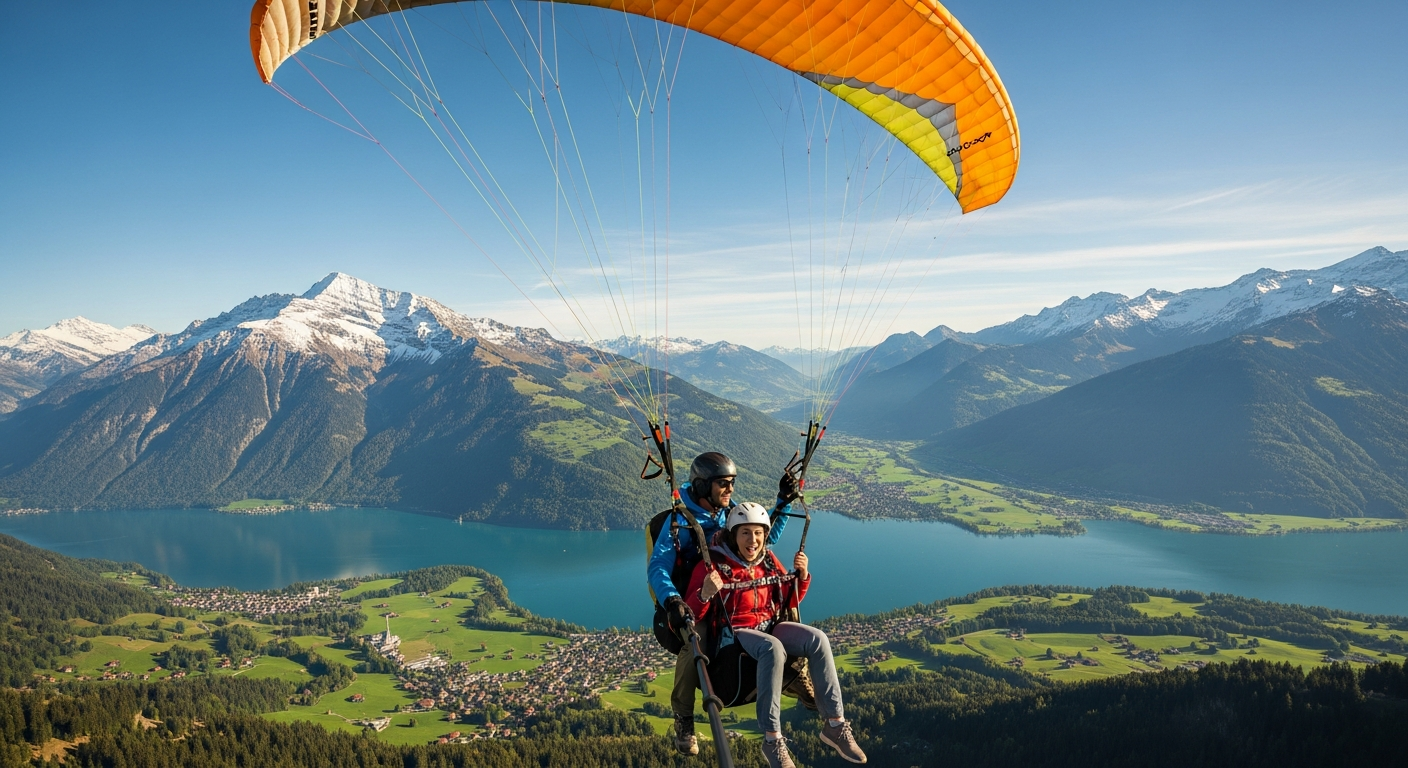
Discover everything about tandem paragliding in Interlaken. Learn costs, safety, flight duration, and why this Swiss Alps adventure ranks as the top-booked activity. Book your unforgettable experience today.
Imagine floating 1,400 meters above turquoise lakes, the Eiger's jagged peaks rising before you, nothing between you and the Alps but air and wonder. Over 10,000 visitors book tandem paragliding experiences in Interlaken every year—from honeymooners to retirees checking off bucket-list dreams. Each one discovers something similar: the combination of genuine adrenaline and profound peace that few activities deliver.
Tandem paragliding has become the crown jewel of Switzerland's adventure tourism scene, where certified pilots handle all technical complexity while you float through breathtaking Alpine scenery. The experience strips away the months of training required for other aerial sports, replacing it with straightforward preparation and professional guidance. What remains is pure sensation: the wind across your face, the silence of altitude, and landscapes unfolding beneath you in ways ground-based activities simply cannot match.
This comprehensive guide walks through every aspect of tandem paragliding in Interlaken—from what happens during your 1.5-hour experience to real costs, safety protocols, and weather realities. By the end, you'll understand exactly why this activity consistently outperforms other Swiss adventures in customer satisfaction ratings.
Start planning your tandem paragliding adventure on Swissactivities CH today.
Why Tandem Paragliding in Interlaken Stands Apart
Unmatched Aerial Perspective
The view from a paraglider's harness cannot be replicated. The Eiger's north face dominates the horizon with raw geological drama. The Mönch and Jungfrau frame the scene on either side, their snow-covered slopes catching afternoon light in ways photographs struggle to capture. Below, the twin lakes of Thun and Brienz shimmer turquoise against forested valleys. This perspective belongs exclusively to those floating above the landscape rather than traversing it.
True Accessibility for Everyone
Tandem paragliding requires no prior experience, no months of training, no special athletic ability. Unlike hang gliding's technical demands or mountaineering's physical endurance requirements, this activity meets you where you are. Retirees alongside adventure seekers, nervous fliers alongside adrenaline junkies—all find their place here. The certified pilot manages every technical decision while you experience the pure sensation of flight.
The Adrenaline-Serenity Paradox
Most people expect paragliding to feel chaotic—wind rushing, heart pounding throughout. Instead, participants frequently describe unexpected stillness. Yes, the launch delivers adrenaline. Yes, the altitude awareness registers acutely. But then comes something unexpected: silence. Genuine quiet. The world below grows distant, and you're suspended in a moment that feels simultaneously thrilling and meditative. Nervous fliers often report that this paradox—the combination of safety with genuine sensation—makes the experience transformative rather than terrifying.
Professional Pilots Handle All Decisions
Your pilot brings extensive international certifications and flight hours. They assess weather in real time, select launch sites based on conditions, manage every technical aspect of flight dynamics. You arrive nervous, follow instructions, and discover that trusting an expert allows you to relax into the experience rather than analyzing it.
Iconic Landscape Immersion
A single 15-minute flight reveals more of the Swiss Alps' character than days of ground-based activities. You witness the geological relationships between mountains, understand valley geography in ways maps cannot convey, and experience the scale and majesty of this landscape from the perspective it demands.
Consistently High Satisfaction Across Platforms
Booking platforms consistently rank tandem paragliding among Interlaken's top-rated activities. Customer satisfaction scores exceed 90% across multiple operators. These aren't marketing claims—they're verified reviews from thousands of actual participants describing genuine experiences.
What Happens During Your Tandem Paragliding Flight
Pre-Flight Preparation
Your 1.5-hour experience begins well before takeoff. Upon arrival, operators fit you with a harness, helmet, and safety equipment. The harness connects you directly to your pilot—you're literally tethered together throughout the flight. A safety briefing follows: information about what to expect, how to position your body, what happens during launch and landing. This preparation typically consumes 30-40 minutes. Most of that time involves equipment checks and simple instruction rather than overwhelming technical detail.
Scenic Ascent to Launch Site
From Beatenberg or Grindelwald, you hike or ride to the launch site, ascending anywhere from 20 to 60 minutes depending on your chosen location. This ascent matters more than it initially appears. As you climb higher, the view expands. By the time you reach launch altitude, your mind has adjusted to elevation, and the surrounding landscape has revealed itself gradually rather than shocking your senses.
The Launch Sequence
Launch feels gentler than many expect. You're not stepping off a cliff or throwing yourself into space. Instead, you and your pilot position yourselves at the launch site, facing into the wind. The pilot manages the wing inflation—controlling the paraglide itself as it fills with air. Then, you're simply walking forward, and the wing carries you upward. Within seconds, your feet leave solid ground, and you're airborne. The transition happens so smoothly that first-time fliers often miss the exact moment of liftoff.
The Flight Itself
Your actual flight duration ranges from 10 to 20 minutes depending entirely on weather conditions and thermal activity. Thermals—rising columns of warm air—allow pilots to stay aloft longer. On optimal days, you might soar for 20+ minutes. On other days, a more direct flight lasts 12 minutes. This variability frustrates some participants accustomed to fixed-duration experiences, but experienced fliers understand it's part of the sport's nature.
During flight, you have genuine freedom. The harness holds you securely, allowing you to move, gesture, and simply experience without gripping something in fear. Many people bring their hands away from the harness within minutes, sensing stability and trusting the system. Photographers position themselves for shots. Videographers capture your expressions and reactions. You simply exist in this peculiar moment—suspended, weightless, witnessing landscape from an impossible vantage point.
Controlled Landing
Descending follows the same smooth principle as launching. Your pilot guides the paraglide toward the landing zone—usually a grassy field in the valley below. As ground approaches, you touch down in a controlled run rather than an abrupt drop. Most landings feel nearly as gentle as the launch. You're standing on solid earth before you fully register the flight has ended.
Post-Flight Experience
After landing, your pilot guides you through equipment removal and a brief debrief. Many operators offer photo or video review immediately, allowing you to see your own reactions. They typically present you with a certificate commemorating your flight—a tangible reminder of something that felt impossible hours earlier.
The Real Cost of Tandem Paragliding in Interlaken
Base Flight Price
Standard tandem paragliding flights range from CHF 200 to CHF 250 per person (approximately $220-$250 USD). This base price includes the certified pilot, all safety equipment, your flight duration, and ground logistics. Multiple operators cluster around these price points, suggesting genuine market equilibrium rather than arbitrary pricing.
Media Packages
Photography adds significant value for participants wanting professional documentation. Standard photo packages cost CHF 50-100, delivering high-resolution images captured during flight. Video packages range from CHF 80-150 depending on video length, editing quality, and delivery format. Some operators offer combo packages bundling photos and video at 10-20% discounts compared to purchasing separately.
Group and Seasonal Dynamics
Booking multiple flights simultaneously often triggers group discounts of 5-15%. Peak summer months (June-August) sometimes see slight price increases due to demand, while shoulder seasons (May, September) maintain standard pricing with better availability. Winter flights remain priced consistently despite lower volume, as operational costs remain constant regardless of season.
What's Included Versus Hidden Costs
The base price includes your pilot, all safety equipment, and the flight experience. Transportation to launch sites sometimes requires vehicle access or cable car fees—typically CHF 15-30 beyond the flight cost. Parking at operator facilities is usually complimentary. Tips for pilots aren't mandatory but customary in Swiss culture, running CHF 10-20 depending on satisfaction.
Comparison to Other Activities
At $220-250 for 10-20 minutes of actual flight time, tandem paragliding costs roughly 40-50% less than helicopter tours offering similar aerial perspectives. It's considerably more expensive than cable car rides (CHF 30-50) but delivers vastly more intimate experience. Skydiving costs similarly but offers different sensation profiles. The cost-to-experience ratio ultimately depends on what you value—duration, personalization, or specific sensory elements.
Safety Standards and Weather Realities
Professional Certification and Training
All tandem paragliding pilots in Switzerland maintain international certifications—typically European or Swiss federation credentials requiring hundreds of flight hours. These aren't casual enthusiasts; they're professionals whose livelihoods depend on safety records. Background checks and insurance requirements are substantial. Each pilot undergoes regular recertification and continuing education in meteorology, emergency procedures, and equipment maintenance.
Equipment and Redundancy Systems
Modern paraglides incorporate multiple safety systems. Each harness contains a primary parachute and a backup parachute designed to deploy automatically if the main wing fails. Emergency descent procedures exist for virtually every scenario. Equipment undergoes regular inspection—paraglides typically retire after 500-800 flight hours regardless of condition. Nothing is left to chance or deterioration.
Real-Time Weather Assessment
Before every single flight, pilots conduct detailed weather evaluation. They assess wind speed and direction, cloud formations, atmospheric stability, and thermal potential. Flights are canceled or rescheduled if conditions fall outside safe parameters. This means that yes, your carefully planned vacation day might result in cancellation. But it also means you won't find yourself airborne in genuinely dangerous conditions. Over 85% of scheduled flights launch successfully, with most cancellations occurring in winter months.
Flight Duration Variability
Weather directly determines how long you remain aloft. Thermal conditions—rising warm air—allow extended flight. On calm, unstable days, pilots descend more directly. This variability surprises participants expecting guaranteed durations. However, pilots consistently fly as long as conditions safely permit, so you're receiving the maximum experience possible on any given day.
Medical and Eligibility Considerations
Age restrictions are minimal—participants as young as five have flown successfully alongside retirees in their 80s. Physical fitness requirements are modest; the harness handles all mechanical load. However, certain conditions preclude participation: advanced pregnancy, recent surgery, severe heart conditions, or significant mobility limitations. Operators screen for these during booking to ensure participant safety and comfort.
Seasonal Flight Success Rates
May through September offers 85-95% flight success rates, with most days launching successfully. October and April see 75-80% success as weather becomes less predictable. Winter (December-February) drops to 60-70% due to cloud cover and atmospheric instability. This doesn't mean winter is impossible—stunning clear days occur regularly—but rather that winter participants should maintain scheduling flexibility.
Choosing Between Launch Sites
Beatenberg: Valley and Lake Perspectives
Launching from Beatenberg at approximately 1,400 meters elevation provides direct views of Interlaken itself—the town nestled between lakes Thun and Brienz. From this perspective, you witness the geographical relationship between populated areas and surrounding wilderness. The flight often includes low-altitude passes over the lakes themselves, creating that visceral sensation of proximity to water while airborne. Beatenberg attracts more casual tourists and families due to easier accessibility via cable car from Interlaken.
Grindelwald: Alpine Drama and Isolation
Grindelwald's launch sites sit at 2,000+ meters elevation, offering higher altitude and different perspectives. The Eiger's north face dominates views from this perspective—more dramatic, more imposing. Flights from Grindelwald often last longer due to increased thermal potential at higher altitude. The experience feels more remote, less touristy, and more integrated with serious mountaineering culture. The terrain requires more hiking, which self-selects for participants seeking deeper alpine immersion.
Altitude and Flight Duration Relationships
Higher launch sites yield longer flight potential. Grindelwald's extra 600 meters of elevation often translates to 15-25 minute flights versus Beatenberg's typical 12-18 minutes. However, flight duration depends primarily on weather conditions and thermal activity—altitude provides potential rather than guarantee.
Landscape and Perspective Differences
Beatenberg offers expansive valley geography—understanding how human settlements fit within Alpine terrain. Grindelwald provides peak-focused perspective—experiencing the raw drama of specific mountains. Your preference determines which site serves you better. Paragliders often fly from both locations across multiple visits, each offering distinct value.
Accessibility Considerations
Beatenberg accessibility via cable car from Interlaken town takes roughly 30 minutes. Grindelwald requires either cable car access followed by hiking or hiking directly from the village. Transportation timing and physical effort differ substantially. Neither is inherently superior—the choice reflects personal preference and physical capability.
Pilot Recommendations
Your chosen operator will recommend specific sites based on your experience level, stated preferences, and current weather conditions. Trust their expertise. They understand daily variations, know which sites offer optimal conditions for particular wind directions, and recognize which locations match participant comfort levels.
Booking Your Experience on Swissactivities CH
Platform Advantages
Swissactivities CH aggregates multiple verified operators, displaying reviews, certifications, and availability in single interface. Rather than researching individual companies, you compare options directly. Operators on the platform maintain verified credentials and comply with Swiss tourism standards.
Advance Booking Versus Same-Day Flexibility
You can reserve flights weeks in advance through Swissactivities CH's online booking system or attempt same-day booking based on weather forecasts. Advance booking guarantees spot allocation and allows planning around other vacation activities. Same-day booking leverages real-time weather assessment, maximizing flight probability. Most operators offer free rescheduling within 30 days, so advance booking carries minimal risk if weather requires postponement.
Review and Verification
Read recent reviews from other participants. Swissactivities CH verifies purchaser status, preventing fake reviews. Pay attention to specific details: did reviewers mention pilot communication style? Equipment condition? Post-flight experience quality? These specifics matter more than star ratings alone. Check pilot certifications listed within operator profiles.
Payment and Currency Options
Online payment through Swissactivities CH accepts multiple currencies and payment methods. Transactions occur securely through encrypted systems. You'll receive booking confirmation immediately with detailed itineraries, operator contact information, and weather-dependent scheduling procedures.
Detailed Itineraries and Communication
Your booking confirmation includes specific meeting locations, arrival times, what to bring, and what to expect. Most operators provide WhatsApp or email contact for last-minute questions. They'll communicate weather-dependent scheduling in real time—typically confirming or rescheduling flights 24-48 hours in advance.
Support and Changes
Responsive support teams handle questions and modifications. If weather forces rescheduling, operators work with you to accommodate alternative dates within your vacation window. Cancellation policies vary—read them carefully during booking. Most operators offer full refunds for weather cancellations or reschedule with no additional charge.
Honest Assessment of Pros and Cons
Genuine Advantages
The perspective is legitimately unforgettable. Landscapes reveal themselves from angles impossible to experience otherwise. The sensation of weightlessness combined with genuine safety creates experiences participants describe as life-changing. For people carrying fear of heights, completing a tandem paragliding flight frequently builds confidence extending into other areas of life. The activity requires no previous experience, no months of training, and no special athletic ability—accessibility is genuine.
The photography opportunities are extraordinary. Every participant receives Instagram-worthy imagery naturally. The shared vulnerability of floating above Alps with a stranger often creates unexpected bonds between partners—couples frequently report intensified connection afterward.
Legitimate Drawbacks
The 10-20 minute flight duration for $220-250 investment frustrates participants viewing it as premium activity with relatively brief delivery. Unlike all-day hiking or multi-day mountaineering, you're investing substantially for what amounts to minutes of actual flight time. That math doesn't feel favorable to everyone.
Weather unpredictability remains genuinely disruptive. Your carefully planned vacation day may result in cancellation or rescheduling. While operator flexibility helps, some participants simply can't reschedule within vacation windows. Multiple cancellations across a week-long trip are possible, particularly in shoulder or winter seasons.
You have zero control over the experience itself. Everything depends on your pilot's expertise, the day's specific conditions, and factors entirely outside your influence. Participants accustomed to controlling their own activities sometimes struggle with this complete dependence.
The Honest Middle Ground
Tandem paragliding delivers legitimate value for most participants. The experience creates memories lasting decades. However, it's not universally perfect. If you're budget-conscious and value maximum activity duration per investment, if your vacation schedule cannot accommodate rescheduling, or if you need personal control over your experience, alternative activities might serve you better. But if you prioritize perspective-shifting experiences, genuine thrills combined with safety, and memorable storytelling, tandem paragliding consistently delivers.
Preparation Tips and What to Pack
Clothing Strategy
Wear warm layers. Altitude temperature drops roughly 6.5 degrees Celsius per 1,000 meters of elevation. At launch altitude, you'll experience 8-10 degrees Celsius cooler conditions than valley floor. Wind chill amplifies this significantly during flight. Wear a wind-resistant jacket over multiple base layers. Cotton absorbs moisture and loses insulation when wet—synthetic or wool layers perform better. Your operator provides harness and helmet, but you provide appropriate clothing.
Footwear Specifics
Wear sturdy hiking boots with good ankle support. Launch site ascents involve uneven terrain, and ankle injuries occur primarily during hiking rather than flight. Proper footwear prevents these preventable accidents. Your pilot will likely hike with you—their recommendations matter. Avoid flip-flops or sandals regardless of vacation resort culture.
Sun Protection
Intense UV exposure at altitude requires serious sun protection. The sun reflects off snow (particularly relevant near Alpine peaks) and affects skin directly from above. Wear high-SPF sunscreen, apply generously before departure, and reapply if your experience extends beyond two hours. Sunglasses protect eyes from glare and wind. A hat provides additional sun and wind protection.
Fitness Expectations
No extreme fitness is required, but reasonable fitness helps significantly. Launch site hikes range from gentle 20-minute walks to more strenuous 60-minute climbs. If you experience difficulty with moderate hiking, consult your operator about site recommendations or cable car options.
Mental Preparation
Breathing exercises and positive visualization genuinely reduce pre-flight anxiety. Practice controlled breathing on your hike to launch—this calms your nervous system before you even reach the site. Mentally rehearse what you'll experience based on operator briefing. Remember that thousands of people complete this flight annually with enthusiastic results.
Device and Media Considerations
Secure personal devices or use professional operator photography services. Dropping a phone from altitude is unrecoverable—either use operator cameras or secure devices extremely well. Most participants choose professional operator photos rather than managing personal devices during flight.
Medication and Medical Considerations
Take necessary medications before your experience. Limited opportunities exist during flight for addressing medical needs. If you take motion sickness medication, take it before launch. Some people experience motion sickness during paragliding despite expecting otherwise—medications should be preventative rather than reactive.
Timing and Punctuality
Arrive 15-20 minutes early for parking and check-in. This prevents last-minute rushing and allows your nervous system to acclimate. Operators begin activities on schedule, and late arrivals may forfeit spots or experience abbreviated experiences.
Real Participant Stories and Experiences
Transformation of Initial Fear
Most nervous participants report that anxiety transforms within minutes of launch. The gentle liftoff, the immediate sensation of control despite initial nervousness, and the pilot's calm professionalism combine to create surprising confidence. People who spent months dreading the experience frequently describe exhilaration dominating the actual flight. The anticipation proved more stressful than the reality.
Unexpected Silence and Stillness
Participants consistently express surprise at the quiet. They expect noise—wind roaring, harness creaking, pilot communications. Instead, they encounter genuine silence. The paraglide creates minimal noise, and altitude removes street sounds entirely. This unexpected tranquility creates space for profound experience—wonder, clarity, and perspective shift.
Moments of Profound Clarity
Floating above familiar landscapes somehow shifts mental processing. People describe sudden clarity about life decisions, unexpected gratitude for relationship, or surprising emotional responses to landscape beauty. Whether this reflects genuine psychological shift or simply the removal of daily distractions remains unclear, but the emotional impact is real and consistent across participants.
Repeat Bookings from Initially Anxious Fliers
Nervous participants become enthusiastic repeat customers at remarkably high rates. Someone terrified of heights completes their first flight, experiences genuine thrills combined with genuine safety, and books a second flight within months. This pattern repeats consistently—fear transformation predicts loyalty.
Wind and Altitude Awareness Surprises
Participants consistently report that wind pressure feels different than expected. Rather than constant buffeting, you experience sustained pressure—more akin to leaning against something than being knocked around. Altitude awareness registers differently too; you're conscious of elevation but not in ways that produce dizziness. The body adapts more readily than minds expect.
Relationship Bonding Through Shared Vulnerability
Couples frequently report that sharing vulnerable experience—genuinely frightening yet ultimately thrilling—creates unexpected bonds. The shared trust in pilot expertise, mutual support through fear, and joint celebration of accomplishment strengthen relationships in ways expensive dinners don't.
Video Regret
Approximately 40-50% of participants who didn't invest in professional video report regret. "I wish I had captured this" becomes common retrospective comment. The memory fades faster than participants expect, and video becomes invaluable for re-experiencing and sharing the moment.
Seasonal Timing for Your Adventure
Summer: Optimal but Crowded
June through August offers consistently excellent flight conditions with 90%+ success rates. Weather stability peaks, and thermal activity is predictable. However, demand is maximum—booking fills 2-4 weeks in advance, prices are highest, and launch sites become crowded. Peak summer feels like an Alpine theme park rather than wilderness adventure.
Shoulder Seasons: The Sweet Spot
May and September offer excellent weather (85%+ flight success rates), dramatically fewer participants, and maintained pricing. Your experience feels less touristy. Morning hikes to launch sites are peaceful rather than crowded. You're more likely to secure preferred dates with less advance planning. If your vacation schedule permits flexibility, shoulder seasons offer superior value across multiple dimensions.
Winter: Stunning but Unreliable
December through February feature snow-covered peaks providing stunning visual contrast. Flight success rates drop to 60-70% due to weather unpredictability. However, when conditions align, winter flights offer dramatic perspectives unavailable other seasons. You'll experience fewer tourists and potentially longer flights if thermals develop. But weather unpredictability demands flexibility.
Spring: Improving Conditions
March and April show progressively improving conditions as weather stabilizes moving toward summer. Flights in late April rival shoulder season reliability. Spring offers acceptable flight probability combined with fewer crowds than summer. Wildflower blooms are beginning (though not full by spring), adding landscape variety to your aerial perspective.
Time-of-Day Considerations
Afternoon flights typically offer better thermal conditions than mornings. Thermals develop as ground warms, usually peaking between 2-4 PM. Early morning flights often involve more direct descents. However, morning flights provide clearer skies with less haze. Choose timing based on your preference: longer thermal flights versus clearer visibility.
Multi-Day Weather Forecasting
Reliable weather forecasts become available 5-7 days in advance. Rather than booking specific dates and hoping, monitor forecasts then book when favorable conditions appear likely. Most operators accommodate flexible scheduling within their capacity.
Peak Season Booking Strategy
July-August requires 2-4 week advance reservations. Late bookings find complete unavailability. Shoulder seasons permit 1-2 week advance booking with better availability. Winter permits shorter booking windows due to lower demand. Plan accordingly based on your travel dates.
Comparing to Other Interlaken Adventure Activities
Versus Skydiving
Skydiving delivers more intense adrenaline but briefer flight duration (typically 5-8 minutes versus paragliding's 10-20). Skydiving costs similarly but feels less integrated with landscape—you're falling fast, experiencing primarily adrenaline. Paragliding allows observation and appreciation of scenery. The experience feels more serene and contemplative despite being genuinely thrilling.
Versus Hang Gliding
Hang gliding offers similar aerial perspectives but requires training, certification, and substantial personal commitment. Tandem paragliding requires zero training and minimal personal responsibility. Hang gliding delivers more control and potentially longer flight duration, but paragliding accessibility makes it preferable for most tourists.
Versus Cable Car and Hiking
Cable cars and hiking reveal Alpine landscapes but from ground-perspective. You understand topology and terrain but lack the comprehensive view paragliding provides. These ground-based activities cost substantially less but deliver fundamentally different experiences. Paragliding offers perspective impossible from the ground.
Versus Helicopter Tours
Helicopter tours cost 50-100% more than paragliding while delivering shorter duration or similar length flights. Helicopter experiences are more passive—you're sealed in a cabin observing landscape. Paragliding is intimate and embodied—you're genuinely suspended in the environment rather than observing it through windows.
Versus Canyoning
Canyoning is water-based adventure involving rappelling and swimming through Alpine canyons. It delivers different thrills—water immersion, technical skill engagement, physical exertion. Paragliding is aerial meditation compared to canyoning's active intensity. Neither is superior; they satisfy different adventure motivations.
Versus Mountaineering
Mountaineering requires multi-day commitment, significant fitness, and technical training. Paragliding delivers Alpine immersion in 1.5 hours without months of preparation. Mountaineering offers deeper Alpine integration but demands vastly more investment.
Versus Zip-lining
Zip-lining provides brief thrills but limited duration and fixed pathway. Paragliding offers extended flight with genuine freedom of movement and genuine altitude immersion. Cost is comparable, but paragliding delivers vastly more comprehensive experience.
The Verdict
Tandem paragliding offers unique combination of accessibility, duration, and perspective. No other single activity delivers comparable value across these dimensions. Whether it's optimal depends on personal priorities, but for tourists prioritizing unique experience requiring no prior training, tandem paragliding consistently outperforms alternatives.
Your Swiss Alps Adventure Awaits—The Time to Book Is Now
Tandem paragliding in Interlaken represents far more than another tourist activity—it's a transformative experience combining accessibility with genuine adrenaline, natural beauty with personal achievement. Thousands of visitors choose this adventure annually, and their enthusiastic reviews consistently rank it among Switzerland's most rewarding experiences.
Whether you're concerned about cost-to-duration ratios, weather unpredictability, or trusting a pilot with your safety, certified professionals manage all technical aspects while you focus purely on soaring above the Eiger, Mönch, and Jungfrau. The 10-20 minutes of actual flight time delivers memories lasting decades. Nervous fliers become repeat customers. Solo travelers forge unexpected bonds with partners. Participants consistently report that tandem paragliding exceeded their expectations across every dimension.
Your next step is straightforward. Visit Swissactivities CH, compare operator reviews and certifications, check your preferred dates against weather forecasts, and secure your spot. Availability is abundant during shoulder seasons and limited during summer peaks—factor this into your timing. Read recent participant reviews to understand which operators match your preferences and communication style.
The Swiss Alps have been waiting to reveal themselves from the sky. Your perspective shift begins the moment you step off that launch site.