
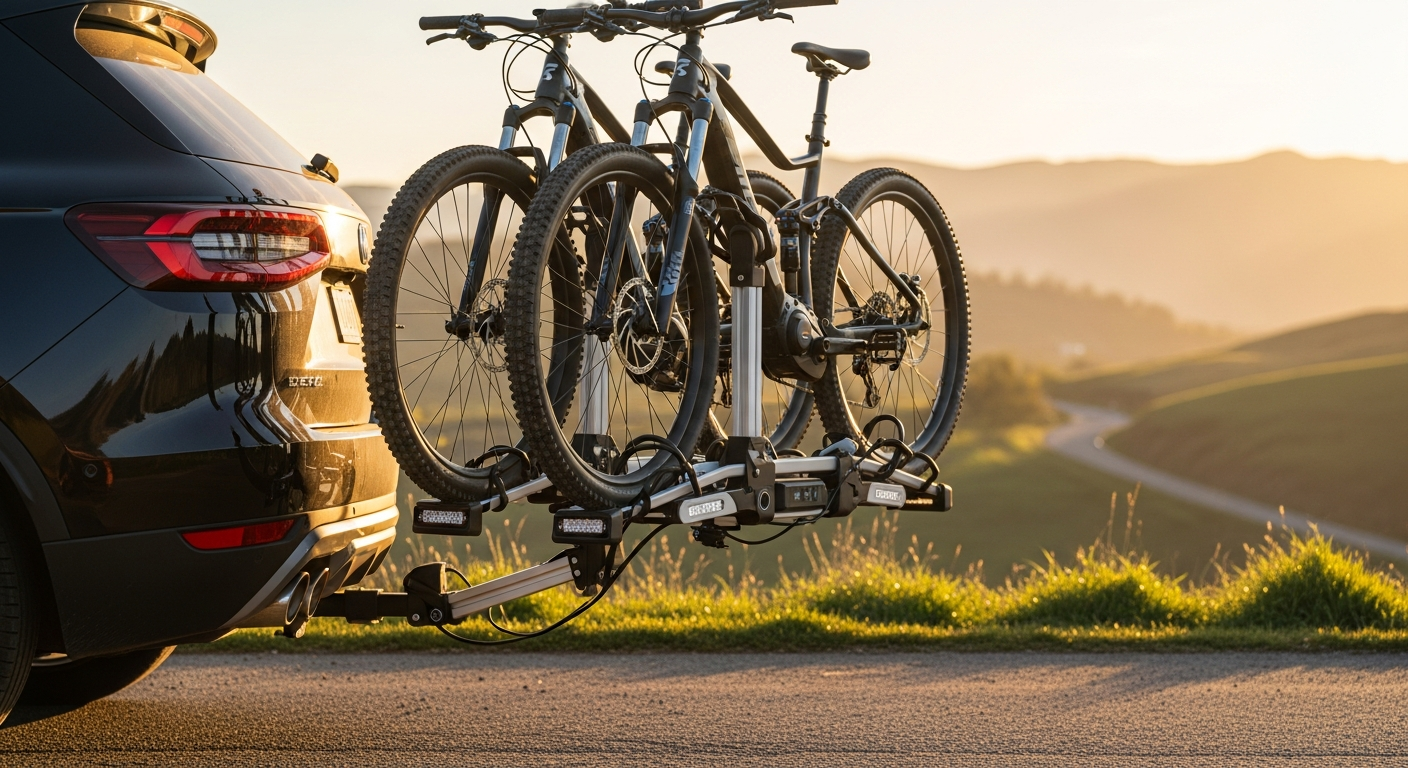
Discover how the Young Electric 2-Bike Hitch Rack handles 200 lbs of e-bike weight with anti-wobble stability. Read our complete review, setup tips, and real-world performance insights.
More than 60% of e-bike owners struggle with transporting their heavy machines—and one wrong move can damage your vehicle's suspension or leave you stranded on the roadside. Electric bicycles tip the scales at 45-80 pounds each, which means hauling two of them requires serious equipment, not just any bike rack bolted to your hitch. The challenge isn't just about space; it's about having the right infrastructure to handle the concentrated weight these machines represent.
Specialized transport solutions have become necessary as e-bike adoption explodes across the country. Standard bike racks designed for lightweight aluminum frames simply weren't engineered to manage the forces that heavy electric bicycles generate during transport. Vehicle owners quickly discover that inadequate equipment leads to sagging suspension, damaged hitch receivers, and worst-case scenarios where bikes shift during travel.
The Young Electric 2-Bike Hitch Rack keeps appearing in conversations among serious riders because it's built specifically for the demands of electric bicycles—accommodating up to 200 pounds total weight while keeping your bikes locked down tight through rough terrain. Explore the Young Electric 2-Bike Hitch Rack today to see if it matches your transportation needs. This guide breaks down its weight capacity, compatibility with different bike styles, real installation challenges, road performance, and whether the $300 price tag delivers genuine value.
Why E-Bike Owners Need Specialized Hitch Rack Solutions
The unique weight distribution challenges of electric bicycles versus standard bikes
Electric bicycles operate under completely different physics than traditional bikes. A standard aluminum road bike weighs 20-30 pounds, while an e-bike easily reaches 50-80 pounds due to the battery pack, motor, and reinforced frame components. This weight concentration changes everything about how your rack must function. The heavier your load, the more force concentrates at a single point—your vehicle's hitch receiver.
How standard bike racks fail under e-bike loads and create safety risks
Conventional hanging-style racks weren't designed with motor-driven bicycles in mind. They distribute weight across the frame tubes, which works fine for lightweight bikes but creates dangerous leverage situations with heavy e-bikes. The extended reach from your vehicle's bumper multiplies the force applied to your hitch system. Vehicle owners report hearing creaking sounds, noticing hitch sag, and experiencing movement that suggests the entire assembly could fail. Beyond vehicle damage, improperly secured e-bikes shift during turns or sudden stops, potentially breaking free or tipping the entire rack assembly.
The strain that heavy e-bikes place on vehicle suspension and hitch systems
Your vehicle's hitch system has a weight rating—usually between 300-500 pounds for standard hitches—but this includes tongue weight. Tongue weight refers to the downward force applied directly over the hitch ball. Two e-bikes weighing 100-160 pounds total create substantial tongue weight that depresses your vehicle's rear end, changing suspension geometry and affecting braking performance. Over time, this repeated stress weakens hitch components and accelerates suspension wear.
Why platform-style racks outperform hanging designs for e-bike transport
Platform racks distribute weight across a solid base rather than concentrating it on frame contact points. This design principle fundamentally changes how the rack handles e-bike mass. The Young Electric 2-Bike Hitch Rack employs a platform style that spreads forces evenly, protecting both the bikes and your vehicle. The bikes rest on the platform rather than hanging from it, which eliminates the leverage problems that plague hanging designs. This approach also provides superior stability during acceleration, braking, and cornering.
The importance of anti-wobble technology during highway travel
Highway speeds amplify vibration and movement issues that barely register on city streets. Any side-to-side movement at 65 mph becomes hazardous—for your bikes, your vehicle, and other drivers around you. Anti-wobble technology actively prevents lateral movement by securing the rack to your hitch receiver with minimal play. The difference between a wobbling rack and a stabilized one becomes immediately obvious when you experience the smooth, confident feel of transport without that nervous bouncing sensation in your mirrors.
Capacity & Compatibility: What Bikes Will This Rack Actually Carry?
Maximum weight specifications: 200 lbs total capacity, 100 lbs per bike
The Young Electric 2-Bike Hitch Rack accommodates a combined weight of 200 pounds, split as 100 pounds maximum per bike position. This capacity covers virtually any e-bike configuration on the market today. Full-suspension e-mountain bikes, cargo-style electric bikes, and even oversized electric cruisers all fall within these limits. The rack won't discriminate based on bike type—only total weight matters.
Frame compatibility with step-through, hardtail, and full-suspension e-bikes
The adjustable clamp system works with multiple frame geometries without requiring adapters. Step-through frames, which feature a lowered top tube design, mount securely. Hardtail mountain bikes with their rigid rear ends clamp tight. Full-suspension machines, with their rear swing arms and additional frame complexity, also secure properly. This versatility stems from pivoting support arms that adjust to frame diameter and shape variations.
Fat tire accommodation up to 5 inches wide
E-bikes equipped with fat tires—increasingly common for off-road and snow applications—need racks that don't force the tire into a narrow well. The Young Electric 2-Bike Hitch Rack accommodates tires up to 5 inches wide, which covers virtually the entire fat tire market. Wide tires rest comfortably in the platform without rubbing against support structures, and the tire wells have sufficient depth to prevent contact during transport.
Wheelbase compatibility up to 50 inches
Wheelbase measurements determine how far apart your bike's wheels sit. Longer wheelbases (48-50 inches) appear on cargo e-bikes and longer-travel mountain bikes. The rack's platform extends sufficiently to support bikes at the extreme end of this spectrum. Shorter-wheelbase road and hardtail bikes also mount securely, as the adjustable nature of the system accommodates the range without sacrificing stability.
Adjustable clamp systems that work without additional adapters
The clamping mechanism adjusts to different frame tube diameters and shapes, eliminating the need to purchase additional adapters or extensions. Standard aluminum tubes, oval shapes, and specialty designs all work with the existing clamp system. This approach saves money and simplifies the mounting process—you're not hunting for specific adapters or worrying whether your particular bike frame will fit.
The Loading Ramp Game-Changer: Ergonomics & Ease of Use
How the integrated loading ramp eliminates the need for lifting heavy e-bikes
The integrated loading ramp represents a genuine quality-of-life improvement for e-bike owners. Rather than lifting a 60-pound machine to platform height and positioning it while holding its full weight, you roll the bike up the ramp. This method distributes the effort across the ramp's length instead of concentrating strain on your arms, back, and shoulders. For owners in their 50s, 60s, or anyone with physical limitations, this feature transforms transport from a frustrating chore into a manageable task.
Reduction in physical strain compared to lifting 50+ pound bikes manually
The biomechanical difference is substantial. Lifting a 60-pound bike requires significant upper body strength and core engagement. After loading the first bike and securing it, repeating the process for a second machine leaves many owners exhausted. The ramp approach reduces peak force requirements—you're pushing rather than lifting, which engages larger leg and core muscles that handle weight distribution more efficiently. Users report noticeably less fatigue when loading two e-bikes using the ramp compared to the lift-and-place method.
Angle and slope design that accommodates different user heights and strengths
The ramp angle matters significantly for usability. Too steep, and it becomes difficult to control a rolling e-bike. Too shallow, and the effort doesn't meaningfully improve over lifting. The Young Electric 2-Bike Hitch Rack's ramp strikes a balance that works across user heights from 5'2" to 6'4", and accommodates various strength levels. Taller users don't have to crouch awkwardly, while shorter users don't struggle with the upward angle.
Step-by-step loading process using the ramp system
The loading sequence is straightforward: position the ramp, stand aside the e-bike, roll it onto the ramp using the handlebars and seat for guidance, push it up the ramp to the platform, position it in the clamp area, secure the frame clamp, and secure the wheel straps. The process requires only basic coordination and doesn't demand high-level technical skill. First-time users typically load their first bike successfully within 5-10 minutes of reading instructions.
Check out this proven e-bike rack solution and experience the loading ramp convenience yourself.
Stability in Motion: Anti-Wobble Design & Road Performance
How the anti-wobble technology keeps bikes secure on highways
Highway driving creates constant vibration from tire contact with road surface imperfections. Without proper stabilization, a bike rack transmits these vibrations directly to your bikes, creating movement that looks chaotic in your side mirrors. The anti-wobble system minimizes hitch receiver play through tight coupling and strategic reinforcement. This keeps the entire assembly from moving side-to-side relative to your vehicle, which maintains bike security and creates the smooth, stable transport experience that separates quality racks from mediocre ones.
Testing on rough roads, potholes, and uneven terrain
Real-world road conditions test equipment ruthlessly. Potholes, railroad crossings, and gravel road transitions all generate impacts that challenge rack design. The Young Electric 2-Bike Hitch Rack's sturdy construction and anti-wobble technology keep bikes positioned securely even on deteriorating road surfaces. Users report minimal movement even when encountering unexpected potholes that bounce the vehicle noticeably. The bikes remain steady while the rack absorbs impacts without transmitting them as jerking motions.
Vibration dampening during acceleration and braking
Vehicle acceleration and braking apply forces in different directions than simple highway driving. Rapid acceleration pushes everything backward, while hard braking throws it forward. Without proper dampening, these forces create jerking motions that could destabilize bikes or damage frames. The Young Electric 2-Bike Hitch Rack's design manages these dynamic forces, keeping bikes stable through normal driving sequences. Users don't experience the unsettling movement that accompanies poorly designed racks during spirited acceleration or emergency braking.
Lateral movement prevention on curves and turns
Cornering generates lateral (sideways) forces that test rack stability. High-speed turns multiply these forces significantly. The anti-wobble technology actively prevents side-to-side movement by locking the rack assembly relative to the hitch receiver. Cornering confidence improves noticeably compared to racks with sloppy hitch connections—you'll notice less that nervous feeling of the rear end shifting as you turn.
Assembly, Installation & Compatibility with 2-Inch Hitch Receivers
Pre-installation checklist for your vehicle's hitch system
Before beginning assembly, confirm that your vehicle has a 2-inch hitch receiver. Standard hitch sizes include 1.25-inch (smaller vehicles), 2-inch (midsize and trucks), and 2.5-inch (heavy-duty trucks). The Young Electric 2-Bike Hitch Rack requires the 2-inch size. Verify that your hitch is actually installed and accessible—some vehicles have receiver openings that appear empty until you look underneath. Check that the hitch area is clean and free from corrosion. If you haven't used your hitch in years, apply penetrating oil to the receiver opening and allow it to soak.
Step-by-step assembly instructions breakdown
Assembly involves several stages: unboxing and inventory check, assembling the platform base and support structures, attaching clamp mechanisms, installing the ramp assembly, and connecting everything to the hitch receiver. Most of the assembly happens in your garage or driveway before you approach your vehicle. The final hitch connection typically takes 10-15 minutes once the rack is fully assembled. The process doesn't require specialized tools beyond common items like an adjustable wrench and screwdrivers.
Common installation challenges and how to overcome them
First-time hitch users often struggle with the hitch pin insertion—the receiver hole sits low and visibility is limited. Using a flashlight to see inside the receiver hole helps significantly. Some vehicles have hitch receivers that don't sit perfectly perpendicular to the ground, which can make alignment tricky. In these cases, a small amount of vehicle rocking (having someone gently rock the vehicle side-to-side while you guide the rack) often allows the receiver to shift slightly and accept the rack connection more easily.
Tools required for proper setup
Basic hand tools handle the entire installation. You'll need an adjustable wrench for hitch bolts, screwdrivers (both Phillips and flat-head for various connections), a socket set for any bolted connections, and a step stool or short ladder to reach the assembly comfortably. A flashlight becomes essential for seeing underneath your vehicle. Optional but helpful: a piece of wood to place under the rack when assembling components on the ground prevents damage to the underside.
Storage & Vehicle Access: The Tilt-Away Feature Explained
How the tilt-away design provides trunk access without removing bikes
The tilt-away feature addresses a practical frustration: needing trunk access while your rack is installed. Rather than unbolting the entire assembly, the tilt-away mechanism allows the loaded rack to pivot downward and forward, creating space for trunk access. This feature works when bikes aren't mounted—if you have bikes loaded, you'll still need to remove them first. The pivot mechanism is robust and secure, handling the additional leverage created by the heavy platform.
Foldable structure for compact storage when not in use
When you're not traveling with e-bikes, the rack consumes minimal space. The foldable design collapses the structure so it occupies roughly the footprint of a large suitcase standing upright. This allows storage in a garage corner, basement, or storage closet without consuming significant real estate. Many users store their racks hanging on a wall-mounted bracket system, creating additional space efficiency.
Quick-release mechanisms for removing the rack between trips
The hitch connection disconnects quickly—you simply remove the hitch pin and can slide the rack out of the receiver. This design lets you remove the entire assembly between trips rather than leaving it permanently installed. Removing the rack reduces hitch-area corrosion exposure and lowers vehicle wind noise. Users who use their racks sporadically appreciate the ability to store it away and only install it when needed.
Price-to-Performance Value: Is $300 Really Unbeatable?
Competitive pricing analysis against other 2-bike e-bike racks
The $300 price point sits substantially lower than comparable racks from specialty e-bike equipment manufacturers. Dedicated e-bike racks from premium brands often start at $400-$600 for 2-bike capacity. Generic bike racks from major retailers that attempt to handle e-bikes often cost $250-$350 but lack the specialized features and weight capacity needed for safe transport. The Young Electric 2-Bike Hitch Rack occupies the sweet spot: lower cost than premium brands while offering superior capability compared to generic alternatives.
Feature comparison with racks in the $400-$600 price range
Premium racks at $400-$600 might include integrated locks, slightly lighter weight construction through advanced materials, or fancy color options. The core functionality—weight capacity, anti-wobble technology, adjustable clamps, and loading ramps—often matches what the Young Electric 2-Bike Hitch Rack delivers at $300. You're primarily paying for brand prestige, weight savings, or aesthetic touches rather than genuine functional improvements. For owners focused on capability rather than status, the value proposition strongly favors the Young Electric model.
What you get for the investment: build quality, capacity, longevity, and reliability
The $300 investment covers sturdy steel construction designed to last years of repeated loading cycles. The 200-pound capacity handles virtually any e-bike combination you'll encounter. Users report reliability extending well beyond five years without significant maintenance beyond occasional cleaning. The manufacturing quality is evident in the tight tolerances and robust component selection. For serious e-bike owners, this represents a multi-year investment that pays dividends with each trip.
Cost per pound of capacity versus competitor models
A simple value calculation divides price by weight capacity. The Young Electric 2-Bike Hitch Rack costs roughly $1.50 per pound of capacity ($300 ÷ 200 pounds). Competitor racks often calculate to $2.00-$3.00 per pound. This metric, while imperfect, illustrates the value proposition clearly. You're getting more capacity for your dollar compared to most alternatives, before even considering the integrated loading ramp and other specialized features.
Honest Limitations: What This Rack Doesn't Do Well
Missing hitch pin lock and the security implications
The rack ships without a locking hitch pin, which means anyone with 30 seconds can remove the entire loaded rack from your vehicle. This presents a genuine security concern if you leave your vehicle unattended in less-secure locations. You'll need to purchase a locking hitch pin separately—typically $15-$30 depending on quality. This isn't a deal-breaker, but it does represent an additional expense and a step you can't skip if you value your equipment.
Rear wheel strap reliability concerns from user reports
Some users report that rear wheel straps feel less robust than the overall construction quality of the rack. A few owners have experienced strap degradation or failure after extended use. These aren't catastrophic failures—bikes remain secured through the frame clamps—but the straps provide important secondary security. For owners planning regular use, purchasing backup wheel straps or upgrading to heavy-duty aftermarket options provides peace of mind.
Installation instruction clarity issues for first-time users
The assembly instructions, while functional, could be clearer and more detailed. First-time users sometimes struggle with specific steps or find themselves unsure about bolt torque specifications and component orientation. The instructions would benefit from more detailed diagrams and step-by-step photography. This issue typically resolves itself within 20-30 minutes of careful reading, but it represents a source of frustration that could be eliminated with better documentation.
Weight of the rack itself (75.9 lbs) and handling challenges
The 75.9-pound weight of the fully assembled rack means that moving it requires physical effort. Most manufacturers recommend two people for installation and storage. Single individuals can handle it, but awkward positioning and leverage make the process difficult. The weight reflects sturdy construction, but it does create practical handling challenges for smaller-framed individuals or those with mobility limitations.
Real-World Performance: Who Should Buy This Rack?
Ideal users: dual e-bike owners with regular transportation needs
The Young Electric 2-Bike Hitch Rack makes sense for owners who actually transport two e-bikes regularly. If you have two e-bikes and take them on road trips, weekend adventures, or commute regularly to trailheads, this rack pays for itself through convenience and security. Owners who transport their bikes once every few months might find the investment excessive, but those using the rack 4+ times yearly will appreciate the capability.
Best use cases: weekend adventures, commuting, travel
Weekend trailhead runs represent an ideal use case. Loading two e-bikes, driving to a location, and unloading them repeatedly becomes effortless with the integrated ramp. Commuters who travel to training locations or social rides benefit from secure transport. Extended travel where you want your own bikes available creates perfect scenarios for this equipment.
Unsuitable scenarios: single-bike owners, occasional users, light bikes
If you own only one e-bike, the two-bike capacity goes unused, which reduces value per unit. Occasional users—those transporting bikes only once or twice yearly—might rent or borrow equipment rather than invest in ownership. Owners with lighter conventional bikes don't need the specialized weight capacity and might find adequate solutions from less expensive options.
Lifestyle factors that make this rack worthwhile
E-bike enthusiasm signals that you value mobility and adventure. Owners who've invested $2,000-$5,000 in quality e-bikes appreciate equipment that protects that investment during transport. Weekend riders, trail explorers, and adventure seekers consistently find that reliable rack transport enables more frequent trips and greater confidence when transporting their machines.
The Bottom Line: Is the Young Electric 2-Bike Hitch Rack Your Answer?
The Young Electric 2-Bike Hitch Rack delivers on its core promise: secure, stable transport for two heavy e-bikes at a price that won't drain your wallet. The integrated loading ramp is genuinely transformative for anyone tired of wrestling 50+ pound machines into position. The anti-wobble design keeps your bikes locked down tight, even when potholes and rough roads test your patience. That 200-pound capacity handles virtually any e-bike combination you'll throw at it. If you own two e-bikes and regularly transport them, this rack represents exceptional value. The foldable design keeps it out of your way when you're not traveling, and the tilt-away feature means you won't sacrifice trunk access.
The honest limitations—missing locking pin, installation instruction clarity, rear wheel strap durability—don't eliminate the value proposition. These represent minor inconveniences rather than deal-killing flaws. For serious e-bike owners seeking reliability without premium pricing, the Young Electric 2-Bike Hitch Rack checks every box.